Who’s Raking it in as the National Debt Explodes?
Friends,
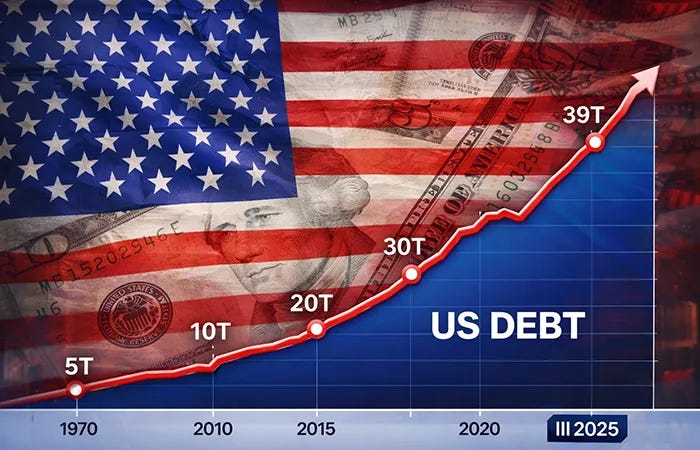
The U.S. national debt has officially surpassed $40 trillion, months earlier than forecasters had expected — because of billions of dollars in lost revenue from Trump’s invalidated tariffs, Trump’s tax cuts (mostly to big corporations and the very wealthy), and the soaring costs of Trump’s war.
Trump’s hair-brained treasury secretary, Scott Bessent, says there’s nothing to worry about because the fiscal trajectory will stabilize. Investors obviously don’t believe him because they’re demanding much higher compensation for buying and holding American bonds. The yield on 30-year U.S. Treasuries hit its highest level in nearly two decades this week, reflecting those growing concerns.
Should you worry? Well, it’s not as if we’re heading into a depression. Passing the $40 trillion threshold doesn’t suddenly cause the world to lose confidence in the dollar.
The problem is that an increasing portion of our nation’s budget — and your tax dollar — is dedicated to paying interest on this growing debt. Annual net interest payments on the federal debt have surpassed $1 trillion, making servicing the debt one of the largest of all federal budget expenditures.
That’s money we don’t spend on schools, healthcare, roads and bridges, and social safety nets. We’ll soon be paying more in interest on the federal debt each year than we spend annually on Medicare.
So, who exactly receives these interest payments? This is an issue you hear very little discussion about, because the wealthy and powerful of this country would rather you not know. (And don’t expect Trump suck-up Bessent* to tell you, because he’s too busy denying that economic inequality is worsening.)
Foreign governments and foreign investors hold only about 30 percent of our debt. The rest — roughly 70 percent — is held domestically. That is, we pay the interest to ourselves.
And who, exactly, is the “ourselves” who receive these interest payments? The Federal Reserve holds part of this debt, state and local governments hold part.
But the biggest chunk — nearly half — is held by mutual funds, pension funds, insurance companies, and banks.
And who owns them? Americans who invest in these funds — and who thereby, directly or indirectly, hold Treasury bills.
And who, exactly are these Americans — the Americans who are directly or indirectly collecting a large amount of the interest we’re paying on the national debt?
People at the top.
The richest 1 percent of U.S. households hold about 35.6 percent of all financial assets — shares of stock, corporate bonds, and Treasury bills — so it’s safe to assume they hold at least a third of all Treasury bills.
Here’s where things get really interesting.
Decades ago, wealthy Americans financed the federal government mainly by paying taxes. Their tax rate was far higher than it is today.
In the 1950s, under President Dwight Eisenhower, the richest Americans paid a marginal tax rate of 91 percent. (Tax deductions and tax credits lowered this top effective marginal rate somewhat.)
Today, the tax rate on wealthy Americans is far lower. The richest 400 Americans pay an average effective total tax rate of about 24 percent — including federal, state, local, and corporate taxes. Jeff Bezos — America’s second or third richest person — paid no federal income taxes in 2018. Trump paid no federal taxes for years before he became president.
So now, wealthy Americans finance the federal government mainly by lending it money and collecting interest payments on those loans.
As I said, interest payments on the national debt this year have surpassed $1 trillion, and a big chunk of that is going to wealthy Americans.
Keep following the money.
One of the biggest reasons the federal debt has exploded is that tax cuts — starting with the George W. Bush administration in 2001 and extending through Trump’s 2018 and 2024 tax cuts — have reduced government revenues by $10.6 trillion.
Most of the benefits from those tax cuts are also going to the wealthy.
Since 2000, 65 percent of the benefits from tax cuts have gone to the richest fifth of Americans — 22 percent to the top 1 percent.
So, you see what’s happened?
Decades ago, the wealthiest Americans financed the government by paying higher taxes. Now, the government pays wealthy Americans interest on a swelling debt, caused largely by lower taxes on wealthy Americans.
Which means a growing portion of your taxes and mine is now paying wealthy Americans interest on those loans instead of paying for government services everyone needs.
So, from now on, whenever you hear someone fret about how huge, horrible, and out-of-control the national debt is, explain to them that it’s largely because of tax cuts to the wealthy — who are also the major recipients of interest on that debt.
America’s wealthy have never been wealthier. Scott Bessent* may deny we’re in a K-shaped economy, but he’s dead wrong. If the wealthy paid their fair share of taxes, we wouldn’t have such a huge federal debt. And we wouldn’t be paying them so much interest on that debt.

-
I noted Monday that Bessent’s claim that we’re NOT in a K-shaped economy — in which inequalities are widening — is pure bullshit, and I provided lots of evidence to back this up. Yesterday he responded with another ad hominem attack on me rather than with facts and analysis (see below). I’m tempted to say he’s an idiot, but that would be an ad hominem attack.