What does it mean to be ‘Wasian’ – and is it OK to celebrate it?
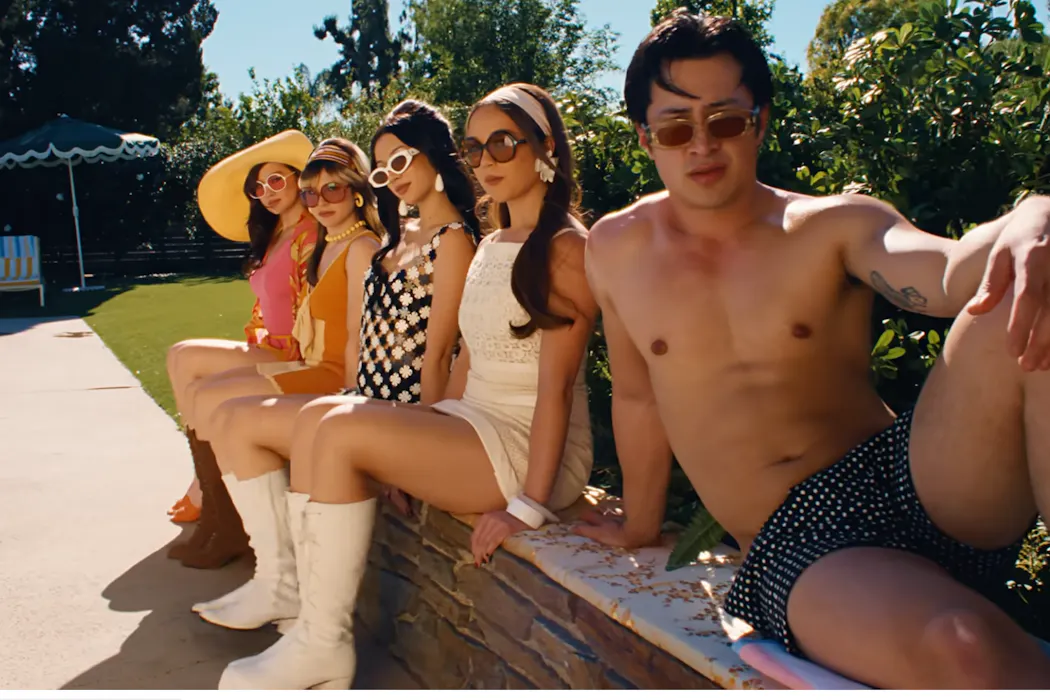
“Wasians” are having a moment right now. Think of Winter Olympians Alysa Liu and Eileen Gu, singer-songwriter Olivia Rodrigo, actors Lola Tang (The Summer I Turned Pretty) and Hudson Williams (Heated Rivalry), or singer/dancer Megan Skiendiel from Katseye. In fact, Icelandic-Chinese singer Laufey featured many of these same “Wasians” in her recent Madwoman music video.
“Wasian” is a portmanteau of the words white and Asian. It has been popularised in coverage around a growing cohort of high-achieving young Gen Z artists, athletes, and actors of mixed white and Asian heritage – and proud of it.
The hype around “Wasianness” has galvanised mixed- or half-Asian meetups trending on social media. This includes the recent “largest half-Asian gatherings ever” in New York and San Francisco in May. One is planned for Melbourne later this month. Many of these meet-ups have sought to include non-Wasian half-Asians – people with, for instance, one Asian parent and one Black parent. Yet much of the recent media focus has been on “Wasians”.
But not everyone loves the term – and the ideas underpinning it are ripe for interrogation.
A language for shared experiences
Part of the appeal of the term lies in its ability to create community. Mixed-race people often feel they must choose one side, or be excluded from both.
A common experience for many “Wasians” is being seen as “not Asian enough”, especially when it comes to Asian language or cultural knowledge skills. Your family background or appearance may also be deemed “insufficiently Asian”.
Mixed-race Asians can find themselves in a paradoxical position; too Asian to be fully accepted as white, yet insufficiently Asian to be recognised as “properly” Asian.
“Wasian” can provide a language for shared experiences that don’t fit neatly in conventional racial categories.
The increasing visibility of mixed white-Asian public figures also conveys a sense that (some) mixed-race identities are becoming more recognised and celebrated.
If you’ve grown up navigating multiple cultural worlds, the idea can be empowering. It can serve as a form of self-identification and resistance to labels often imposed by others. It can be about strategically reclaiming space through coming together over shared experiences.
Viral “waydar” or “mixed Asian radar” social media clips highlight “superpowers” of connection between mixed Asians against experiences of marginalisation.
For some, it’s about celebrating a chameleon-like ability to adapt and bring the “best of both worlds” to the table.
The recent meetups may reflect histories of racial minorities gathering in solidarity.
But are we celebrating ‘proximity to whiteness’?
Yet, much of the “Wasian” discourse centres whiteness in ways that other mixed-race descriptors do not. This label specifically highlights white-Asian ancestry rather than mixed-raceness more broadly.
This can reinforce the idea that whiteness remains the desirable point of reference.
Race upholds hierarchies. As such, not all mixed-race identities are valued equally.
As some social media users have observed, the “Wasian” label raises questions about a society that values proximity to whiteness.
We must ask whether mixed white-Asian identities are afforded social advantages unavailable to other minority groups.
These debates are further complicated when considering beauty standards and representation.
The current “Wasian” moment has emerged alongside media that frequently privileges lighter skin, Eurocentric features and racially ambiguous appearances.
This reflects colourism shaped by racial and class hierarchies, among others.
Yes, greater visibility for mixed-race people can be positive. But it can also reproduce longstanding hierarchies. Certain kinds of racial diversity are presented as more palatable because they more closely reflect dominant white norms.
The celebration of “Wasian” identities can even sometimes slide into a celebration of “acceptable” Asianness. It is a version of Asianness that is softened, diluted or made more palatable through association with whiteness. It is available chiefly to those who come from greater socioeconomic privilege.
Broader tensions about race
The current “Wasian” conversation reveals broader tensions about race in multicultural societies.
It raises questions about who can claim an identity, how racial belonging is policed, and why some forms of racial mixture attract celebration over others.
One of us (Aaron Teo) is a parent to a mixed race child and the other (Alexandra Lee) is mixed race. For us, the issues surrounding “Wasianness” underscore the fact race remains deeply shaped by histories of exclusionary hierarchy and unequal power.
In Australia, the concept of “mixed-raceness” was used to justify the Stolen Generations(with similar patterns elsewhere). It has also been part of larger genocidal intentions to “breed out” blackness.
In other colonial contexts, such as India and French colonial Indochina, mixed children were born under wider conditions of (sexual) violence perpetrated by white male colonisers against local populations.
Racial mixedness has been the norm in many Meso- and South American countries, and a feature of non-Western scholarship. Chicana (Mexican-US) feminist writer Gloria Anzaldúa, for instance, writes about what she calls “mestiza consciousness”. This is a fluid way of navigating multiple identities that embraces contradiction rather than seeking strict definitions.
However, these kinds of perspectives seem to be diminished or even absent from much of the current “Wasian” discourse, reflecting the dominance of white Western perspectives.
Questioning racial hierarchies
The label “Wasian” goes some way to disrupting conventionally separate categories of white and Asian.
But it can still fail to meaningfully disrupt existing racial hierarchies and race-based categorisation.
The current “Wasian” discussion presents an opportunity to shake up conversations about race and identity. If we’re interested in disrupting the status quo, it’s important to think carefully about how the discourse fits with broader systems that perpetuate racism and celebrate whiteness.

Aaron Teo has received funding from Community Broadcasting Foundation, State Library of Queensland. He is a member of the Asian Australian Alliance.
Alexandra Lee does not work for, consult, own shares in or receive funding from any company or organisation that would benefit from this article, and has disclosed no relevant affiliations beyond their academic appointment.