Tragedy stopped Mawson exploring this remote Antarctic region. We must get there to study its melting ice
Over a century ago, Australian geologist Sir Douglas Mawson led a sledging expedition over hundreds of kilometres of ice into a remote part of East Antarctica. The party turned back after the tragic death of a party member. Fellow Australian Cecil Madigan led another group across sea ice into the region before also turning back.
These intrepid explorers never set foot on an ice sheet which may be crucial to our future. Even now, we don’t know anyone who’s been there. It’s time to change that.
This remote region is known as the Wilkes Subglacial Basin, an enormous area of ice covering 1,400 kilometres by 400 kilometres.
The reason it matters is because much of the Wilkes basin sits well below sea level. If all the basin’s ice melted, it would raise sea levels three to four metres, while torrents of meltwater would likely disrupt vital ocean currents and cause major upheaval to marine life and the broader climate.
As we explain in our new review, the region is vulnerable to change. Reconstructions of past warm periods show its ice sheet shrank dramatically when the climate was 2–3°C warmer – conditions we are rapidly approaching.
The ocean is the great enemy of Antarctic ice
If you walked on the Wilkes basin, you wouldn’t see anything out of the ordinary – ice as far as the eye could see.
It’s what’s under the ice that matters. The underlying bedrock is up to 2,000 metres below sea level. Subglacial basins are huge ice-filled bowls of rock. Today, the ice is thick enough to keep the ocean out of the basin, but the ocean is always in contact with its edges.
Off East Antarctica, ocean temperatures tend to hover around -1.8°C. That’s cold, but the ice is much colder. Even a small boost to water temperatures due to ocean warming or changing ocean currents means the ice at the edge of Wilkes basin will melt more quickly and then flow faster into the ocean.
Some of the bedrock of the Wilkes basin slopes deeper as you move away from the ocean. As the ice retreats, the ocean can wash against more ice, melting it faster. At some point, the retreat of the ice down this slope will become self-sustaining and the melting unstoppable.
Signs of change
Much of the data we do have on the Wilkes basin comes from aircraft using ice penetrating radar. This revealed the basin’s shape and made clear its vulnerability. Satellite observations of the basin captured East Antarctica’s first known collapse of a fringing ice shelf into the ocean in the 1970s or 1980s.
But there’s much more we don’t know. We don’t know the pathways warm ocean water can use to access the ice. To understand this, we need to map the shape of the ocean floor. We also lack data on changing ocean temperatures. Without this data, we can’t reliably project how fast the ice will melt.
By contrast, we know much more about the Thwaites Glacier, another high-risk region of Antarctica. That’s because it’s been the focus of large international research programs for years.
Lessons from the deep past
During the Pliocene period three million years ago, global air temperatures were 2–3°C warmer than the modern pre-industrial period. Melting ice sheets retreated hundreds of kilometres inland, while global sea levels were 6–23 metres higher. Seafloor sediments show this dramatically altered Antarctica’s shape.
This is worrying, as the world is likely to reach a similar level of warming by the end of the century.
Future projections show this will lead to accelerating melting and the dramatic retreat of the Wilkes basin ice sheet. What we don’t know is the timeframe.
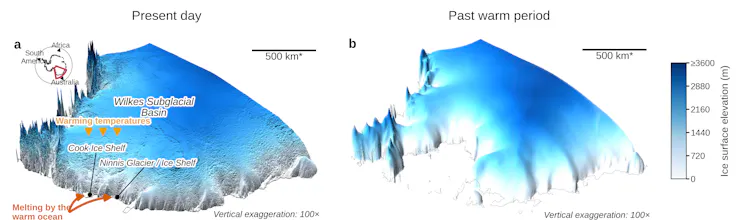
Author supplied, CC BY-NC
Why is it so hard to get eyes on the ice?
The Wilkes Subglacial Basin is among the least observed places on Earth.
That’s not due to its remoteness – it’s relatively close to Australia. Hobart residents are closer to its major glaciers than they are to Darwin. It’s due to the fact the basin is protected by a frozen ocean – unusually thick, persistent and compacted sea ice.
While satellite images can give some data, satellites cannot see through ice or oceans. Scientists will need to go there in person.
It won’t be easy. Accessing the Wilkes basin by sea would be impossible in anything less than the most capable ice breakers. No ship has ever been within 150 km of the Cook Glacier, one of the major Wilkes basin glaciers.
Even if an expedition gains access to some areas, scientists will have to use robotic sensors to comprehensively map the ocean conditions and the seafloor.
On land, the closest permanent station is 250 kilometres away.
The good news is, the Wilkes basin is becoming reachable.
Australia, New Zealand and other Antarctic nations are now better able to traverse long distances to deliver fuel for airborne surveys and support remote field camps.
New technologies make it possible to drill more than three kilometres down to the bottom of the basin’s ice and take samples from the sediments and bedrock beneath.
Any remnants of ancient ocean species in the sediment can be used to trace how far and how quickly the ice retreated during warm periods when the ocean entered the Wilkes basin.
Unfinished business
Scientists once thought Antarctica would take centuries to change. But that was too hopeful. Land ice is melting faster, sea ice is shrinking and the floating glaciers known as ice shelves are melting faster from beneath.
Doing fieldwork on the Wilkes basin will require a years-long multinational effort across oceans and land.
But we cannot wait another century to understand the threat posed by this enormous reservoir of ice.

Matt King receives funding from the Australian Research Council, the Australian Government’s Department of Climate Change, Energy, the Environment and Water, CSIRO, and ACCESS-NRI.
Nancy A.N. Bertler receives funding from the New Zealand Ministry of Business, Innovation and Employment, Victoria University of Wellington, Earth Sciences New Zealand, and the Royal Society of New Zealand.
Check this story
Ask the guide
The guide explains what to check and where. It cannot see this article or recent news.
Is this AI-made?
AI checkers give a likelihood, not proof.