The Coconut Children is a tender coming-of-age story about taking root between two worlds

Vivian Pham’s bestselling 2020 novel The Coconut Children, set in Cabramatta in 1998, makes its stage debut at Sydney’s Belvoir St Theatre this November.
Co-directed by Hannah Goodwin and Catherine Văn-Davies, it is a tender and playful exploration of finding joy in adolescence, amid the hardships faced by a Vietnamese Australian community.
Sixteen-year-olds Sonny Vuong (Gemma Chua-Tran) and Vince Tran (Kevin Khan), once childhood friends who played together in cardboard boxes, now navigate vastly different circumstances during a turbulent period in their community’s history.
Daniel Boud/Belvoir
The art of making do
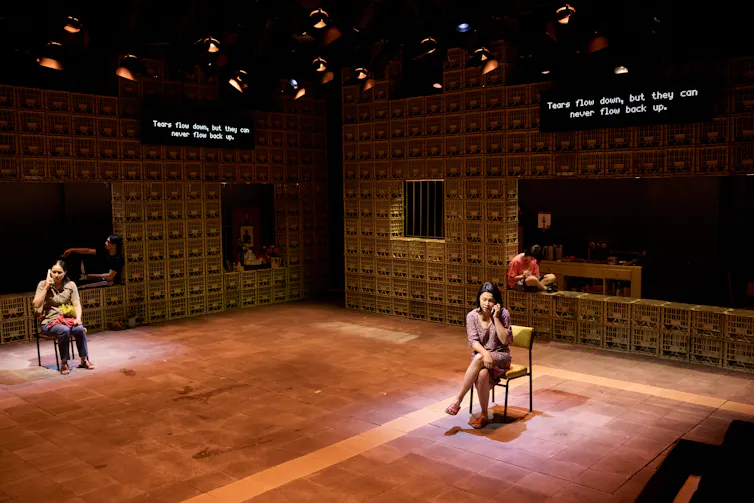
As we enter Belvoir’s upstairs theatre, we look down onto an open space framed by grey milk crates stacked to the ceiling. Set and costume designer Dale Ferguson’s choice of the humble milk crate is particularly fitting, its versatility speaking to the resourcefulness of a community making do with what it has.
Two screens displaying “The Coconut Children” in retro arcade game lettering sit high on the walls, providing translations for conversations in Vietnamese and English.
Warm light, designed by Phoebe Pilcher, pours through window-like gaps of the milk crate walls, revealing a meticulously clean yet busy kitchen, and an altar for ancestor worship. Steve Francis’ sound design welcomes us with the synthesiser-driven disco track Hold Me Tight, featuring verses in Vietnamese and English.
The play begins. We are propelled into energetic scene changes inviting us to imagine a family home, a golf course and the outside of a drug house with minimal props. Some scenes creatively overlap two distinct places within a shared stage space. Similar blocking inventiveness was seen in Goodwin’s recent direction of Belvoir’s A Room with a View.
Growing pains in Cabramatta
The Coconut Children is a distinctly Sydney story, full of ‘90s Australian nostalgia, but firmly grounded in the city’s history. Following the Vietnam War, Cabramatta became home to a thriving Vietnamese community. By the 1990s, however, the suburb had become closely associated in the public imagination with Sydney’s drug crisis and gang violence.
Recently released from juvenile detention, Vince struggles to resist being drawn back into this world. Meanwhile, Sonny struggles under the impossible expectations of her strict mother, Hu’o’ng (HaiHa Le). Bound by chores, homework and the need to appear perfectly virtuous, Sonny has little opportunity to experience the joys of adolescence.
The pair are polar opposites, expressed not only through their circumstances but through their bodies. Sonny is tightly wound yet bursting with energy, while Vince carries himself with a relaxed confidence. Their contrasting ways of moving make for joyful interactions.
In a more distressing moment, Sonny furiously tears apart a bowl of mint leaves. We are concerned for her, yet unsure of the exact circumstances of what lies behind her anger. Our unease lingers, as does the scent of torn mint throughout the theatre.
The play takes us to deeply distressing places but never leaves us there for too long. Playful theatrical devices and moments of comedy continually offer relief. Here, we see Pham’s intentions come through. She wrote the work “for anyone who feels like they were robbed of their childhood and want to see their childhood in a more magical way”.
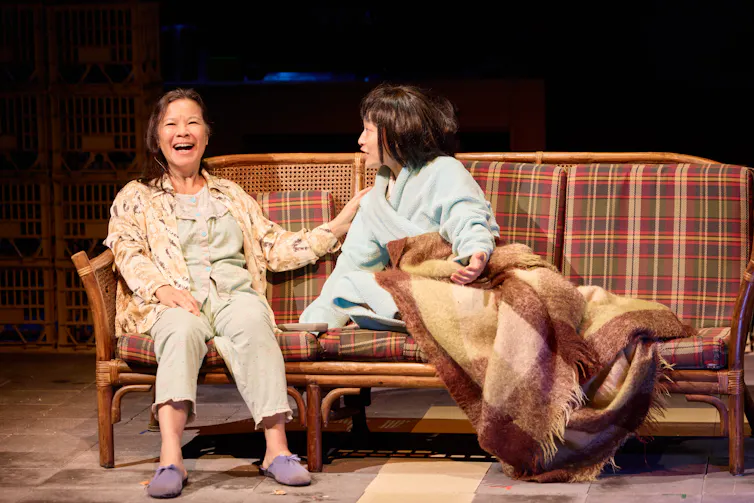
Sonny’s grandmother, Ba Ngoai (Vân Đoàn), a self-aware gambler and heavy drinker, encourages her granddaughter to find pleasure amid suffering. In a tender image, the two lie side by side on the couch, their legs spread and eyes closed. For a moment, Sonny releases the bodily restraint she usually maintains.
Daniel Boud/Belvoir
This desire for pleasure and freedom also emerges through the recurring theme of dreaming. Sonny gently presses her mother to recall her dreams before having children, perhaps hoping to find permission to pursue her own.
In an earlier scene, Sonny enters Vince’s house party in a dream. Bathed in pink light and dressed in her pyjamas, she drifts through the thumping party. Bubbles rain down as she dances a duet with Vince, before the entire cast joins in a boppy, synchronised choreography by Elle Evangelista.
Like seeds floating across the ocean
Near the play’s end, Sonny and Vince sit in a rowboat made of milk crates in Lane Cove National Park. Vince asks Sonny to close her eyes and imagine her life in ten years, pressing her with questions in the hope of finding himself in her vision. Little does he know he has long been in her dreams.
The origins of the play’s title are revealed in a sweet moment between Sonny and her father, Linh (Khanh Trieu). Often seen tending to the garden, he explains how coconut palms growing along the shoreline drop their fruit into the water, carrying their seeds across oceans to take root on distant shores.
The Coconut Children is a story of these seeds – the children of those who have journeyed across oceans. It is an exploration of how these children find room to grow and dream in the places their parents have come to call home.
The Coconut Children is showing at Belvoir St Theatre, Sydney, until December 23.

Lillian Shaddick does not work for, consult, own shares in or receive funding from any company or organisation that would benefit from this article, and has disclosed no relevant affiliations beyond their academic appointment.
Check this story
Ask the AI guide
The guide explains what to check and where. It cannot see this article or recent news.
Is this AI-made?
AI checkers give a likelihood, not proof.