Settlers use water to ethnically cleanse the occupied West Bank
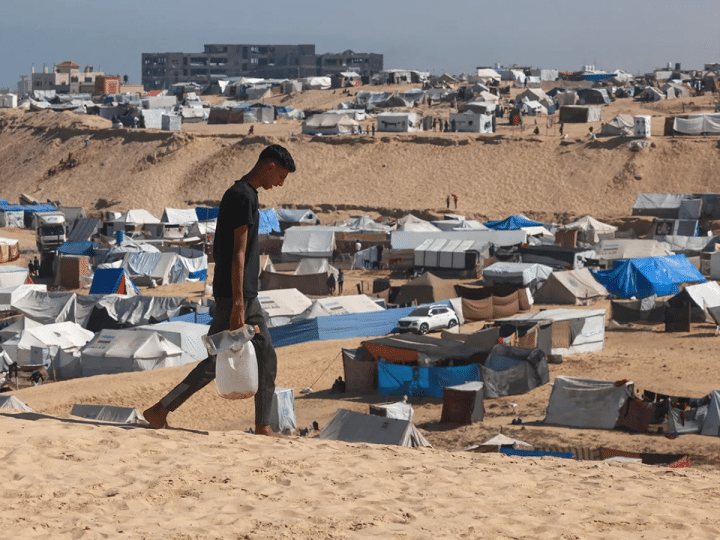
Israeli settlers were filmed deliberately emptying vital water tanks in the Palestinian herding community of Ein al-Hilweh in the northern Jordan Valley.
Ein al-Hilweh freshwater spring had been used by the farmers and Bedouin shepherds of the village for generations.
But in 2019, illegal ‘Israeli’ colonists from the nearby Maskiyot settlement, with the help of the Israeli Occupation Forces (IOF), seized the spring and fenced it off.
Now, Palestinians no longer have access to it and the IOF has threatened them with forcible displacement if they try.
The community now relies on tankers for their water supply, which is why these structures became a target for settlers.
Settlers coerce residents to leave
Not content with stealing their main water supply, the occupation continues to pressure the community of Ein al Hilweh to leave their land. They do this through the use of demolition orders and restricting access to their grazing lands.
A similar situation has occurred north-west of Jericho in the Jordan Valley. Al Auja Spring has been a historic, vital water source for nearby Palestinian towns, farmers and sheep herders.
However, in 2024, a new settler outpost, illegal under international law, was established close to the spring which spelt disaster for those relying on it. Settlers installed water pumps and blocked Palestinian access, a move enforced by the IOF.
This lack of water, combined with daily harassment and repeated violent attacks by armed settlers, made life unbearable for the nearby herder and Bedouin villages. They were left with no option but to leave their homes and land. The only community remaining was Ras Ein Al Auja, long considered the guardians of the Al Auja spring.
‘Israel’ restricts water supply by any means possible
Not long ago, this Bedouin community was one of the largest in the West Bank, with a population of about 600 people. Then constant settler and IOF violence resulted in most of these Palestinians leaving their homes and land.
By the end of January of this year, the remaining 100 residents of Ras Ein al Auja were forcibly displaced.
The Applied Research Institute-Jerusalem (ARIJ) has reported that more than 56 water springs in the West Bank have been subjected to repeated settler attacks or takeovers. The aim is always to force Palestinians to abandon their homes.
Water is essential to life, so is weaponised by the Israeli occupation in the West Bank. Through legal restrictions, infrastructure control and settler violence, ‘Israel’ has created an apartheid water system.
Water flows freely to settlements but is rationed, seized or denied to Palestinians in any way it can.
The takeover of water sources is a common practice by the occupation. It often involves physical fencing, intimidation and threats of violence. Natural water sites are also often converted into localised recreational spots for Jewish settlers.
Attacks on water systems have also surged. Ein Samia is a village north-east of Ramallah. Its pumping station, serving 100,000 Palestinians, has been attacked at least 10 times since early 2026. Settlers have smashed pipes, severed wires and shattered monitors.
UN data shows incidents of settler violence and demolitions damaging or destroying water and sanitation structures have risen exponentially. In 2021 there were 57 such attacks. By 2025, this figure rose to 387.
Between January and June 2026, more than 100 incidents of demolition or settler violence damaged or destroyed over 190 of these structures across the West Bank. The majority of these were water tanks, but pipelines, irrigation systems, household connections and other water infrastructure were also affected.
The occupation weaponises West Bank water
These settlers are funded, supported and enabled by the ‘Israeli’ government, so when they succeed in forcibly displacing Palestinian communities, ministers openly celebrate and thank them for their “good work”.
In addition, many settler attacks on Palestinian communities target water systems. Pipes are cut, and wells filled with concrete or contaminated by poisoned livestock.
Methods differ, but the intention is always the same: to dispossess and expel the entire community, and ethnically cleanse the West Bank of Palestinians.
Since its occupation of the West Bank, including East Jerusalem in 1967, ‘Israel’ has had significant control over Palestinian water sources. Thanks to the Oslo II water agreement, the ‘Israeli’ occupation continues to control 80-85% of the West Bank’s water resources. It also maintains authority over Palestinian water infrastructure.
Settlers use seven times more water than Palestinians
Palestinian communities have faced systematic restrictions on access to water for decades now, by both colonists and the army. Meanwhile, illegal Jewish settlements, built on stolen Palestinian land, enjoy an uninterrupted supply of water, lush agriculture and swimming pools.
Jewish colonists reportedly consume seven times more water than Palestinians in the West Bank.
The World Health Organisation (WHO) recommendations a minimum of 100L of water per person per day. But Palestinians only have a daily average of about 80L. In some rural Palestinian communities, this figure goes down to less than 15L per person.
Under international humanitarian law, an occupying power must ensure the basic needs of the occupied population, including access to water. With ‘Israel’ as the occupying power, it maintains a permit regime, which makes it almost impossible for Palestinians to drill new wells, or even repair damaged infrastructure.
Mekorot, the ‘Israeli’ occupation’s national water company, sells millions of cubic metres of water to the Palestinian Authority every year. This water, of course, costs more for Palestinians to buy than ‘Israelis’.
Every summer, multiple towns and villages across the occupied West Bank experience prolonged water cuts, which can sometimes last a month. This is mainly due to Mekorot limiting or temporarily cutting off their supplies, while ‘Israeli’ colonists on adjacent land receive a continuous supply throughout the year. As a result, many Palestinians are forced to buy water, which can be extremely costly.
Water is an instrument of control
In this way, Palestinians are made dependent on water that the ‘Israeli’ occupation can withhold, destroy or price beyond their means. Emptying a single tank can force families to spend money they do not have on emergency deliveries, or leave animals without sufficient water.
The destruction of water infrastructure forms part of a wider pattern in which access to land, grazing areas and natural resources is increasingly being restricted by ‘Israel’.
These illegal settlers sent a clear message to the community of Ein al-Hilweh: even the water stored beside their homes is no longer safe. When settlers can empty a community’s tanks in broad daylight with little fear of consequences, water becomes an instrument of control and a way of making life on the land impossible.
Featured image via Mohammed Abed/ Getty Images
By Charlie Jaay
Check this story
Ask the guide
The guide explains what to check and where. It cannot see this article or recent news.
Is this AI-made?
AI checkers give a likelihood, not proof.