‘Noirvember is the perfect excuse to discover film critics’ favourite style

For movie lovers, its time to observe “Noirvember”: the month-long celebration created by film critic Marya E. Gates in 2010 as an excuse for movie lovers to extend the Halloween tradition of watching scary movies into November, replacing horror with film noir.
The holiday is now celebrated globally across repertory cinemas, libraries and streaming platforms.
For newcomers, it’s the perfect excuse to discover this compelling genre.
What is film noir?
In its simplest definition, the term film noir signifies a Hollywood crime film from the 1940s and 1950s characterised by a dark, pessimistic worldview and an even darker, chiaroscuro lighting style, with intense contrasts between light and shadow.
Recurring tropes – seen in classics such as The Maltese Falcon (1941), The Big Sleep (1946) and Double Indemnity (1944) – include cynical private detectives, sultry femme fatales, and hard-boiled vernacular.
Many of the best known Hollywood noirs are adaptations of pulp fiction by authors such as Dashiell Hammett, Raymond Chandler and James M. Cain.
But noir also crossed over into different genres. For example, Gilda (1946) is a musical melodrama, The Big Heat (1953) is a police procedural and Criss-Cross (1949) is a heist film.
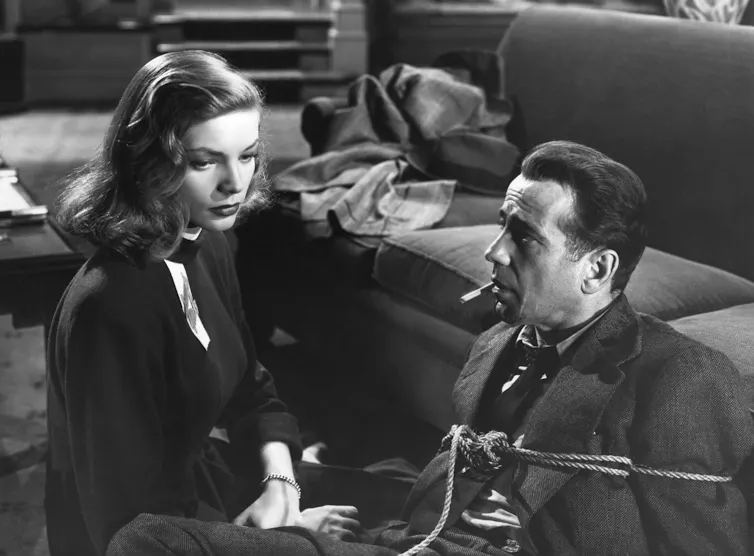
Getty Images
French origins
Unlike other Hollywood genres, film noir is an invention of film critics.
The term originated in 1930s in France, during a period of political upheaval. It was initially used by the popular press to criticise a trend of films that would later be categorised as French Poetic Realism, including Pepé Le Moko (1937), La Bête Humaine (1938) and Port of Shadows (1938).
Conservative newspaper Le Petit Journal used the term film noir to decry Port of Shadows, calling it “immoral and demoralising”.
Even the left-leaning magazine Marianne characterised noir as “grim” films that “only express the powerless of men”.
It became a moot point: with the rise of fascism, and under the collaborationist Vichy government, the French film industry was commandeered for Nazi propaganda.
Post-war France
The term film noir re-emerged after the second world war, applied to a series of new Hollywood films that had been banned from French cinemas during Nazi occupation.
In 1946, critic Nino Frank wrote about “a new kind of police drama”, name-checking The Maltese Falcon, Double Indemnity, Laura (1944) and Murder, My Sweet (1944).
Frank saw similarities between these films and Poetic Realism, and repurposed the term film noir to categorise them – this time as a compliment.
“These ‘noir’ films no longer have any common ground with run-of-the-mill police dramas,” he wrote. Instead they embraced a “dynamism of violent death” that felt more “true to life” in the aftermath of war.
A decade later, film noir was codified as a distinctive phenomenon with the publication of Raymond Borde and Etienne Chaumeton’s A Panorama of American Film Noir: 1941-1953, which laid out its most prominent features and established a basic canon.
Counter-cultural America
The term remained relatively obscure, not crossing the Atlantic until the late ‘60s and early ’70s, with the institutionalisation of academic film studies.
It began to appear in film journals such as Sight and Sound, Movie and – most prominently – Film Comment.
Paul Schrader’s 1972 article for Film Comment, Notes on Film Noir, was particularly influential. In it, Schrader continued Borde and Chaumeton’s essential arguments, and claimed that film noir “is not a genre” as it is defined by “more subtle qualities of tone and mood”.
Schrader also commented that film noir’s fatalistic cynicism aligned with a similar perspective emerging as part of ’70s New Hollywood cinema.
“American movies are again taking a look at the underside of the American character,” he wrote. “As the current political mood hardens, filmgoers and filmmakers will find the film noir of the late forties increasingly attractive.”
He proved to be correct. Films such as Chinatown (1974) and The Long Goodbye (1973) updated the tropes for a post-Watergate audience, later earning the moniker neo-noir.
Schrader contributed to this trend himself, as the writer of Taxi Driver (1976) and the director of Hardcore (1979) and American Gigolo (1980).
Noir and the global ‘mediascape’
In the subsequent decades, film noir became a much more familiar term.
In his seminal book on the subject, More than Night: Film Noir in its Context, James Naremore borrows cultural theorist Arjun Appadurai’s notion of the mediascape to describe how film noir exists in its current form.
[Noir is now] a loosely related collection of perversely mysterious motifs or scenarios that circulate through all the information technologies.
The term’s meaning would gradually expand to account for a range of cultural products that invoked noir aesthetics.
Within cinema, this included sci-fi noir (Blade Runner, Dark City), Western noir (Lone Star, No Country for Old Men) and superhero noir (The Batman, Spider-Noir).
But the term also encompasses other media, including the literature of Paul Auster and James Ellroy; television shows such as Twin Peaks and Better Call Saul; and video games like L.A. Noire and Disco Elysium .
The cartographic lines of film noir have also expanded, most famously with Nordic noir, but also to Japan, Greece, India and Mexico.
It’s easy to be cynical. Acclaimed American film critic Jonathan Rosenbaum complained that the term film noir
changes meaning today just about every time an academic or a mainstream merchandiser thinks up a new reason for using it.
However, this also points to the powerful durability of the term. It can be changed, updated and modernised. As long as there are dark undercurrents to our world, film noir is likely to endure.

Kristian Ramsden receives funding from Adelaide University in the form of a research stipend.
Check this story
Ask the AI guide
The guide explains what to check and where. It cannot see this article or recent news.
Is this AI-made?
AI checkers give a likelihood, not proof.