How Sam Neill’s Jurassic Park performance inspired a generation of paleontologists

The sudden death of actor Sam Neill prompted tributes from colleagues and fans worldwide. But the news also resonated strongly with many palaeontologists, for whom Neill’s character in Jurassic Park, Dr Alan Grant, was a pivotal inspiration for their career choice.
“I was preparing for a fossil show-and-tell the day I heard the news Dr Grant left us”, says University of Montana palaeontologist and PBS Eons co-host Kallie Moore. “When I dedicated the talk to Sam – holding back tears – I got many sad nods from parents. It’s incredible the reach a fictional character had in palaeontology, because for us 90s kids Dr Grant wasn’t just a character – he became a colleague.”
Moore is just one of many paleontologists around the world who answered the call when we asked how Neill – and his famous movie character – had influenced them. Alan Grant’s fictional colleague Dr Ellie Sattler, played in the movie by Laura Dern, also featured in their memories.
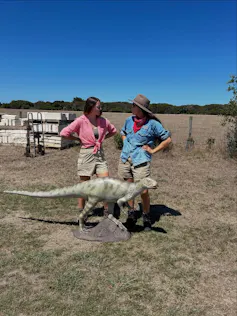
Sally Hurst
As Australian palaeontologist and science communicator Sally Hurst replied: “On every dinosaur dig I’ve done, from the Cretaceous rocks of Inverloch, Victoria, to the Badlands of Canada or the deserts of Mongolia, there’s always a day where myself or someone else embodies palaeobotanist Dr Ellie Sattler and Dr Alan Grant. For many of us now in this profession, it was those who first showed us that being a palaeontologist was a real job.”
This raises an interesting question: can a movie really inspire scientific careers? Having state-of-the-art special effects dinosaurs always helps. But in this case, we suggest it goes beyond that.
Portraying a relatable scientist
When Dr Grant arrived in cinemas in 1993, he was unlike many fictional scientists before or since. He wasn’t portrayed as an eccentric genius, a socially awkward academic, or someone whose brilliance came at the expense of their humanity.
Sam Neill’s Dr Grant was authentic, normal and relatable. He was curious, patient and deeply knowledgeable – but also approachable. He was human. His excitement about dinosaurs felt genuine.
Even as the fictional Jurassic Park descended into chaos, Grant remained recognisable as a palaeontologist trying to understand these extraordinary animals.
“Sam Neil’s portrayal of Dr Alan Grant was pretty satisfying to those of us aware of what was known about dinosaurs at the time”, says British palaeozoologist and author Darren Naish. “Dr Grant clearly had his fingers on the pulse of things in the dinosaur world, and Sam played him well. He’s wise and patient but also passionate.”
Indeed, Neill himself wrote of Grant’s appeal in his 2024 memoir Did I Ever Tell You This?: “In the thirty years since the first Jurassic, Alan Grant has become a rather beloved character. Not a super-hero – no magic powers. A man who faints at this first sight of a brachiosaurus is just a man. An ordinary bloke, doing the best he can under extreme circumstances”.
For the many millions of children watching Jurassic Park, this was (and still is) the first time they had seen a scientist whose work looked adventurous and genuinely exciting. Rather than spending all day inside a lab, Grant was outside, in the field, observing living dinosaurs. For a significant number of today’s palaeontologists, this mattered.
“Before Jurassic Park, dinosaurs were depicted in film as lumbering beasts”, says Canadian Kathryn Abbot, executive producer of the Why Dinosaurs? documentary. “Alan Grant taught us they were dynamic, intelligent animals with real behaviours and ecological roles.”
Children are remarkably good at spotting when adults genuinely care about something. Neill never looked like he was pretending to be a scientist. He looked like someone who loved their work.
There is no doubt Jurassic Park inspired an extraordinary surge of interest in dinosaurs, museums and the natural world in general. And for many, Alan Grant showed us that being a palaeontologist could be an actual job.
“Sam Neill’s performance shaped the trajectory of my life,” says Jake Kotevski, a palaeontologist at Monash University in Melbourne. “For as long as I could remember, I wanted to be a palaeontologist, to be Dr Alan Grant. But also to share his values – quiet intelligence, a sense of wonder, a cool head and a protective father (or father figure). Jurassic Park has been with me forever, through good times and bad. There would be no Dr Kotevski without Dr Grant.”
Inspiring generations of children
The palaeontologists reflecting on Sam Neill’s life are remembering more than their favourite film. They’re remembering the moment they first realised science was something they could do.
“I grew up watching Jurassic Park on repeat”, says British palaeontologist, author and television presenter Dean Lomax. “I couldn’t tell you how many times I’ve quoted him over the past 30 years, even to this day. Now those quotes will have more meaning.
“I think one of the difficulties with processing Sam’s loss is the realisation that one of your childhood heroes has died. No doubt Sam’s Dr Grant helped influence my decision to pursue a career in palaeontology, as it did for many others. And for that, I thank him. In my opinion, Dr Grant might be considered the most influential palaeontologist ever.”
Few actors can claim to have influenced an entire profession. Sam Neill almost certainly did that – and will continue to, given the film’s cult status. Not because Alan Grant outran dinosaurs, but because he made the pursuit of knowledge look exciting, meaningful and real.
“If you can get a kid interested in dinosaurs, you can get them interested in science, STEM, using their brain and being creative”, says Kathryn Abbot.
Long after Jurassic Park revolutionised cinema, the generations of palaeontologists making new discoveries to shape our understanding of the prehistoric world may prove to be its most enduring legacy.
The last words go to American palaeontologist and children’s book author Ashley Hall. “Sam Neill’s brilliant performance fuelled my passion for pursuing paleontology as a career, but it also led me to meet my now-husband, a fellow palaeontologist, who proposed dressed as Alan Grant – engagement ring on a raptor claw and all.
“Sam Neill will be sorely missed, and my deepest condolences go out to his family, friends, and everyone whose lives he touched. Thank you, Sam.”
The author acknowledges the contribution of palaeontologist, writer, producer and science communicator Michael Mills, Creative Director at Heaps Good Productions and Heaps Good Music, to the research and co-authoring of this article.

Nic Rawlence receives funding from the Royal Society of New Zealand Marsden Fund.