How a 35% Affordable Housing Pledge in Brooklyn Was Torpedoed
In 2022, developers behind two Atlantic Avenue projects committed to making a “record-setting” 35 percent of the apartments affordable. But after interest rates shot up and the owner cited cost pressures, nonprofit partners recruited by Councilmember Hudson agreed to renegotiate, rather than pursue enforcement.
It looked like dramatic progress. In April 2022, 35th District Councilmember Crystal Hudson announced that, after the Council approved two spot rezonings along under-built Atlantic Avenue in Brooklyn, it showed that “developers can and must offer more” affordable housing than what the city usually requires under its Mandatory Inclusionary Housing (MIH) program.
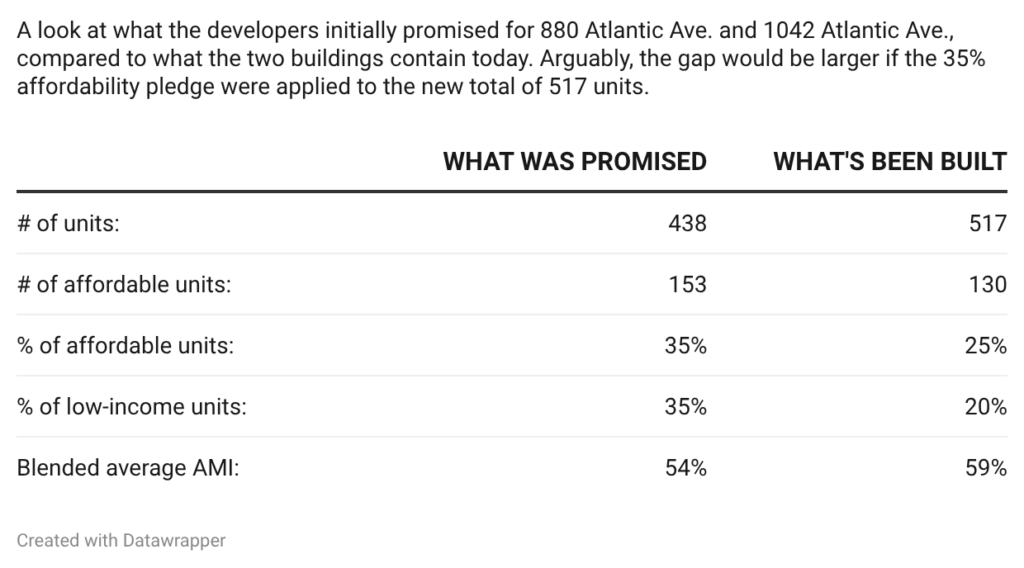
Hudson, who had earlier told the applicants to wait for an area-wide rezoning, got the developers to commit to a “record-setting” 35 percent low-income affordable units. Projected as 153 apartments—out of 438 total—the units would be set aside for tenants at a range of incomes, averaging 54 percent of Area Median Income (AMI). She earned praise from numerous stakeholders, including affordable housing advocates like ANHD.
“For too long, developers have driven the land use and planning process in this city. They’ve convinced New Yorkers that affordability quotas and community demands will stifle development in a time when we need to build more to confront the growing affordability and housing shortage we’re facing,” Hudson said in a statement at the time. “However, the truth is developers can stand to do much more.”
But four years later, after a sharp rise in interest rates and closed-door negotiations excluding Hudson that were never formally revealed, the buildings have opened with only 25 percent affordability, plus a gift of nearby property that might—assuming government agencies offer future funding—help make up for part of the shortfall.
The deal also gave the developers a head start on competitors also looking to build in the area. As part of that 2022 statement, Hudson also announced that the city would pursue a comprehensive rezoning along the Atlantic Avenue corridor in Prospect Heights and Crown Heights, from Vanderbilt Avenue to Nostrand Avenue, involving capital, infrastructure, and programmatic commitments.
So the two buildings, then known as 870-888 Atlantic Ave. and 1034-1042 Atlantic Ave., were the last one-off upzonings—allowing an enormous boost in valuable square footage—before the Atlantic Avenue Mixed-Use Plan (AAMUP), which was approved three years later.
Developers had long eyed the blocks, shackled by low-rise industrial zoning but near gentrifying areas and just east of the long-gestating Atlantic Yards/Pacific Park project. That had prompted Brooklyn Community Board 8 to pursue a plan, known as M-CROWN and a precursor to AAMUP, to encourage housing while retaining job-creating space.
Not what was promised
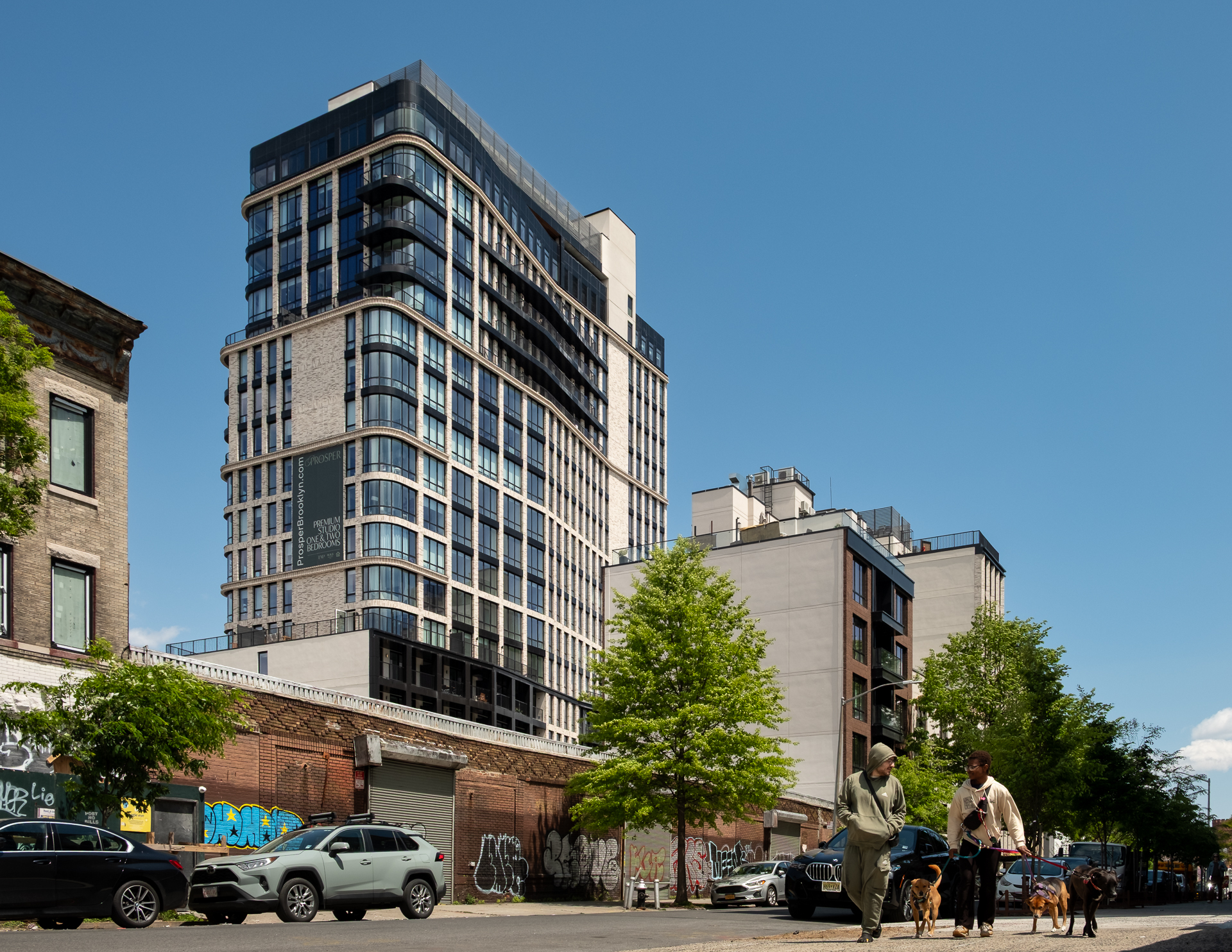
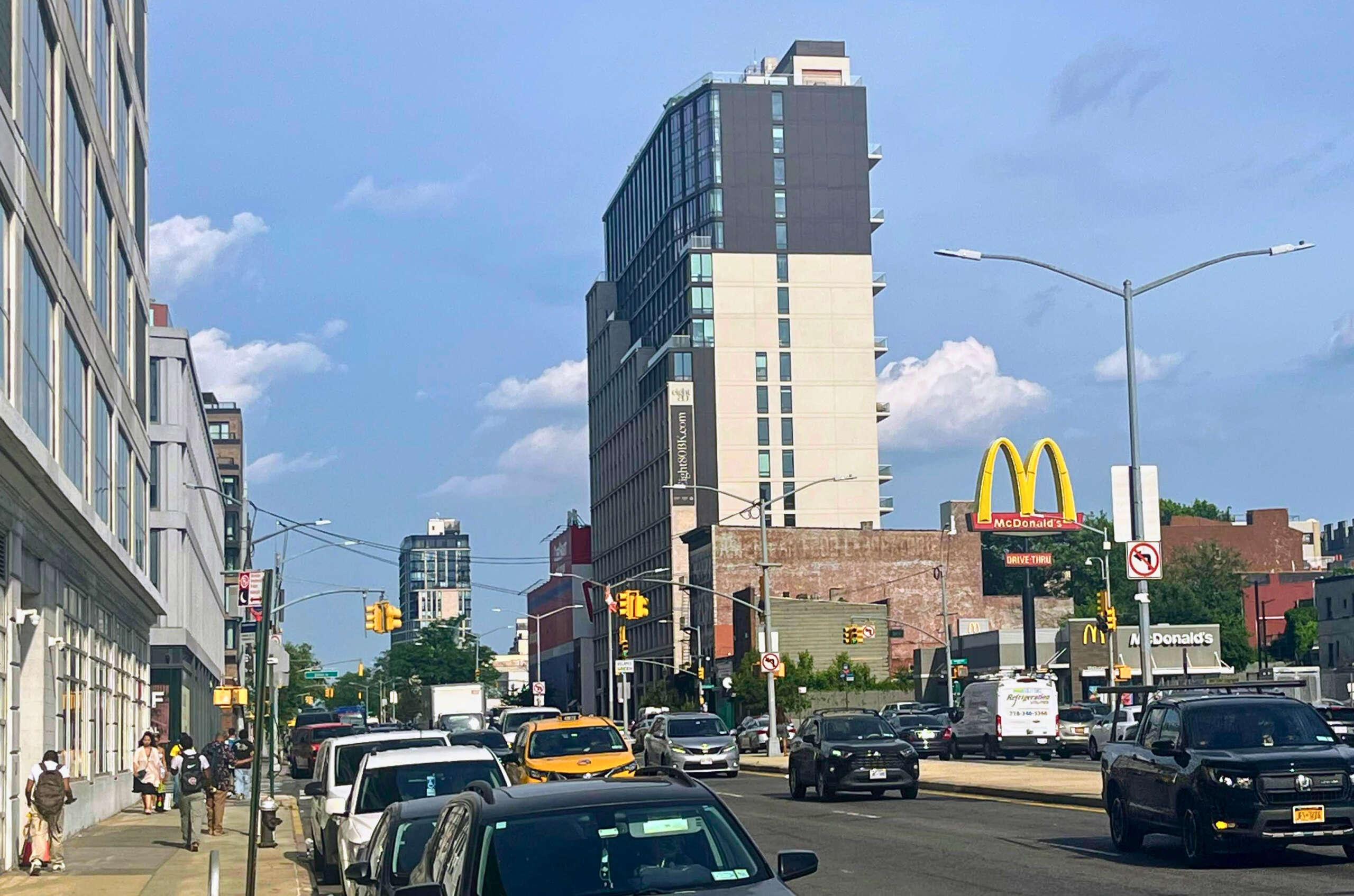
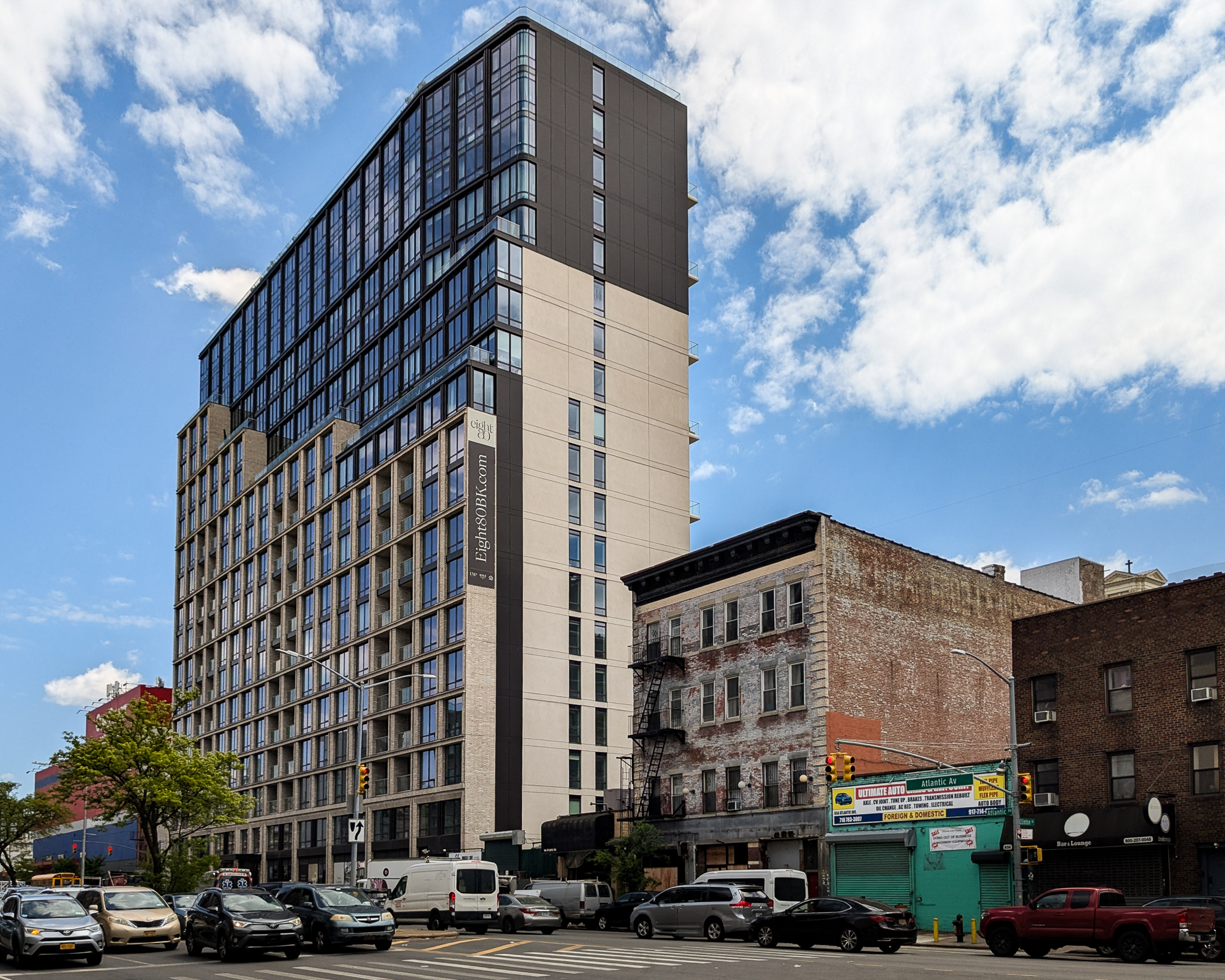
The two 19-story buildings, today dubbed Eight80 and Prosper Brooklyn and for now looming over neighbors, come with taglines like “sophisticated design meets effortless luxury” and “where Brooklyn’s energy meets modern luxury.”
They do not, however, offer the promised 35 percent affordability: 15 percent of units for households earning 40 percent AMI—$58,320 for a family of three, as of 2025—15 percent at 60 percent AMI, and 5 percent at 80 percent AMI.
Among the 517 apartments now renting across the two buildings, 130 are below-market, with 97 (about 20 percent) at 40 percent AMI, such as 50 one-bedrooms averaging less than $1,000 in rent, for two-person households earning roughly between $37,000 and $54,000. (That’s well below the city’s $1,215 benchmark for that income category, but tenants must pay for all utilities.)
The buildings reflect both the “deep affordability” option under MIH, with 20 percent “very low-income units,” and Option A of the state’s 421-a tax break, which allows middle-income units as part of 25 percent affordability. There are 26 units (5 percent) at 130 percent AMI, plus seven studios at 60 percent AMI.
So the Housing Connect lotteries for 880 Atlantic and 1042 Atlantic, which launched this winter, prompted no celebration from Hudson nor from the two veteran non-profit housing groups, the Fifth Avenue Committee (FAC) and IMPACCT Brooklyn, that she recruited to enforce promises outside of the city’s zoning framework.
Their groups did not help manage, as initially planned, the intake from those affordable housing lotteries. Nor will the developer give each $100,000 in anti-displacement funds—intended for things like tenant organizing and eviction prevention—as promised in the agreements they signed.
What happened?
Last year, the nonprofits involved in the original deal agreed to less demanding terms sought by developer Elie Pariente of EMP Capital. (Initially, Pariente was to develop just one parcel, but he bought out the other developer, Yoel Teitelbaum, who had pursued the rezoning. Both shared the same land-use lawyer and architect.)
On Feb. 10, 2025, the signatories modified the agreements, with FAC and IMPACCT accepting—in place of the original affordability pledge—a nearby development site donated by Pariente to FAC and IMPACCT. The revised agreement directs the $200,000 in pledged anti-displacement funds to pre-development costs at the new site, where the nonprofits say they intend to construct at least 46 affordable apartments.
Michelle de la Uz, executive director of FAC, told City Limits that Pariente had called the original promise negotiated with Hudson untenable, citing rising construction costs and “where the lending community was.” Jamal Robinson, who joined IMPACCT as executive director in September 2024 after the original agreement, said he was told that, from an investor perspective, the projects couldn’t be financed.
Indeed, the industry faced a dramatically changing financing market. When the agreement was reached in April 2022, interest rates were just .33 percent. The Federal Reserve, aiming to stem inflation, hiked rates sharply, to 5.33 percent in 15 months.
“I think that 35 percent might have always been a high goal to make it work financially,” added de la Uz, who hadn’t negotiated the initial terms. Still, it’s unclear how closely they could vet Pariente’s case; neither de la Uz nor Robinson could specify the financial gaps the developer cited. Pariente didn’t respond to multiple queries.
Though Hudson helped facilitate what some called a Community Benefits Agreement, or CBA, only the signatories could enforce it, leaving her frustrated. “It was up to them to determine whether it was worth the legal fight with the developer to enforce the CBA rather than come to an alternative agreement—a decision I was neither involved in, nor informed of, in real time,” the councilmember said in a statement to City Limits.
Nor did Pariente contact Hudson about the revised terms, short-circuiting any opportunity to address the barriers he claimed, the councilmember observed. (In de la Uz’s recollection, Hudson’s reaction, paraphrased, was “I wish it were different, but I understand why this is happening, essentially.”)
Despite significant progress with the city’s wider rezoning of the area, Hudson said that “the news of a breached agreement is a disappointing development that shows the limitations of existing legal mechanisms to secure additional affordable housing beyond current requirements.”
Did Pariente make a promise he didn’t intend to keep, or were good intentions whipsawed by circumstances? Either way, he got the rezonings on acceptable terms, ahead of rival projects—which under the AAMUP must deliver 25 percent affordable units averaging 60 percent of AMI, via MIH.
So that reflects his strategy, articulated in a quote on his EMP Capital website at the time of the agreements: “Buy Real Estate in areas where the path exists and buy more real estate where there is no path, but you can create your own.”
That path can be questioned. When he bought the Prosper Brooklyn site, Pariente kept his land purchase under wraps until Hudson unveiled the compromise, apparently seeking to avoid scrutiny of his cost basis. EMP also locates Prosper Brooklyn, as hinted by its name, as “in the heart of Prospect Heights,” though it’s clearly in Crown Heights.
A partial solution
Because Pariente “wanted to make good on the commitment in some way,” as de la Uz put it, they discussed finding a nearby site that he could buy and donate for 100 percent affordable housing that would “get to the 35 percent.”
That site, 1001 Pacific St., on the same block as the rear entrance to block-through Prosper Brooklyn, should “include 46 or more affordable units, exceeding the 24 units required under EMP Capital’s commitment,” according to the Fifth Avenue Committee’s project page.
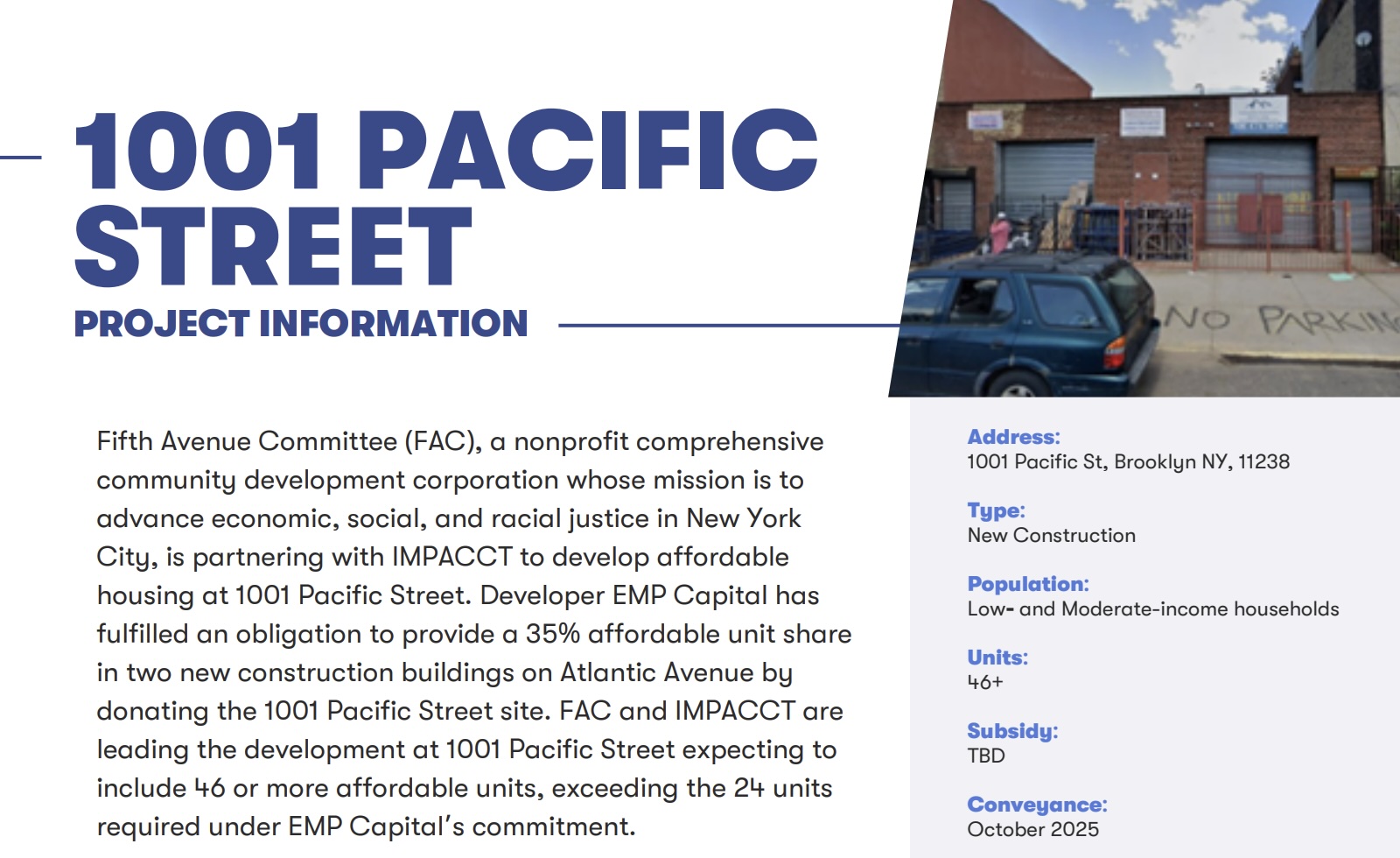
That plan, however, requires new funding, with no timetable, even as AMI, the baseline to calculate affordability, inevitably rises. Pariente’s cost: $3.6 million for the site, far less than the cost to fulfill the 24-unit obligation calculated by FAC, as of the original pledge.
That number, which approximates the difference between the total affordable units delivered—including middle-income ones—and those promised in 2022, may be an underestimate.
While Pariente has built 104 apartments at 60 percent AMI and below, Hudson had expected 131 such units in the two buildings, or 27 more. Also missing from the initial pledge are 22 apartments at 80 percent AMI. That suggests a 49-unit gap.
That earlier calculation, however, reflected 438 total apartments. As of the renegotiation, the buildings were to contain 483 units. Today, they have 517 apartments. A 35 percent share would require 181 units at 80 percent AMI or below. That suggests a deficit of 77 low-income units. (de la Uz did not respond to a query about that revised math.)
Hudson, said de la Uz, was informed “after we’d identified a site that could be purchased.” To de la Uz, the lesson is that “everybody involved in that process should be thinking about: how is this feasible and is this enforceable for the long term?”
For her part, Hudson said the city “needs stronger tools to monitor and enforce private application commitments beyond those clearly required by law.”
A city-initiated neighborhood rezoning, she noted, holds the city accountable for community benefits, so commitments in the AAMUP—including neighborhood investments—can be monitored via its rezoning commitment tracker.
The city also has more enforcement resources than relatively small nonprofits. It’s “very difficult,” IMPACCT’s Robinson acknowledged, to enforce a CBA.
Also, noted de la Uz, the city’s MIH regulatory agreement can be modified to include deeper affordability but not a larger percentage of units, thus limiting enforceability.
Community outreach?
Local community boards, Hudson said, will hear from administration officials in the next months to discuss AAMUP progress.
When it came to the spot rezonings, however, transparency has been scarce. As City Limits reported on Dec. 8, 2022, it took Hudson’s office seven months to release a summary of the agreements, which revealed the involvement of FAC and IMPACCT.
It took several months more, as reported in City Limits, to obtain the Cooperation and Development Agreements via FAC, as the developers had not filed them “promptly” as required.
At a contentious April 6, 2023 meeting of Community Board 8’s Land Use Committee, some members criticized a lack of transparency and potential self-dealing by the nonprofits, given that they were slated to receive the anti-displacement funds, and warned against using the term “Community Benefits Agreement.”
Jay Marcus, then the FAC’s director of real estate, acknowledged that other agreements they’d negotiated had had more community involvement.
FAC and IMPACCT, slated to be hired as administering and marketing agents for the affordable housing, would partner with the community board to recruit potential tenants, to ensure they contacted the “hardest-to-reach people,” Marcus predicted at the time.
The nonprofits also wanted CB 8 to review how anti-displacement funds would be used to protect vulnerable tenants. After Marcus pledged that FAC and IMPACCT would return to CB 8 “before 50 percent construction completion,” committee member Mimi Mitchell, also a Crown Heights Tenant Union member, pushed him to do so earlier, citing ongoing displacement, especially of Black and brown tenants.
Neither of those things happened. (Marcus left FAC at the end of 2023.) In the 2025 renegotiation, FAC and IMPACCT agreed to let Pariente use a different company, Williamsburg-based Reside New York, to market the affordable units, as long as the cost was lower and they could not match it.
Reside New York operates citywide and, while it markets units at various income tiers, states that “our goal is to assist middle income earners.”
“I think partly it’s an acknowledgment that things have gotten harder and more expensive to do,” said de la Uz regarding the switch, noting that FAC had both hired Reside New York and worked with it in the past. As to anti-displacement funding, she noted, “The city’s doing more on that front.”
Asked to comment, CB 8 member Mitchell said, “Not only did that [promised] follow-up never happen, but an entirely new deal was renegotiated without our input! Regardless of assumed benefits or drawbacks of this new deal, this undermines trust.”
“The need for anti-displacement resources—especially tenant representation in housing court—is extremely urgent and far exceeds what’s available,” she observed.
Curious reticence at CB 8
Pariente has had a good relationship with Community Board 8, signing an agreement, which has been honored, with the board’s nonprofit affiliate for an earlier spot rezoning in the district. A joint press release in August 2020 listed both Pariente and Gib Veconi, head of the board’s M-CROWN subcommittee, as contacts.
Since the revision of terms with FAC and IMPACCT, Pariente and his land-use counsel, Richard Lobel, have returned to Community Board 8, gaining support for applications under the city’s FRESH program to house supermarkets at the two Atlantic Avenue developments, allowing for a residential bonus and enabling 19-story buildings rather than 17-story ones, as initially planned.
They, however, did not inform CB 8 of the change in affordability. Nor did the nonprofits. With neither CB 8 nor city housing officials responsible for enforcement, neither apparently pressed for clarity. (This reporter was alerted after counting the number of units published in the city’s Housing Connect listings, which advertise affordable housing lotteries.)
In June 2024, seven months before the agreements were formally renegotiated, Pariente’s lawyer, Lobel, asked CB 8 to support the FRESH bonus at Prosper Brooklyn. Asked about affordability numbers, Lobel said there’d be 47 affordable units at 40 percent AMI, under MIH Option 3. (While that was more apartments at that income band than Hudson had negotiated, Lobel didn’t mention units at the other required income bands.)
Veconi, according to board minutes, “reminds the board that this applicant is delivering more than is required under MIH.” Queried by City Limits, Veconi said, “I believe I assumed at the time that the terms CM Hudson had negotiated were still in effect, and that the comment about MIH 3 was not accurate.”
CB 8’s June 2025 board minutes cite member concerns about the supermarket’s affordability at Eight80, as well as questions about how deliveries might work. The FRESH residential bonus, they were told, would create three more affordable units, but there’s no mention of the 35 percent requirement. CB 8 Land Use Chair Sharon Wedderburn didn’t respond to requests for comment.
“Had CB 8 had been a party to the CBA for these buildings, I assume the developer would have brought the issue to it,” Veconi observed in response to City Limits’ query. “A modification of terms would have been voted on by the general membership, providing transparency missing from the process you’ve described.”
The bottom line
To Hudson, the overall package—including the AAMUP, these buildings, and the 100 percent affordable project FAC and IMPACCT are planning—is “a major success for Brooklynites and a meaningful commitment beyond MIH.”
She noted that she’d secured $1.2 million to fund tenant and legal assistance in her district office and millions in funding for District 35 residents in city programs to support tenant organizing, homeownership support, and anti-harassment tenant protections.
Hudson, de la Uz, and Robinson all cite a commitment to deep affordability in a district where displacement, especially of Black residents, has accelerated.
In private negotiations, though, assessing the balance between project viability and public resources remains a challenge. No one compared Pariente’s provision of affordable housing, the additional $3.6 million he committed, and the rising cost of financing to the value of his upzoning.
Similar questions plague the far larger Atlantic Yards project nearby, where a much-promoted Community Benefits Agree—supposed to guarantee community commitments but signed by mostly fledgling nonprofits—ran aground. So did a seemingly enforceable affordable housing commitment signed by New York State with BrooklynSpeaks, a coalition led by de la Uz and Veconi.
Today, Empire State Development, the state authority that oversees/shepherds the project, is negotiating subsidies and project contours with the new Atlantic Yards development team. Also awaited: a credible structure to oversee new public promises.
To reach the editor, contact Jeanmarie@citylimits.org
Want to republish this story? Find City Limits’ reprint policy here.
The post How a 35% Affordable Housing Pledge in Brooklyn Was Torpedoed appeared first on City Limits.