He can Handel it: Philharmonia Baroque’s new director Peter Whelan mounts ‘Tolomeo’
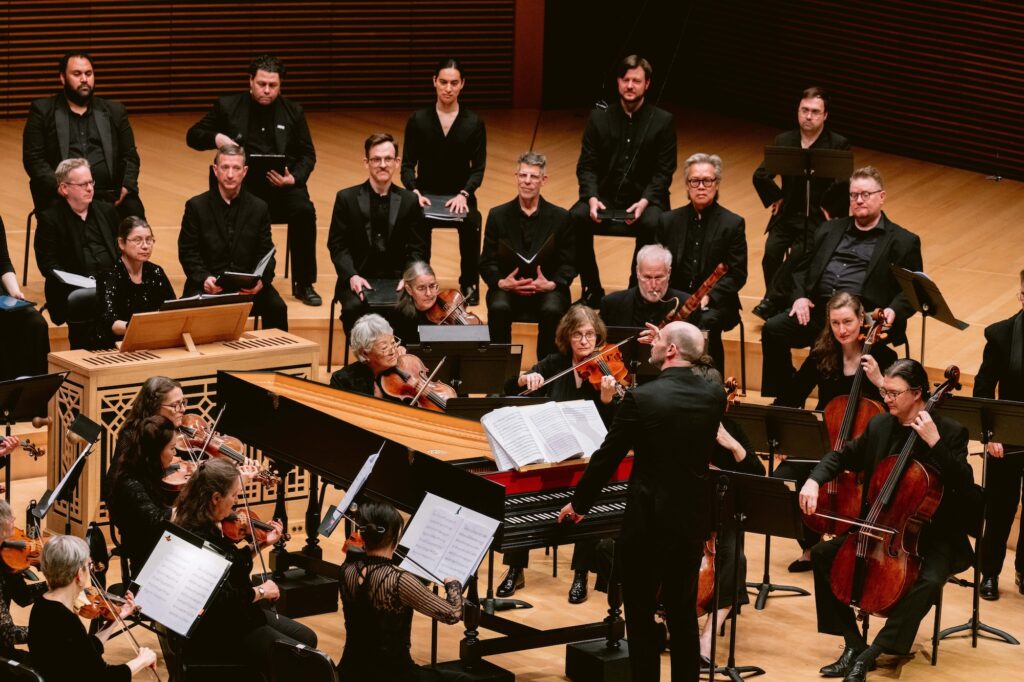
Storied 45-year old San Francisco Philharmonia Baroque Orchestra and Chorale kicks off its latest season Thu/23 in SF and Fri/24 in Berkeley with one of its typical rare gems: A semi-staged performance of Handel’s 1728 opera Tolomeo—sprinkling the historically informed performance with dramatic theatrical elements and vibrant playing that sharpens the experience.
The evening also sees the debut of Olivier Award-winning Irish conductor Peter Whelan as music director, which heralds an exciting new chapter for the period music orchestra—harpsichordist and educator Laurette Goldberg founded it in 1981; Nicholas McGegan led it for 35 years, and Richard Egarr took over in 2020.
Formerly with Dublin’s Irish Baroque Orchestra, Whelan, who has had some experience with both the Philharmonia and San Francisco opera, promises to approach period music as “a living, breathing force”—and the season ahead looks terrific, with everything from Haydn’s grand “Creation” to a newly commissioned concerto for the oud by Philharmonia Composer-in-Residence Tarik O’Regan.
Ahead of his debut, I emailed Whelan some questions about his ambitions and the importance of hearing period music now.
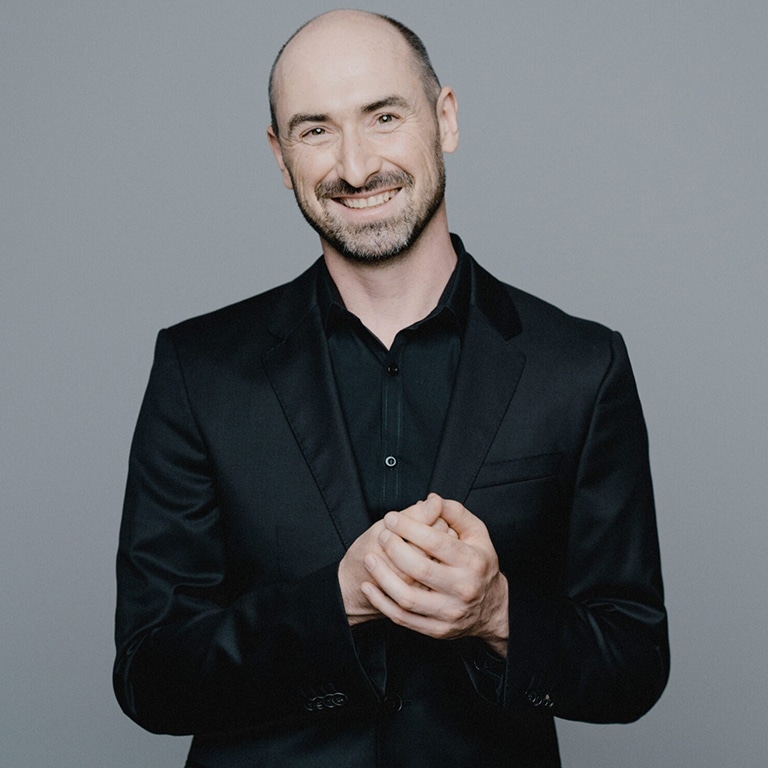
48 HILLS Welcome to the new position! I know you have experience with San Francisco Opera and Philharmonia Baroque—how does it feel to be leading this ensemble, and what are some of your ambitions for your tenure?
PETER WHELAN Thank you. It feels less like arriving somewhere new than picking up a conversation I’d already started. I made my debut with Philharmonia Baroque conducting Handel’s Alceste, and from that very first rehearsal I was struck by the fearless spirit of this group: They’re not an ensemble that simply plays old music well, they’re a company of musical time-travelers who bring a visceral, theatrical charge to every note. Add to that the warmth of the Bay Area audience, that genuine curiosity and sense of connection between stage and hall, and it’s an extraordinary place to become a music director.
As for ambitions: I want to build on the legacy Nicholas McGegan established here and push Philharmonia Baroque toward the vanguard of the next generation of historical performance. I think of the orchestra as a laboratory for discovery, uncovering neglected masterpieces and also finding ways to make the familiar “hits” feel like you’re hearing them for the first time. We’re not here to preserve a museum piece. This music is a living, breathing force, and I want to keep proving that it can speak directly to a modern audience.
48 HILLS Besides a conductor, you’re both a harpsichordist and a bassoonist, a tremendous combo. Will we see those instruments peeking through a bit more than before in the choice of works?
PETER WHELAN Almost certainly, though probably more in spirit than as a strict rule. Playing continuo from the harpsichord keeps me inside the music in a way that standing purely on the podium doesn’t; you feel the architecture of a piece from the inside, bar by bar, which changes how I think about pacing a whole evening.
Being a bassoonist has shaped me just as much, if in a different way. The bassoon connects you to the bass line of the orchestra, to the rhythmic, driving engine room of the ensemble, and that gives you an instinct for how a piece is built from the ground up. And breathing for a wind instrument turns out to be exactly the same discipline as breathing for a singer: you learn to shape a phrase the way a voice would, where to take a breath, where a line needs to arc and release.
That combination, harpsichord and bassoon, continuo and bass line, keyboard and breath, has been enormously valuable for developing all-round musicianship, and it’s part of how I hear an orchestra now: from the inside out, rather than just from the podium down.
48 HILLS You’re coming from the storied Irish Baroque Orchestra—how do Dublin and San Francisco approach period music differently, do you think? Are there any unique historical or cultural forces at play in each?
Dublin and San Francisco come at this music from very different histories. Ireland’s relationship with the Baroque is bound up with recovery: reclaiming a musical life that was disrupted for centuries. But that relationship hasn’t always been an easy one. Baroque music in Ireland is sometimes still viewed as something imported from outside rather than something that belongs to us, and there’s real work involved in making Irish audiences feel they own this music, that it’s part of their own story and not somebody else’s museum piece. That’s been a big part of what I’ve tried to do with the Irish Baroque Orchestra.
San Francisco’s period-instrument tradition, by contrast, was built from scratch over the last 45 years by Philharmonia Baroque. Laurette Goldberg and then Nic McGegan didn’t inherit an early music culture here, they created one, with real experimental daring precisely because there was no old orthodoxy to push against. I hope to do something similar here: to approach this music in a fresh way for young and curious ears, so that it feels like it belongs to this city and this audience, not like something borrowed from somewhere else.
48 HILLS Tolomeo is such an interesting choice to kick things off. Can you tell us what draws you to this particular Handel work, and what can we expect from a semi-staged production?
PETER WHELAN Tolomeo is one of Handel’s most psychologically intense operas, and one of the most unjustly neglected. First performed in 1728, right at the end of the first great King’s Theatre period, the drama is extraordinarily compressed: betrayal, poisoning, assumed death, disguise, madness, reunion. It has the quality of a late Shakespeare play, where tragedy is only narrowly averted and the reunion, when it finally comes, feels almost unbearably hard-won.
This isn’t Giulio Cesare, with its enormous ceremonial sweep. Tolomeo is chamber-scale emotionally, and that felt exactly right for opening this chapter. It contains some of Handel’s top-level operatic devices and arias; some of the scenes are simply breathtaking, and it’s clear he’s trying something new here. The public image of Handel can flatten him into the composer of the “Hallelujah” chorus: triumphant, extroverted, magnificent. Tolomeo reveals a completely different Handel: inward, chromatic, willing to sit in painful harmonic territory for long stretches, where the da capo arias feel less like ornamental repeats and more like genuine emotional reckonings. It’s forward-looking music.
As for the semi-staged production, we’re combining historically informed performance with just enough theatrical elements to sharpen the drama, working with director James Darrah Black and a cast that includes Aryeh Nussbaum Cohen, Lauren Snouffer, Nicole Heaston, Kangmin Justin Kim, and Dashon Burton. It’s not a fully staged opera with sets and costume changes at every turn, but it’s also not a concert performance where singers simply stand and deliver. It sits in between: enough dramatic life that the emotional stakes land, while keeping the orchestra and the music itself at the center of the frame.
48 HILLS Finally, how is it especially important today to make sure period works like Tolomeo are played, heard, and preserved here? I feel it’s a bit like an ancient ’80s computer coding language that still underlies what’s happening now…
PETER WHELAN I love that analogy, it’s not far off. So much of what we think of as “classical music,” and honestly a good deal of contemporary pop harmony and phrasing, has its roots in the rhetorical language Handel and his contemporaries were writing in. This music was built on the idea that a phrase should be trying to say something specific, trying to move a listener physically, not just create a pleasant atmosphere. That’s a kind of source code, and if we stop performing it, we lose access to why so much of what came after works the way it does.
But there’s something more than preservation at stake. The biggest misconception about early music is that historically informed performance is about restriction, playing everything smaller and safer because “that’s how they did it.” I think it’s the opposite. Understanding the conventions Handel was writing within is enormously liberating, and when it’s done right, this music doesn’t feel like a museum piece at all, it feels like a living, breathing force. Handel’s music does not need to be polite.
There’s also something bigger than technique or historical accuracy at stake. Performing this music is a way of checking in with certain values of the past, and feeling that we belong to a long succession of people trying to say something true through sound, across centuries. Preserving Tolomeo isn’t just an act of historical curation; it’s a way of bringing forward the best of what we were, and what we still are, into the present. Getting it in front of new audiences now, especially somewhere as curious and engaged as the Bay Area, matters because this isn’t nostalgia. It’s proof that a 300-year-old language can still say something that speaks directly to us.
PHILHARMONIA BAROQUE: TOLOMEO Thu/23, 7:30pm, Herbst Theater, SF and and Fri/24, 7:30pm, First Congregational Church, Berkeley. More info here.
The post He can Handel it: Philharmonia Baroque’s new director Peter Whelan mounts ‘Tolomeo’ appeared first on 48 hills.