From Eastside beer to artist lofts: The Brewery Artwalk returns to Lincoln Heights
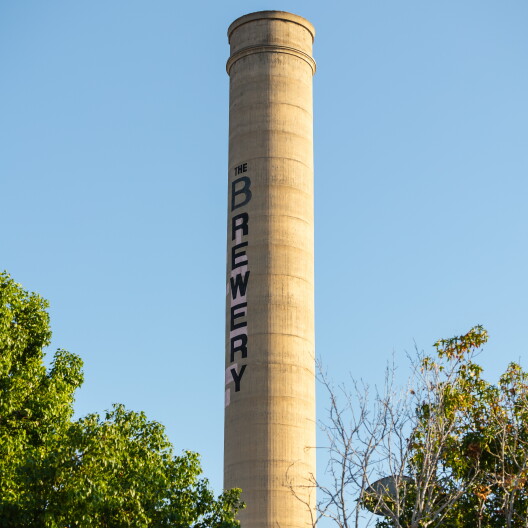
An artist live-work colony in Lincoln Heights is opening its 17-acre campus this weekend, where a beer named Eastside was once brewed.
More than 100 artists are participating in the Brewery Artwalk, an event that started in 1983, according to Kristen Carlson. She is president and CEO of Carlson Industries, which operates the Brewery.
“It was an idea with the artists that were there at that time to have open studios,” Carlson said.
A year earlier, in 1982, Carlson’s family founded the artist colony after Los Angeles passed the landmark Artist-in-Residence ordinance, which permitted the conversion of unused industrial buildings into artist live-work space.
The complex started its life in 1897 as Los Angeles Brewing Company, which sourced water from the adjacent L.A. River, according to the L.A. Times. It was purchased in 1907 by George Zobelein, an immigrant from Bavaria who would become a kind of brewing titan in the city. Zobelein christened his beer Eastside, a nod to the plant’s location east of the river.
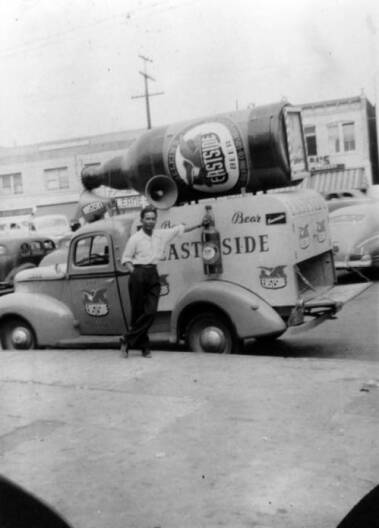
Pabst took over in 1948 and turned it into a distribution hub for the western states.
In 1979, New York transplants Arnold “Whitey” Carlson and his sons Steven and Richard bought the shuttered plant. The eldest Carlson had built the Island Garden — a one-time home of the New York Nets.
“My grandfather and my father and my uncle basically came to California in the ’70s trying to find property to purchase and develop,” Kristen Carlson, Steven’s daughter, said. “That’s where they ended up.”
The family started selling off the plant’s contents piece by piece — “bricks and kegs and tanks and whatever,” Carlson said. Their earliest tenants, she added, included the repair academy American Institute of Piano Technology and a stainless-steel fabricator for restaurant equipment.
The 1982 law changed everything.
“They developed one unit as an artist loft and put an ad in the L.A. Times,” Carlson said. “They had a line down the street. The phone rang off the hook until my mom literally took it off the line. And they were like, ‘OK, I guess this is what we do now.’”
Today, 23 buildings make up the Brewery, with studios, galleries, a restaurant and 300 live-work lofts.
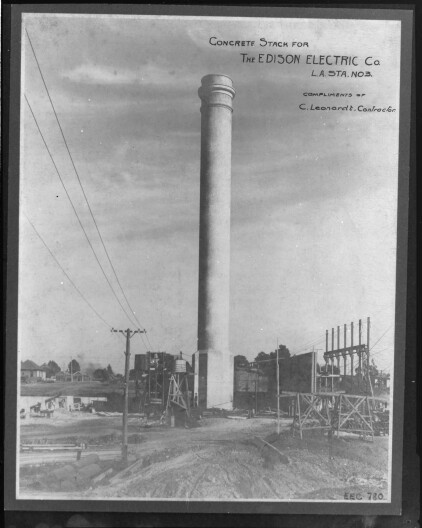
Its oldest building is the steam power plant with its iconic smokestack, designed by John Parkinson and built in the early 1900s by Edison Electric.
Inside, it’s now a state-of-the-art climbing gym.
The Brewery Artwalk is a financial supporter of LAist. Like other funders, it has no influence on our coverage.
Check this story
Ask the guide
The guide explains what to check and where. It cannot see this article or recent news.
Is this AI-made?
AI checkers give a likelihood, not proof.