For costume legend Beaver Bauer, all the city’s a character
When Debra “Beaver” Bauer completed her 75th trip around the sun a couple of years ago, friends took her for a spin on the Ferris wheel at Pier 39. As the wheel turned, each view of San Francisco brought back a different memory.
“Over there, this happened, and over there, I met so-and-so,” the costume designer recalled. “Then there were the places that had disappeared: ‘Oh, that’s gone now. They tore those houses down in redevelopment.’”
Bauer has spent more than five decades observing, dressing up, and making art in San Francisco. She says the city is “a character in my life, as rich a character as the stalwart members of the Angels of Light,” referring to the legendary theatre troupe she was part of.
Bauer’s artful life is the subject of From Street to Stage, a free retrospective opening Thu/5 at the San Francisco Public Library. The exhibition, which runs through April 11, 2027, brings together costumes, props, drawings, photographs, and performance footage spanning Bauer’s career, from the radical Angels of Light Free Theater to major Bay Area companies and circus stages.
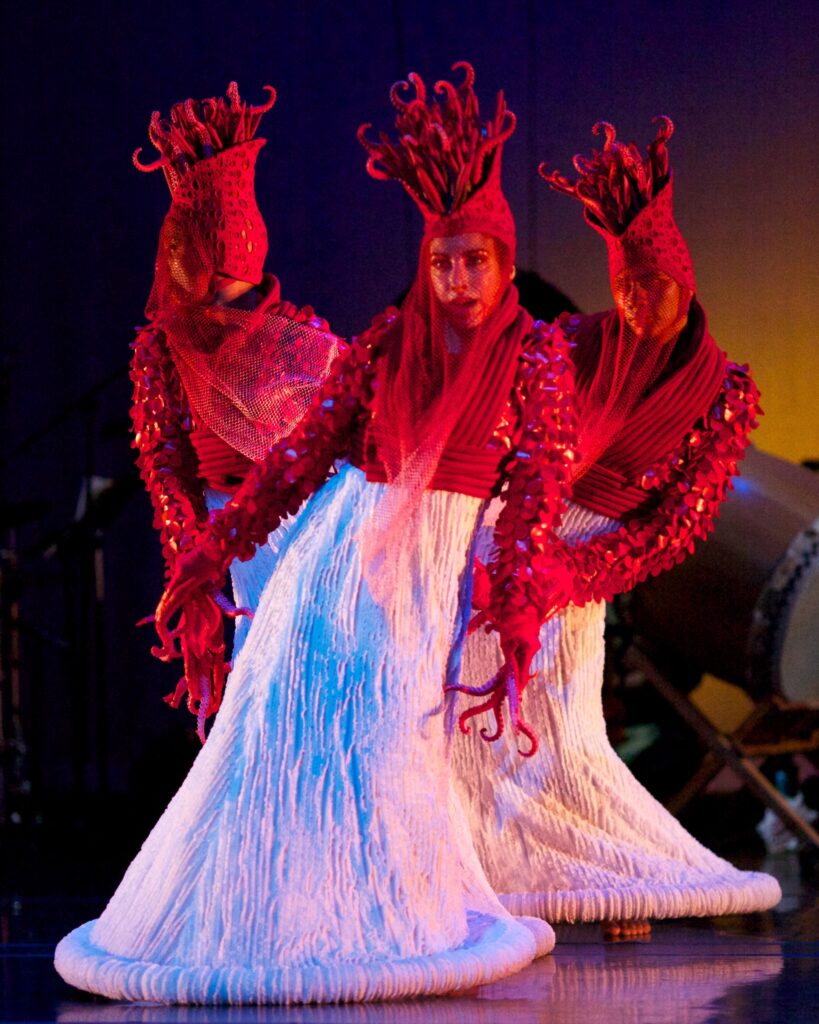
It also includes portraits of passengers on the 22 Fillmore Muni bus and a new installation honoring theater colleagues lost to HIV/AIDS. Throughout the show, Bauer’s work reflects an enduring interest in people: how they present themselves, who they might become, and what can happen when they’re given room to play.
Bauer grew up in the Cleveland area and spent time on New York’s Lower East Side before hitchhiking to San Francisco. She lived in crash pads and spent her days wandering from Chinatown to the Haight to Golden Gate Park. She and her friends dressed up extravagantly and staged little performances, looking for ways to attract attention.
“The people who influenced me most were on the streets of San Francisco,” says Bauer. “It was about being out and about, being seen, and seeing other people.”
She met Hibiscus, one of the Angels of Light’s founders, on Polk Street. The troupe’s free productions emerged from the city’s counterculture, mixing theater, music, elaborate costumes, and an irreverent spirit. Bauer became a founding member and eventual co-director.
At the time, Bauer says, meeting people on the street or at a club could change the way you saw the world. The Cockettes were out and about, and the Diggers served soup in the Panhandle. Bauer and her friends visited gay bars and community centers, scoured thrift stores, and searched dumpsters for things they could wear.
San Francisco’s fog made an impression, too. “I feel like the fog has always brought me magic and mystery,” she says.
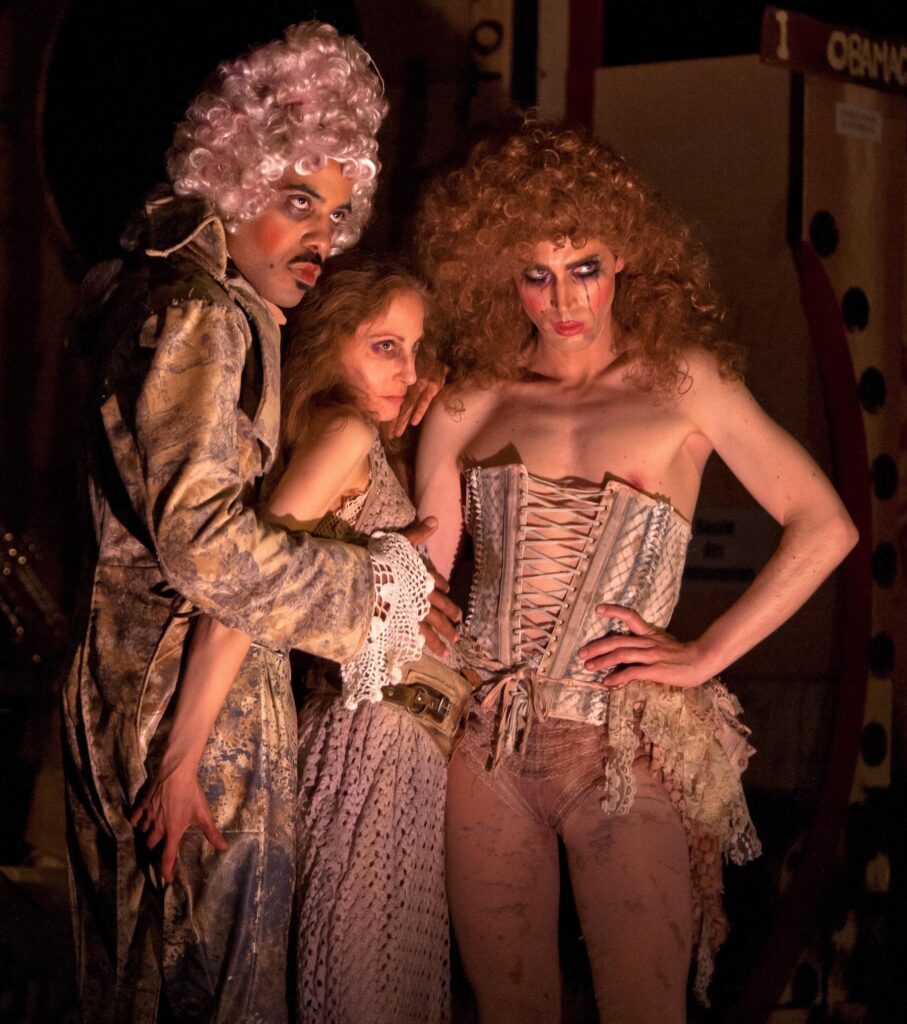
Bauer doesn’t think she or the Angels would have become what they did anywhere else. Even as her career took her into more traditional theater, she carried their spirit with her.
“I think I’ve always carried a little bit of the Angels into everything I do,” she says. Sometimes, she added, it’s especially valuable to bring that spirit to a conservative audience and “tickle the public’s mind.”
Her designs have appeared at American Conservatory Theater, Berkeley Rep, Magic Theatre, and Teatro ZinZanni, as well as on stages in New York and Washington, D.C. She also designed costumes for NBC’s “Brian Boitano Skating Spectacular.”
As she assembled the retrospective, Bauer noticed recurring shapes and motifs, along with changes in her drawing. She now favors work made from impulse and emotion. She also saw the influence of the performers who wore her costumes and the friendships formed along the way.
For Bauer, transformation begins in the fitting room, where performers, designers, and costume makers work together to bring a sketch to life.
During COVID, she kept drawing characters and inventing stories, but she missed that in-person collaboration. “I craved that journey where a two-dimensional sketch—an idea—becomes real,” says Bauer.
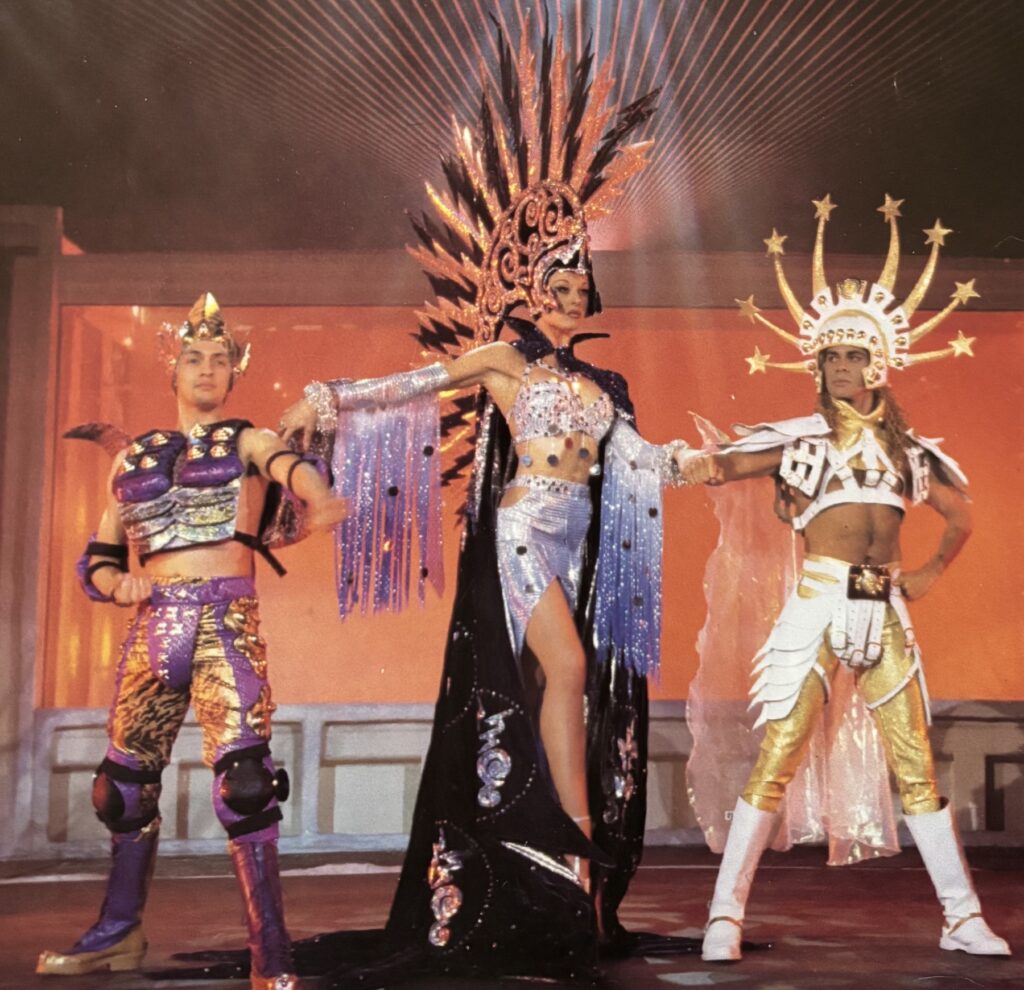
The Angels’ costume experiments also explored identity. Bauer recalled a group made up of people who resisted easy definitions and fought for gay and queer rights. Dressing up, she says, could reveal something unexpected about the person beneath the clothes.
“Everybody has preconceptions about themselves and how they appear,” she says. “I found that playing different characters could unlock something you might not have if you just marched up and down the street in your daily clothes.”
As a child, Bauer associated being a boy with freedoms she didn’t have as a girl. She says she never thought of herself as a boy in a girl’s body, but she also didn’t really see herself as a woman.
“I saw myself as myself,” says Bauer. “I came to believe that was who I was supposed to be, and that was OK.”
The exhibition’s An Arboretum of Dreams brings that history together with remembrance. Bauer had long wanted to honor Angels who had died and inspired her. The installation grew from her discovery of the Waqwaq Tree, a Persian tree of life sometimes depicted with people or animals hanging from its branches.
Her design evolved into a tree with a body and wing-shaped branches. Among its willow boughs are photographs of the Angels, pictured in moments of happiness: performing, backstage, or at home.
“I thought, ‘That’s who we are,’” Bauer says. “‘We’re resilient people. We’ve made it through AIDS and every up and down.’”
Beneath the tree will be a photograph of Bauer with Rodney Price, whom she called her “angel and mentor of mentors.” Taken three days before Price died of AIDS, it shows him in a wheelchair with Bauer holding him from behind.
Visitors can contribute memories on leaf-shaped notes attached to two columns transformed into trees.
Another part of the exhibition returns to Bauer’s daily encounters with the city. For The Bus Queen’s Gazette, she drew fellow passengers on the 22-Fillmore, a route she has ridden throughout her life in San Francisco.
Sometimes, she says, she imagines casting a production with the people on board. For a costume designer, watching body language and clothing is part of the work: the way a person dresses might reveal something about them—or suggest the opposite.
Bauer hopes the library setting will reach people who might not seek out a theater retrospective. She wants a mother and child, a person sleeping in the stacks, or someone who has never heard of the Angels to find something that sparks their imagination.
She remembers a gardener at the zoo giving her a peacock feather when she was a child. She carried it all day and treasured it for days afterward.
“It was incredibly beautiful to me,” says Bauer. “I hope visitors take a peacock feather home with them in their minds.”
FROM STREET TO STAGE: VIBRANT NEW EXHIBITION AT THE LIBRARY SHOWCASES THE WORK OF DEBRA “BEAVER” BAUER, EARLY MEMBER OF THE ANGELS OF LIGHT FREE THEATRE Nov. 5-April 11, San Francisco Public Library’s Jewett Gallery and Koret Lobby, SF. More info here.
The post For costume legend Beaver Bauer, all the city’s a character appeared first on 48 hills.
Check this story
Ask the guide
The guide explains what to check and where. It cannot see this article or recent news.
Is this AI-made?
AI checkers give a likelihood, not proof.