E pluribus ants: At Cabrillo Music Fest, Sarah Hennies’ work buzzes with communal activity
Composer Sarah Hennies is accustomed to delivering surprises, not receiving them. Granted a Cabrillo Festival of Contemporary Music Creative Lab commission, she garnered an entirely unexpected, first-time-ever invitation to compose a work for full orchestra.
“It’s absolutely significant,” Hennies says in a phone interview. “I never thought I’d get asked to do this. I almost never see composers of adventurous music in the way I work in orchestral spaces.”
Hennies’ Sat/1 world premiere, The Grain House, is among several new and a few rarely heard works performed during the annual Santa Cruz music festival, running through August 9. World or West Coast premieres and festival commissions include new works by Vivian Fung, Pedro Emanuel Pereira, D. Riley Nicholson, Clarice Assad, Jackson A. Waters, accompanied 90-year-old giant of the genre Philip Glass’s Brass Sextet and Symphony No. 15 Lincoln. Throughout the week, free open rehearsals, Meet the Composer events, and solo artist talks offer close-up access beyond ticketed concerts.
New York-based Hennies, until now, is recognized primarily as a composer of acoustic ensemble music. Her work occasionally ventures into film, performance art, and projects involving improvisation. She has received commissions from Bent Duo, Ensemble Dedalus, The Living Earth Show, Mivos String Quartet, Talea Ensemble, Yarn/Wire and more. Cabrillo Music Festival 2026 takes as its theme “We the Dreamers” in recognition of the country’s 250th anniversary, and Grain House will debut as part of the “Defiant Dreams” program.
In terms of Hennies’ work, “defiant”—especially in the current political climate—could be applied to her mere existence. Defining her too exactly might be an exercise in error, but she herself has said, “I’m a queer, transgender, bipolar parent working as an experimental musician.” The Cabrillo Festival materials are more wordy, promoting Hennies’ work as “concerned with a variety of musical, sociopolitical, and psychological issues including queer and trans identity, psychoacoustics, and the social and neurological conditions underlying creative thought.”
Underlying Grain House’s title, structure, and artistic concepts is Hennies’ interest in ant colonies, which grew concurrently while composing the new work. “I was thinking about doozers [bulldozers] and buildings and construction and I started reading about ant colonies online. I learned that a species of ant called harvester ants work in huge, harmonious teams to create these deep, tiered, underground structures that have many chambers designed for storing grain and food.”
Hennies sends over a cross-section illustration of an ant colony pulled from the internet. Topped by an anthill, ants climb through tunnels leading to chambers filled with stored grains and grasses.
Because the roughly 30-minute orchestral work is episodic in form, she thinks of the instrumental clustering the score dictates as “chambers” the musicians inhabit. And if well-defined blocks of music in her previous works change abruptly with no obvious reason, Grain House flows as one movement in a less severe manner. Hennies wrote the work from start to finish, a stream of consciousness. She found herself still making solid compositional decisions while writing spontaneously—and likes the approach.
“It’s more linear, almost like a narrative. Working on previous works Blue Hour and Blindsight, it came to me I’ve never written a melody. Even playing in bands where I sang, I wasn’t thinking melodically. I think of myself as a percussion composer working with sound and rhythm. Melody and harmony are just not present.”
Recently while presenting her multimedia piece Contralto, she asked a violinist to play a loop of repeating material that is a mixture of pitch and noise. “It’s supposed to emit a weird, heathen sound, but the violinist kept playing a three-note melody in his loop. I said, “No, it shouldn’t sound like music.” Then I said, “Never connect two pitches. And then, he got it.”
Hennies is a habitual learner, as well as an insightful instructor. Realizing the new work’s complexity needed to be controlled after considering wiring unique, dense loops for each instrument and re-spatializing the entire orchestra, she switched gears.
Aiming for definition without sacrificing each player’s sonic identity, large gestures became the solution. The score has short melodic fragments assigned to instrumental “teams.” All tubists play the same line of notes, all clarinetists play their line, etc. With everything played in unison, she anticipates it will sound like one, immense community. Other than placing two percussionist in the audience late in the piece to bring immediacy to gunshot-like snare drum hits and cymbal sizzles, the spatialization of the orchestra is standard.
“There’s no crazy stuff. I wanted to do the assignment, basically, and write a solid, standard orchestral piece,” she says. I don’t have one career path I’m on. I just want to keep growing and the only way you do that is by trying new things.”
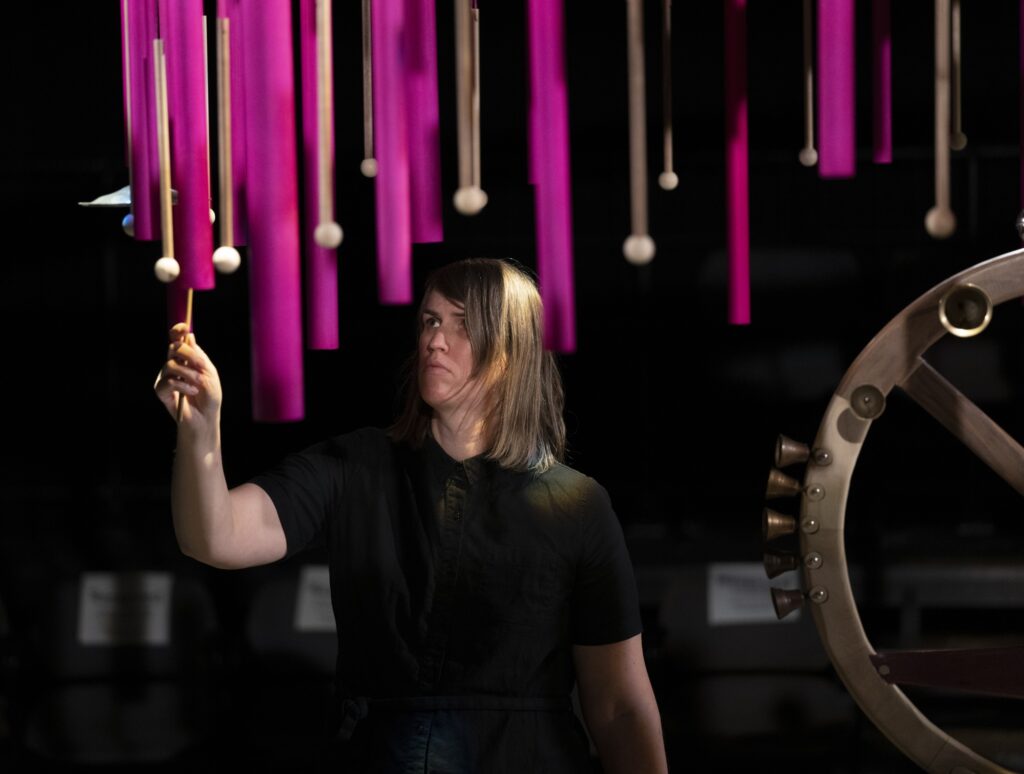
Nothing terrified her about the commission, but writing for woodwind and brass instruments has not always been as comfortable or organic as writing for strings and percussion. “My preference is for physical. With woodwinds, everything happens in the mouth. It’s invisible.” Like the underground ants in her mind, she dug in and hopes the resulting sound is profound, intensely beautiful, a piece with weight and impact. “I have a sense of what I wrote, but I won’t fully know until I’ve heard the full orchestra.”
A conversation with Hennies is incomplete if it excludes the music scene beyond the festival. Often described as a “trans composer,” Hennies says she simultaneously rejects and embraces the label. “It feels important to me that it’s a known thing, but it’s not the only thing. I was worried at first, but ultimately, I talk about it because I’m navigating in an outspoken way to validate our presence in the world.”
Her practices are deeper than a tokenized, narrow-focus label suggests. “Have I ever been diversity hired? Yeah, probably. But for anything anyone has gotten, if the work was shitty in the end, that wouldn’t matter.” Trans artists, as much as the support might have increased in recent years, she insists are still disproportionately underrepresented
Which means the Creative Lab commission and the sonic potential of 70 instrumentalists is especially alluring and significant. Seeking surprise, she hopes people will hear Grain House and think, “Wow, what’s that?” The music comes with Hennies’ ant-like heavy lifting and industriousness that is a direct extension of her mind, body, and approach to music-making.
After the call ends, odd questions arise. Do ants heads’ buzz with orchestral-like pieces as they move grain around all day? After talking with Hennies, it feels presumptuous to say no. A second question: Is it possible to surprise an ant? Turns out, the answer might be yes.
GRAIN HOUSE will be performed along with other works Sat/1, 7pm, at the Santa Cruz Civic Auditorium, as part of the Cabrillo’s Contemporary Music Festival, running through August 9. More info here.
The post E pluribus ants: At Cabrillo Music Fest, Sarah Hennies’ work buzzes with communal activity appeared first on 48 hills.