Bessent threatening Iran with an ‘economic D-Day’ shows he’s panicking as US bonds sell off
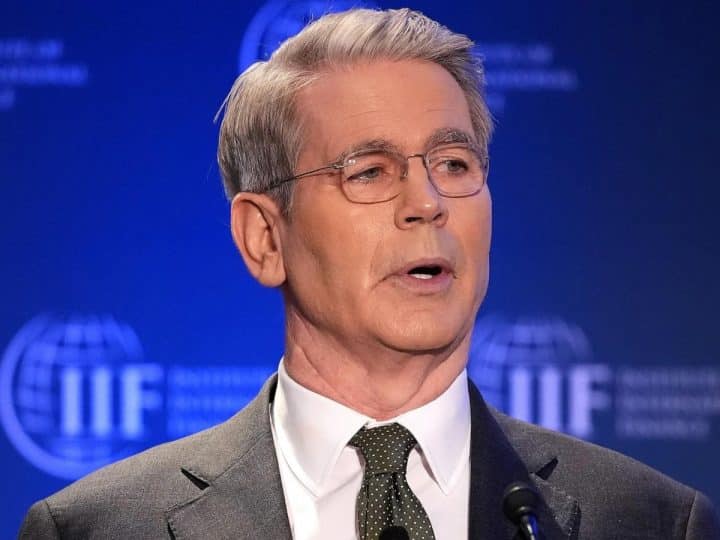
The US Secretary of the Treasury, Scott Bessent, wrote an opinion piece for the Financial Times in which he threatened an “economic D-Day” for Iran, but Yanis Varoufakis has interpreted the bizarre rhetoric as a sign that Washington is not just panicking but has slipped into outright despair.
Bessent: panicking
This all happened while Bessent’s efforts to calm the sell-off in US treasuries failed.
President Trump has dismantled Iran’s military capabilities, destroyed nearly 100 percent of its military factories, and buried its nuclear program.
We are now entering the endgame. At dawn begins an economic D-Day — the single greatest financial offensive ever marshaled against…
— Treasury Secretary Scott Bessent (@SecScottBessent) August 23, 2026
Bessent used Pascal’s Wager to warn Iran’s trading partners that sticking with Tehran is a bad bet. If the US follows through, they will be isolated. “Any nation that serves as a financial artery of a withering regime should expect to share in its isolation,” he said.
Goodness gracious! For Scot Bessent to enlist Pascal’s Wager in the Financial Times against Iran, Washington must be in the psychological state that lies just beyond panic: despair. https://t.co/yM3pFtytRc
— Yanis Varoufakis (@yanisvaroufakis) August 23, 2026
Efforts to calm bond markets slammed
Bessent said Iran’s “enablers” were purchasing and transporting its oil, moving its finances through exchange houses and free trade zones, welcoming its flights, and turning a blind eye to seaborne fuel transfers and the illicit use of their banks, all while “concealing” the extent of their “complicity.”
The same FT just on Saturday 22 August had slammed Bessent’s efforts to calm the US bond markets, saying:
Bessent’s running battle with the bond market is starting to look like his boss’s war in Iran — started by his own hand with a tangled set of objectives, an underestimated opponent and an implausible path to victory.
Financial Times:
“Scott Bessent’s running battle with the bond market is starting to look like his boss’s war in Iran — started by his own hand with a tangled set of objectives, an underestimated opponent and an implausible path to victory. And like the conflict in the Middle… pic.twitter.com/gTmzj3OGOU
— JaguarAnalytics (@JaguarAnalytics) August 22, 2026
Last week, Bessent tried to calm the US bond markets by announcing the Treasury would double its buybacks of long-dated debt. But the intervention offered only “temporary relief.”
Blatant act of lawlessness
These unilateral sanctions are a direct breach of the UN Charter, the rules of sovereignty and non-interference, human rights law, and the prohibition of collective punishment. They are, in essence, a form of economic terrorism. A full third of the world is currently suffering under unlawful US sanctions. And the US has even unlawfully sanctioned international judges, prosecutors, UN human rights monitors, and independent human rights organizations. Countries must choose between international law and the dictates of a rogue imperial government on a global rampage.
Seen it before – before Bessent, too
Iran’s foreign minister, Araghchi, said the new sanctions package is like watching “some movie playing over and over again,” Al Jazeera reported.
Iran’s Foreign Minister Abbas Araghchi said the new US sanctions package, likely to be unveiled Monday, is like watching the ‘same movie playing over and over again’.
He added that the ‘bullying’ under Trump is no different from that under previous US administrations. pic.twitter.com/gXjNoGqZIE
— Al Jazeera English (@AJEnglish) August 24, 2026
Quincy Institute’s Trita Parsi told CNN that this new pressure campaign on Iran will likely result in “counterescalation” by Iran – not surrender. He said that Trump’s maximum pressure was supposed to break Iran eight years ago, and the blockade was supposed to do the same four months ago.
Told @cnn that we have been here before: Trump’s maximum pressure was supposed to break Iran 8 years ago. The blockade was supposed to break Iran four months ago.
Trump’s D-day pressure will squeeze Iran, but Tehran’s most likely response is counterescalation – not surrender pic.twitter.com/IfTbes9Tcj
— Trita Parsi (@tparsi) August 24, 2026
The New York Times, in an article, quoted Wu Xinbo, a leading American studies scholar at Fudan University in Shanghai who advises China’s foreign ministry, as saying about the “economic D-Day” threats:
This threat reveals how desperate the Trump administration has become on the issue of Iran.They issue this threat, not because they think it is workable, but because they have no other options.
NYT also noted that China is Iran’s largest trading partner and has for decades defied Western sanctions by buying up to 90% of Iran’s oil exports.
China has also supplied Iran with technology and raw materials for its missile and drone programs. The paper said China feels confident it can resist the pressure, in part because it can squeeze US “critical mineral supplies” and has “stockpiled months worth of oil” to withstand the loss of Iranian crude.
Iran still controlling Hormuz
Bloomberg’s Abeer Abu Omar reported that the IRGC has “scenarios laid out” for any US economic isolation plan.
She said while Iran’s oil exports are “virtually at zero” due to the US naval blockade, it will take about six months for Iran to feel real pressure.
She added that Iran still “asserts dominance over the Strait of Hormuz,” where vessel traffic is “very close to zero.”
She also noted that “the Houthis are forcing Saudi Arabia to take the French routes through Africa” to avoid danger in the Red Sea.
By Nandita Lal
Check this story
Ask the guide
The guide explains what to check and where. It cannot see this article or recent news.
Is this AI-made?
AI checkers give a likelihood, not proof.