Australian poetry classics: John Forbes’ On the Beach exposes the nation’s myths of convenience
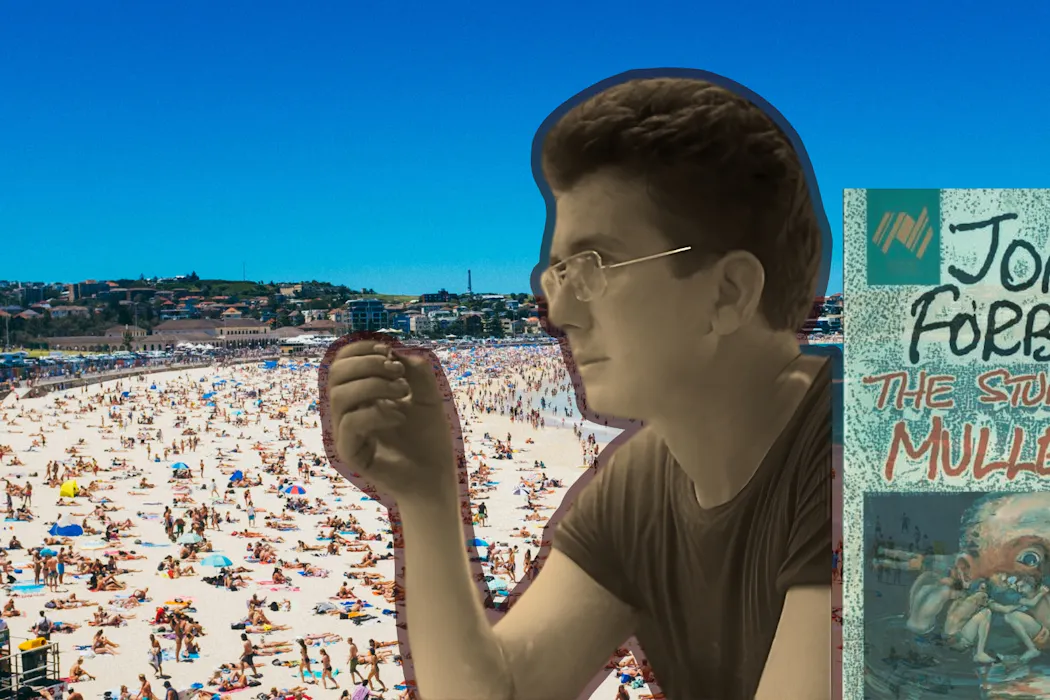
In this series, we explore influential Australian poems.
When John Forbes (1950–98) died of a heart attack at the young age of 47, he left behind a slim but remarkable body of work. He is still influential and widely read. His Collected Poems recently went into a fifth reprinting. A biography and anthology of his prose writings will be published in 2027.
Educated at De La Salle Catholic boys’ schools in the Sydney suburbs of Carringbah and Cronulla, Forbes showed promise as a scholar. He dazzled many of his contemporaries at the University of Sydney, where he studied arts, but his academic transcript wasn’t particularly impressive. A colloquial but original master’s thesis on New York poet Frank O’Hara was ultimately abandoned.
Although he was awarded a series of literary grants, Forbes lived in increasing
penury. He was forced to take a range of casual jobs, from telemarketing and furniture removal to working in a tinsel factory. He also taught creative writing. As he aged, he drank more heavily and became more dependent on the codeine-based medicine he began consuming in his early twenties.
Crushes and unrequited loves haunt his poems, but he was popular with men and women alike and was often sought out for his conversational brilliance.
Four Heads & how to do them
Forbes announced his arrival with the poem Four Heads & how to do them. Written when he was just 21, this daring piece features four heads: Classical, Romantic, Symbolist and Conceptual. The “Symbolist Head”:
No longer begins with even a mention of anatomy,
the approach in fact leaves one with the whole glittering
universe from which only the head has been removed.
One attempts, in the teeth of an obvious fallacy, to find
the shape, colour, smell, to know the “feel” of the head
without knowing the head at all. And the quarry is elusive!
If the stomach disappears, butterflies are liberated & while
the head teems with ideas who has ever seen one? Equally,
the sound of a head stroked with sponge rubber or the sound
of a head kicked along the street on Anzac Day could be
the sound of a million other things kicked or stroked.
Reader anxiety might be assuaged by Forbes’ comment that the poem was “just a doodle”. Four Heads won the 1972 New Poetry Award and quickly became a showpiece of avant-gardist writing in Australia.
The next two and a half years were remarkably fecund. Forbes wrote Ode/Goodbye
Memory, Ode to Tropical Skiing, Angel, To the Bobbydazzlers and Rrose Sélavy.
The latter was written for Julie Rose, one of Forbes’ unrequited loves. It might be one of the century’s strangest love poems. The zigzag typography whizzes through a Contiki tour of settings. All locales are interchangeable because all are illuminated by the beloved’s presence. Her name is an incantation that can open any door and banish any sorrow. Julie is “more precise than a stocking” and “more tasteful / than a day at the zoo”. She is “a crazed spanner in the intricate works of death!” Under the power of her transformative spell,
helicopters are learning,
slowly,
to dance (their feet are clumsy but tender
tender!)
These poems completed a bounty of anthology staples comparable to any Australian poet of equivalent age. Even these early lyrics show a high level of craft. They give a foretaste of the force of Forbes’ rhetoric and his metaphysical audacity.
David Malouf declared Forbes “the most elegant and inventive poet” of his
generation, “the one who moves with the most agility and wit in a contemporary
world of his own making”.

Some critics resisted, decrying the poetry’s lack of serious themes. The themes were there – love, death, joy, poetry – but Forbes’ abiding concern was with representation and, in this sense, he is a philosophical and political writer. The revelations in his poems are often stark, disabusing readers of the comforting ways they choose to see the world. Sydney, the city in which he spent two thirds of his life, is also central.
Hostile critics accused Forbes of being derivative, but were not forthcoming with details. The New York School poets – particularly Frank O’Hara, John Ashbery, Kenneth Koch and Ted Berrigan – are useful points of reference, but their influence was not overpowering, nor was it straightforward. Forbes is more different from these New York interlocutors than they are from each other.
Forbes championed the poetry of avant-garde allies in his work as an editor with the literary journal Scripsi and in his own magazine Surfers Paradise. But he could recognise a good poem of any aesthetic lineage. He was a mentor to a broad array of poets, from Adam Aitken, Steve Kelen, Antony Lawrence and John Kinsella, to Luke Davies, Dipti Saravanamuttu and Emma Lew.
His stylish reviews were taste-shaping and influential, broadening perceptions of what Australian poetry might be. His prose was characterised by the same wit and epigrammatic sparkle that marked his poetry.
The Stunned Mullet
Forbes’ strongest collection is The Stunned Mullet (1988). The book was funded by
the Australian bicentennial authority. The celebrations marking 200 years of European “settlement” were controversial. Almost from the moment he accepted the commission, Forbes was plagued by a nagging guilt.
The commission redirected his creative energies to the political issues confronting contemporary Australia. As laureate to the bicentennial, Forbes’ irony vaporised the thin pageantry of the festivities. The Stunned Mullet would be – in the words of cultural studies scholar Meaghan Morris – “a survival guide for the bicentenary”.
The volume, which is saturated with Australian iconography, marked a shift in Forbes’ critical reception. He came to broad acceptance as a major Australian poet.

The Stunned Mullet’s centrepiece is On the Beach. The poem’s six episodic sections resemble a succession of parade floats with commentary; taken together, they are an ultimate statement on the contradictions and deflections of the sanitised official history.
The poem’s title succinctly captures two contrary moods: the thoughtless frivolity of Cliff Richard’s song and the apocalyptic doom of Neville Shute’s novel of the same title. Neither mood cancels the other out.
The quick cuts between the sections undermine the rhapsodic oration that might be expected of a national bard. The notion of speaking for one’s country is “de-naturalised”. The speaker’s private “vocation” clashes with public expectation, as the bardic impulse is constantly undercut by bathos:
Milled day-glo ephemera
sell you this image of Australia
& where it appears, flogged and true-blue,
your vocation looks
more like a blurred tattoo
or something you did for a bet
& now regret, like a man
walking the length of the bar on his hands
balancing a drink on his shoe
The gymnastic contortions of the speaker dramatise the complications of presenting a history worthy of celebration. He goes in search of “a national style” and “model for Australia” that might be credible, not “too far-fetched” or “cute”:
what model of Australia as a nation
could match the ocean, or get your desk
to resemble a beach /
it would have to function
like Tom Roberts’ Opening of the
Federal Parliament, our nation being
a sort of awkward, academic machine.
Roberts’ painting – a celebration of federation – was years in the making and debilitating for the artist. It is marshalled as a fitting emblem for the strained metaphors that no longer convince. As one of the portrait’s subjects exclaims: “If I hold this pose much longer I’ll collapse!”

Public domain, view Wikimedia Commons

The “speckled drongos” that “coo in the margins” of the poem’s fourth section are both birds and – as per Australian slang – idiots. They fulfil the requirement of including natural fauna in an ode to the nation, but these drongos also represent the lowest common denominator. They heckle the poet for wanting to present something more challenging than mere bunting for the festivities.
The famous pronouncement of novelist L.P. Hartley – “the past is a foreign country; they do things differently there” – which calls for historical context, is reduced to an abnegation of responsibility:
the past
is like an Overseas no one’s gone to.
It is an apt slogan for the prescribed amnesia. The violence of the colony’s founding is present, but generalised and off-stage: “the bodies scream under the keel”. The Royal Navy is portrayed as cold and efficient:
Fatal as the blue-ringed octopus
but far less idle.
The oppression of the original inhabitants is a prelude to their treatment by the cultural industries of the bicentennial. The sacred is commodified, reducing an entire culture to a product:
& know that what they gave you when they took your land
is just a foretaste of what you’ll get
now your religious imagery looks subtle on a fabric.
The poem ends in a merging of the personal and public. Nostalgia sits uneasily with dispossession and violence. The banality of a specific location – “the lounge bar of the Coogee Bay Hotel” – undermines the grandeur of a poet speaking for the nation.
In the final image, the poet waves goodbye to his vocation as a suitable model for the nation washes out to sea, taking with it the possibility of a public poetry of celebration:
in the lounge bar of the Coogee Bay Hotel
where you first dreamt up
this model of the Ocean
& watched it slide, slowly at first,
down the beach & into the surf.
Australia needed to mature, but Forbes saw little prospect of this. He performs the nation the service of exposing its myths of convenience.
Damaged Glamour
In his final decade, in which he moved to Melbourne, Forbes published New
and Selected Poems (1992). Love Poem intertwines unrequited love with CNN’s packaging of the first Gulf War as mass entertainment. It is a conceit worthy of John Donne. The poem ends, as the speaker-poet watches
the west
do what the west does best& know, obscurely, as I go to bed
all this is being staged for me.
The new work lamented the passing of time and a reader senses a growing fatalism. The devastatingly comic resolution of The History of Nostalgia is typical of many poems:
so that you’re left thinking, ‘Can this be it?’
&, sure enough, it is – you’re here, that’s all,
another miserable subject, composed of a few jokes
& catchphrases worn smooth with repetition
but at the same time almost statuesque, like a bust
of yourself in marble or bronze & mounted on
that plinth you used to lounge against, back
when you were still smoking Marlboros & worried
you’d come to resemble your father, not yourself
As in Shakespeare, laughter is never far from tears.
Forbes’ final collection Damaged Glamour was published posthumously. It is a book of sparser forms and sombre moods. The poetry is often more direct and conversational, though still marked by brilliant metaphors. Ode to Karl Marx begins:
Old father of the horrible bride whose
wedding cake has finally collapsed, youspoke the truth that doesn’t set us free —
it’s like a lever made of words no one’slearnt to operate.
Although Forbes remained sceptical of concepts like the self, best exemplified in the short lyric Panto, these late poems are more personal. Despite their bleak outlook, many are humorous and memorable.
In Sydney Harbour Considered as a Matisse, the beauty of the poet’s hometown is offset by big business and the grotesqueness of its parvenus. The salvific power of art wins a narrow victory in the poem’s conclusion:
Can art be good enough to save all this,
plus the perfume of frangipani blooms
crushed on sandstone piers? Maybe just.

Aidan Coleman does not work for, consult, own shares in or receive funding from any company or organisation that would benefit from this article, and has disclosed no relevant affiliations beyond their academic appointment.
Check this story
Ask the guide
The guide explains what to check and where. It cannot see this article or recent news.
Is this AI-made?
AI checkers give a likelihood, not proof.