Aerial Arts Fest flies high on a shoestring and a dream
As a child I was obsessed with The Flying Wallendas, a family of high-wire artists who performed without a safety net. It wasn’t because I wanted to be such a dare-devil, but because thinking about them was an antidote to my own overwhelming fear of heights. That’s why I’m going to the seventh biennial San Francisco Aerial Arts Festival Fri/7-Sun/9, presented by Zaccho Dance Theatre and Fort Mason Center for Arts & Culture. It promises many different types of high-flying performances from dozens of artists, including contemporary aerial dance, circus arts, and site-responsive works. Don’t worry, fellow acrophobiacs: You just have to watch, not participate.
With the exception of ancient traditions like Mexico’s 400-year-old Los Voladores ritual, most aerial performance comes from the circus: Ringling Bros, Barnum & Bailey, smaller ones here in the US, famous ones in Europe. Then in the 1960s and ’70s some post-modern dancers and choreographers like Trisha Brown, then later contemporary choreographer Elizabeth Streb, began utilizing space in a much more vertical, gravity-defying way.
Award-winning performer, choreographer, and founder of Zaccho Dance Theatre Joanna Haigood explains how and why she started the festival. “I never really get to see [many aerial performances] or get to be in conversation with folks in a way that feels substantive. I thought it would be wonderful to come together and be in dialogue about this practice that’s unique and very specific.
“I was part of a movement to get people to understand that this was an art and a dance form. It wasn’t just a circus act. I worked at Circus Center for seven years, so I had a lot of exposure to that. It really did demonstrate how much we needed to be together, and what a wonderful offering it is for the larger community to see this practice done in so many different ways.”
It’s been a long road to this year’s festival, especially rougher in the current arts environment. Haigood laments that “We’re still working on fundraising and trying to get a larger investment from financial partners. We’re still at this beginning stage. There wasn’t the budget to bring a lot of people in from all over the world” as was the case previously, because “we lost our NEA funding, which was huge. And there are a lot of [foreign] artists who actually are not interested in coming here right now.”
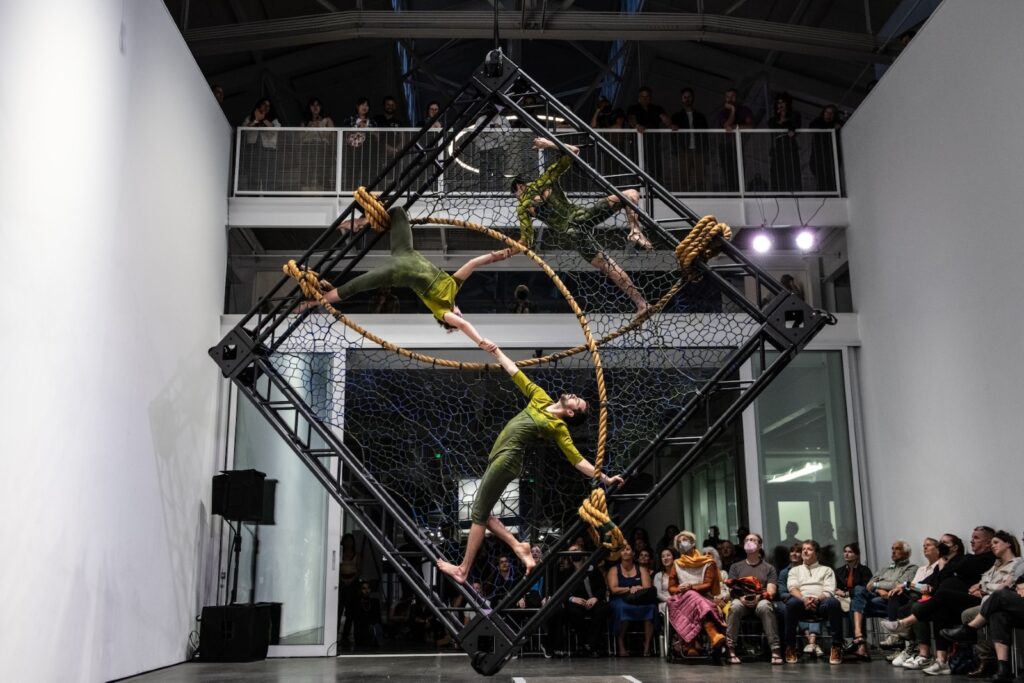
It’s always interesting to find out why individual performers gravitate to aerial/vertical dance. Megan Lowe has her own company, Megan Lowe Dances, and has paired up with company member Roel Seeber for their duet in the festival.
“I went to college at UC Berkeley and had a professor who found out that I really liked rock climbing and had a tendency to climb all over everything—and that I also liked dancing,” Lowe said. “He asked if had ever heard of vertical dance because I might really enjoy it. He mentioned [local vertical dance companies] Bandaloop and Flyaway Productions. Shortly after I graduated I took one workshop with Bandaloop and one with Flyaway and then started working with Flyaway. I was also dabbling in different aerial circus forms like silks, trapeze and lyra [aerial hoop].
“But I think vertical dance is definitely where I found my comfort zone in aerial dance. I like working with static objects or climbing ladders, staircases, and railings either in rope and harness or without them. For me there’s something about being a small female and feeling the agency to be powerful. I have the ability to shape the space I’m in. Or choose how high I am up above something to see what’s below me and listening to gravity and to momentum and respecting the heights,” Lowe said.
“It’s not just about me having power or being vulnerable, but the conversation of talking to gravity or someone I’m dancing with in relationship to gravity and then listening for what they’re offering or gravity’s offering. It’s very symbiotic. You can’t have one without the other.”
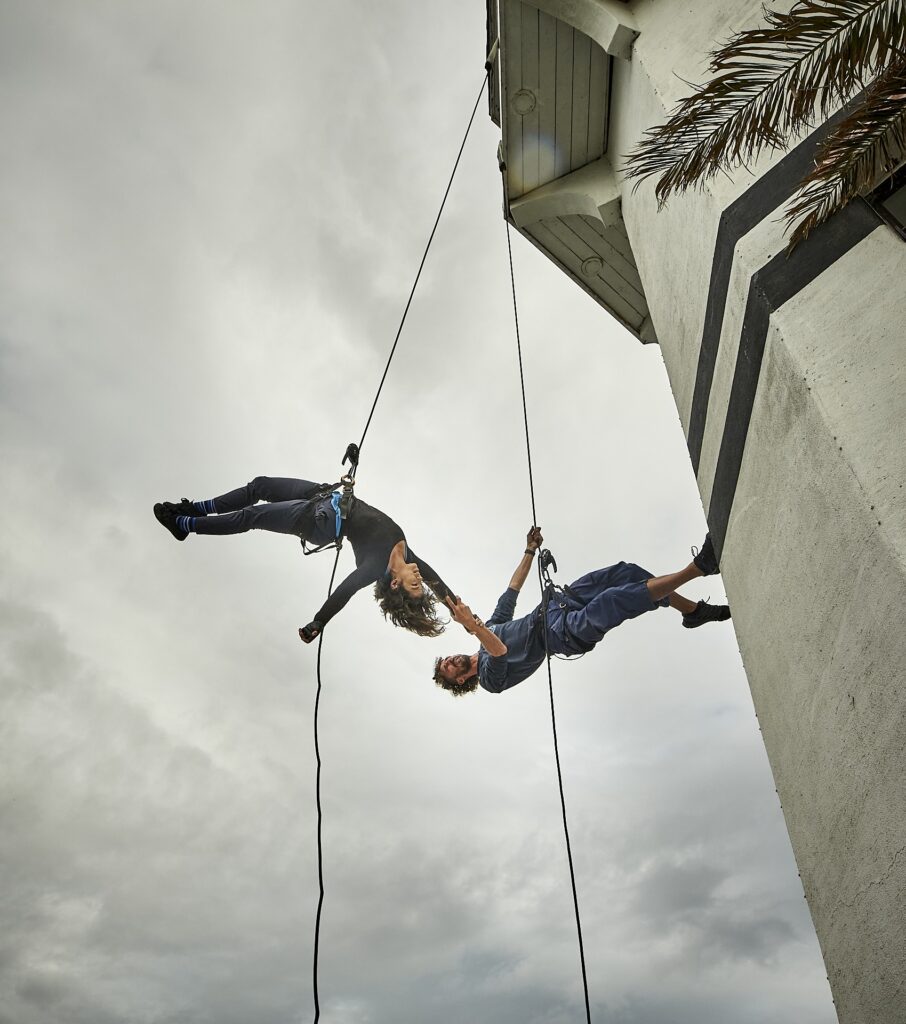
Seeber, Lowe’s partner in the air spent the early portion of his career primarily as a dancer. “In the early 2000s, I was hanging out with this group of climbers and dancers who happened to be in this area of New York that has a lot of rock climbing. Just a mixture of climbers who danced and dancers who climbed. Some of the most amazing movers I’ve ever seen,” he said.
“I was drawn into a show that they were doing after 9/11. It was a fundraiser in an abandoned cement mine in Rosendale, New York, and the piece I ended up performing had a counterbalance with a spreader bar. There were two pulleys and one rope that goes down. And I’m on one side and my friend’s on the other. And there’s a bolt in the ceiling. We’re dancing on a big 40-foot diameter column, and as he would come down, I would go up. We were doing these incredible spirals through the air and I remember this intense sensation. I could do that for the rest of my life.”
Seeber graduated from the SUNY Purchase dance program and became a member of the José Limón Dance Company for seven years. “I was out here in San Francisco in 2007, was visiting a friend who told me about the Bandaloop audition. I went, and they offered me a job. I said I needed one year to clean up my life in New York and I’ll see you then. I arrived in 2008 and I’ve been here ever since. I danced with Bandaloop for about 13 years. Now I’m a teacher at the studio, and do my own work with Megan as well as other projects.”
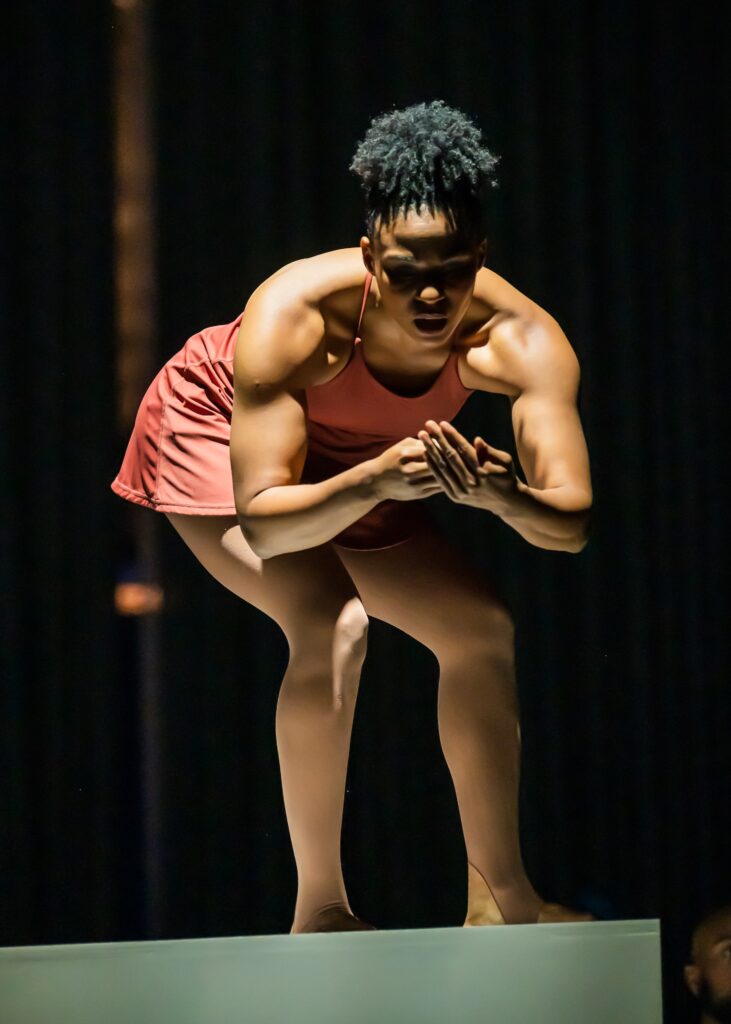
Veronica Blair, one of the nation’s leading Black aerialists, said “What drew me to the circus was the artistry. In the United States some people would not consider circus to be art. But in the rest of the world, it’s high art.
“I started in the teen apprentice program [in San Francisco] with a company called Make a Circus. It was not only the athleticism; I just liked challenging myself and gaining body autonomy, self-awareness, and confidence, which was really valuable for me as a teenager. But also it was the pageantry of circus: the big shows from Ringling Brothers & Barnum and Bailey, the capes, the presentation, the ballet in the air, the old vintage photos. I was enamored by all that. I started to envision myself as this beautiful aerial performer.
“I signed on with Universal Circus which is the country’s only African American-owned and operated circus. I traveled with them for five years consecutively doing about 39 to 40 weeks per year with over 300 shows per year. Having a healthy respect for gravity and the physics of this realm means being able to defy them with a lot of safety checks, a lot of equipment, and a lot of practice. It takes a lot of effort to defy gravity! But it’s one of the most satisfying things that I’ve chosen to do in my life,” Blair said.
“Now it is for us to witness and expand our minds about how these apparatuses can be used and what we can express through them. The art of building an act or a piece or performance with the apparatus is an opportunity to share lived experience, to crack open or pull back layers for the audience—to help them to transmute or move through things while I’m transmuting or moving through things. So before a performance, I ground myself, put on a layer of protection, and then open myself up to be vulnerable in that space.
“Whether working in the circus, in a theme park, or creating my own works, this is the process I go through to make sure that what I’m conveying on stage is being seen and felt.”
SAN FRANCISCO AERIAL ARTS FESTIVAL presented by Zaccho Dance, Fri/7-Sun/9, Fort Mason Center for Arts & Culture, SF. More info here.
The post Aerial Arts Fest flies high on a shoestring and a dream appeared first on 48 hills.