A Realist’s Guide to the American System
Friends,
I’m devoting the next several Fridays to what I’m calling a “Realist’s Guide to the American System.” If you hadn’t noticed, almost everything’s going to hell.
Why? Trump is horrendous, but he isn’t causing all the failures of that system. He’s a consequence of that system. Think of him as a boil on its backside — an infected pustule on the giant ass of the American system. The boil would have become infected eventually because of deeper flaws in how the system has evolved.
The best way of beginning is to introduce you to Jamie Dimon.
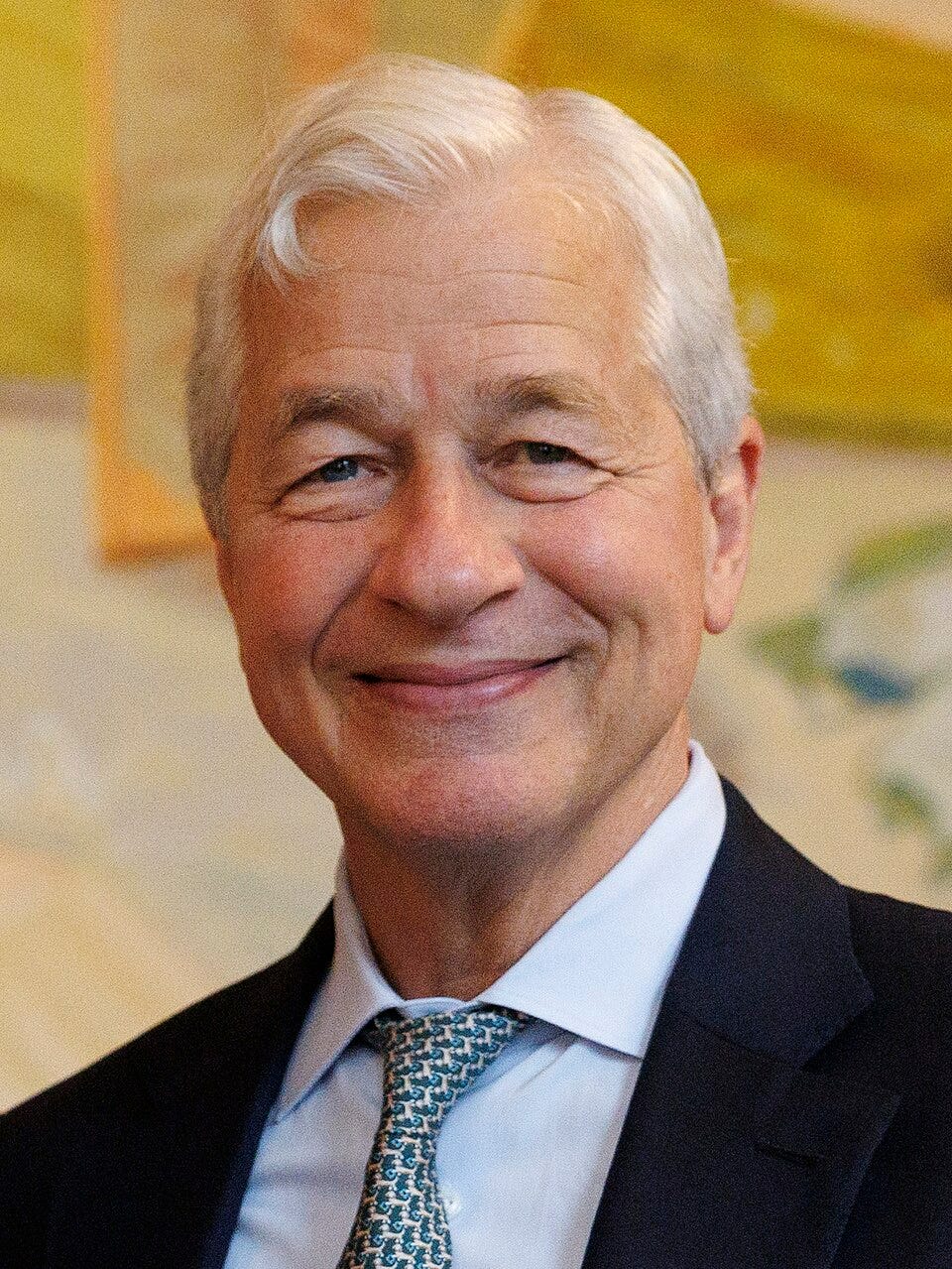
Jamie Dimon
In the spring of 2018, Jamie Dimon phoned me at my office at the University of California, Berkeley. I had criticized him publicly, and he was not pleased. He sounded off on the phone for several minutes without stopping.
Dimon has a great deal of influence over the system. He heads the largest bank on Wall Street, JPMorganChase, which survived the 2008 financial crisis better than any other big bank. After the crisis, The New York Times gave Dimon the back-handed compliment of being “America’s least-hated banker.” He has also headed the Business Roundtable, a lobbying group of the most powerful CEOs in America. He is featured regularly on cable news and in the business press. His opinions carry significant weight on Capitol Hill.
Dimon describes himself as “a patriot before I’m the CEO of JPMorgan.” He is a lifelong Democrat. He admirably speaks out about the injustices and inequalities of contemporary America. He is not just talk. He has pushed his bank to invest in poor cities and to create better opportunities for the disadvantaged.
I believe he’s sincere. But he is awash in self-delusion, a condition especially dangerous in people who have significant power over others.
Dimon doesn’t see how he has contributed to the mess we’re in. He doesn’t acknowledge the inconsistencies between his preferred self-image as “patriot first” and his roles as CEO of America’s largest bank and former chairman of the Business Roundtable. He doesn’t understand how he has hijacked the system.
Dimon is emblematic of an abdication of public responsibility to maintain the health of our political-economic system at a moment when a comparative few at the top have more power over it than at any time in over a century.
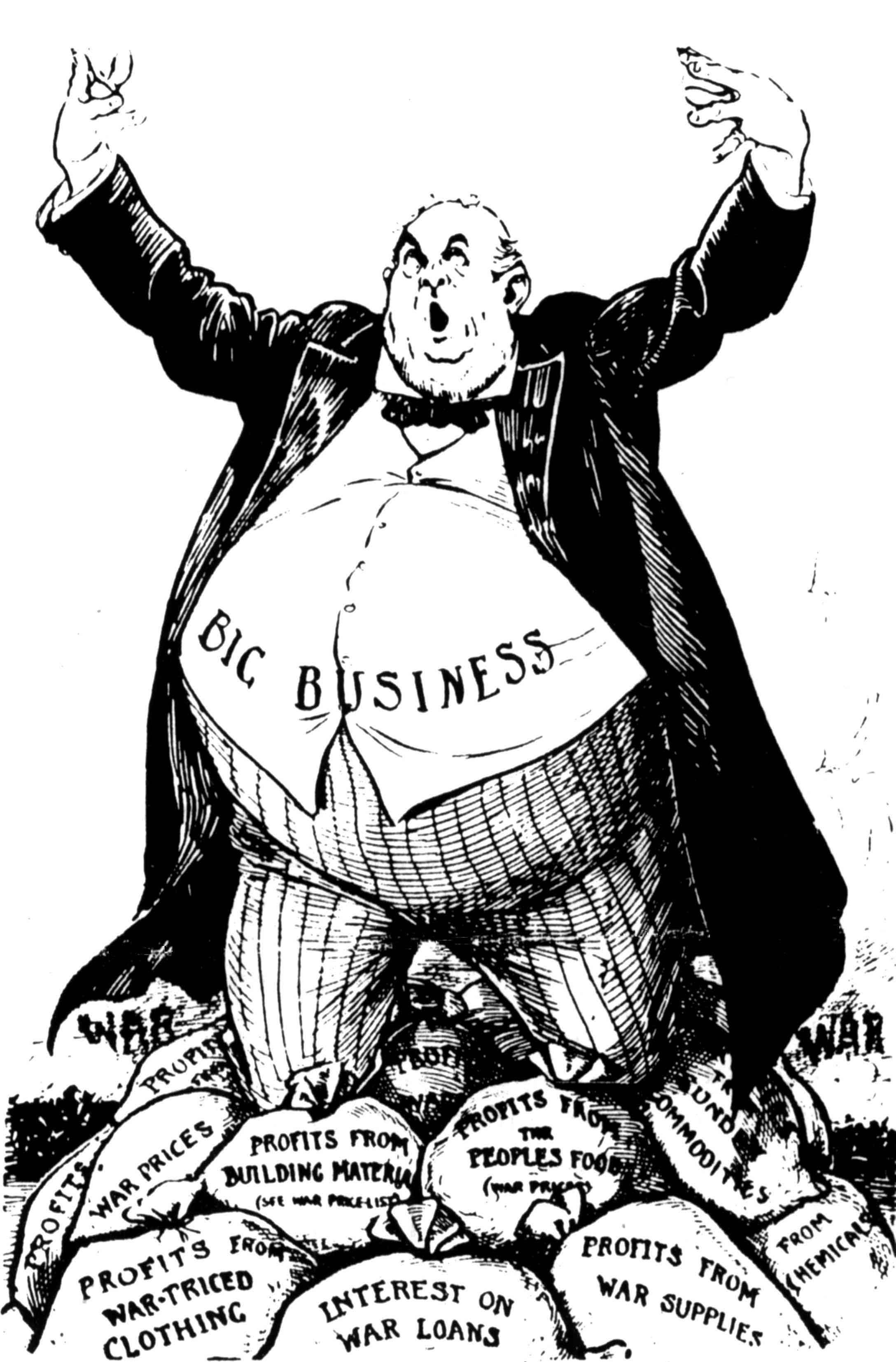
They have used their power to give themselves unprecedented wealth, which has bought them even more power. They have justified their wealth and power as being in the interest of the public, but the public has been shafted.
Dimon is among the most capable of American CEOs, adept at promoting and defending his corporation. He also understands some of the failings of the system and has called for some useful reforms. If he weren’t running JPMorgan, someone else would be, and probably not doing so nearly as well.
Nonetheless, a big part of Dimon’s job is to siphon off the gains of the economy for the benefit of a few at the top. As he does this, he’s eroding trust in the system. He’s undermining democracy.
This is how we got into the quagmire we’re in. Dimon is simply playing his part in the current system as it has evolved. He’s responding to how incentives within the system are designed.
To the extent Dimon or others like him are blameworthy, the fault lies in their unwillingness to buck these incentives in order to change the system for the well-being of the vast majority.
This may be an unrealistically high bar. Dimon has no legal obligation to reach it. But I believe he has a moral duty to try to change the laws and incentives so no one ever again can become as rich and powerful as he and his fellow CEOs at the Business Roundtable and as other major financiers on Wall Street. He has a moral obligation to ensure that the American system is no longer rigged in favor of people like him.
I’ll return to Dimon next week, but right now I want to talk about the consequences of all this.
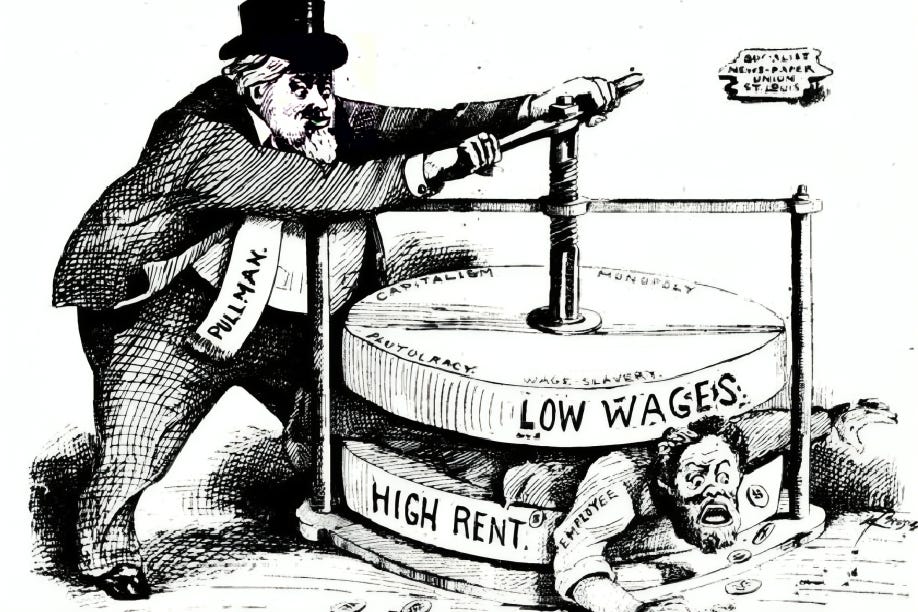
The enshittification of America
Millions of Americans, whether on the left or right of the political spectrum, know something has gone profoundly wrong.
The concentration of wealth in America has created a political system in which the super-rich can buy Congress and the presidency, an education system in which they can buy admission to college for their children, a healthcare system in which they can buy care others can’t, and a justice system in which they can buy their way out of jail.
Almost everyone else has been hurled into a dystopia of bureaucratic arbitrariness, corporate greed, and the legal and financial sinkholes that have become hallmarks of modern American life.
The term “enshittification” was coined in 2022 by novelist Cory Doctorow to describe the declining quality of almost everything. Monopolistic corporations are charging more for the products they sell and cutting back on services. Stuff breaks more often than it used to. Government is being starved of tax money to provide even the most basic of public services.
The whole system seems to be collapsing in on itself.
The word “enshittification” has been officially incorporated into major lexicons like the Merriam-Webster dictionary because of people’s increasingly common experience of being crapped on by big corporations, big hospitals, big energy, and big insurance, and of being bogged down in seemingly endless legal quagmires of corporate and government bureaucracies. As the New Yorker put it, we live in the “Age of Enshittification.”
The advent of AI has highlighted the possibility of mass unemployment and also the growing impossibility of boosting workers’ share of both corporate and national income.
The oligarchs who are now spending hundreds of billions of dollars developing AI — with funds funneled to them by Jamie Dimon and others on Wall Street — have done everything in their power to keep workers’ wages low, prevent them from organizing or joining unions, and stop them from having more political power, and they’re now funding campaigns to protect their fortunes against higher taxes on capital income and wealth.
This mammoth, systemic dysfunction is generating a great deal of heat — anger, frustration, and outrage. That anger is a major reason why Trump became president, twice (even though he has further enshittified America and much of the world).
Heat in any system signals potential change. Like tectonic plates causing earthquakes and volcanoes as they crash into each other, heat is a sign of underlying tumult. In today’s America, the status quo is unsustainable. Subterranean tensions are building.
Trump exploited those tensions for his own malignant ends. But even if Trump is replaced by someone who’s noble, humble, and talented, and who cares more about America than himself — in other words, someone who’s the opposite of Trump — we’d still be in trouble.
The system is out of whack. It needs fundamental change.
The 16 Realities
If you want to understand why the American system has become so dysfunctional, and what you might do to help it to meet the needs of average people, you need to reassess many of your likely assumptions about it.
1. First, forget politics as you’ve come to see it as electoral contests between Democrats and Republicans. Think power. The underlying contest is between a small minority who have gained power over the system, and the vast majority who have little or none.
2. Forget what you may have learned about the choice between the “free market” and government. A market cannot exist without a government to organize and enforce it. The important question is whom the market has been organized to serve.
3. For the same reason, don’t try to separate economics from politics. They’re two sides of the same issue. (Be suspicious of anyone who tries to separate them.)
4. Forget the standard economic goals of higher growth and greater efficiency. The issue is who benefits from more growth and efficiency.
5. Don’t be dazzled by “corporate social responsibility.” Most of it is public relations. Corporations won’t voluntarily sacrifice shareholder returns unless laws require them to. Even then, be skeptical of laws unless they’re enforced and backed by big penalties. Large corporations and the super-rich ignore laws when the penalties for violating them are small relative to the gains for breaking them. Fines are then simply very manageable costs of doing business.
6. Don’t assume that we’re locked in a battle between capitalism and socialism. We already have socialism — for the very rich. Most Americans are subject to harsh capitalism.
7. Don’t define “national competitiveness” as the profitability of large American corporations. Those corporations are now global, with no allegiance to America. Real national competitiveness lies in the productivity of the American people — which depends on their education, their health, and the infrastructure linking them together.
8. You can also forget the ups and downs of the business cycle. Focus instead on systemic changes that have caused the wealth and power of a few to dramatically increase during the last 40 years at the expense of the many.
9. Forget the old idea that corporations succeed by becoming better, cheaper, or faster than their competitors. They now succeed mainly by increasing their monopoly power.
10. Forget any traditional definition of finance. Think instead of a giant gambling casino in which bets are made on large flows of money, and bets are made on those bets (called derivatives). The biggest winners have better inside-information than anyone else.
11. Don’t assume the system is stable. It moves through vicious spirals and virtuous cycles. We are now in a vicious spiral. The challenge is to turn the vicious into the virtuous.
12. Don’t believe the system is a meritocracy in which ability and hard work are necessarily rewarded. Today the most important predictor of someone’s future income and wealth is the income and wealth of the family they’re born into.
13. Don’t separate race from class. Racial discrimination is aggravating class divides, and wider inequality is worsening racial divides.
14. Think systemically. Most people’s incomes haven’t risen for four decades, and they are becoming less economically secure. Meanwhile, climate change is intensifying competition for arable land and potable water around the world, generating larger flows of refugees and immigrants. Together they allow demagogues to fuel bigotry by blaming immigrants for the stagnant incomes and economic insecurity.
15. Don’t confuse attractive policy proposals with changes in the system as a whole. Even if enacted, such proposals at most mitigate systemic problems. Solving those systemic problems requires altering the allocation of power.
Power
16. Most importantly, you need to understand the nature of power — who possesses it and why, how it is wielded, and for what purposes.
Power is the ability to direct or influence the behavior of others. On a large scale, power is the capacity to set the public agenda — to frame big choices, to influence legislators, and to get laws enacted or prevent them from being enacted, to assert one’s will on the world.
Power has been leached out of conventional discussions about what is occurring. Power doesn’t show up in standard economics texts, finance courses, or even political science and law. But you cannot comprehend today’s system without confronting power head on. It is the most important subterranean force.
Power is exercised through big Wall Street banks, global corporations, the executive and legislative branches of government, the Federal Reserve and the Supreme Court, the military, elite universities, and the media (including social media as organized by Big Tech).
But these institutions don’t wield power on their own. Particular people have outsized influence over them. They include CEOs like Jamie Dimon, large investors, hedge fund and private-equity managers, media moguls, key lobbying groups like the Business Roundtable, and major donors to political candidates and universities.
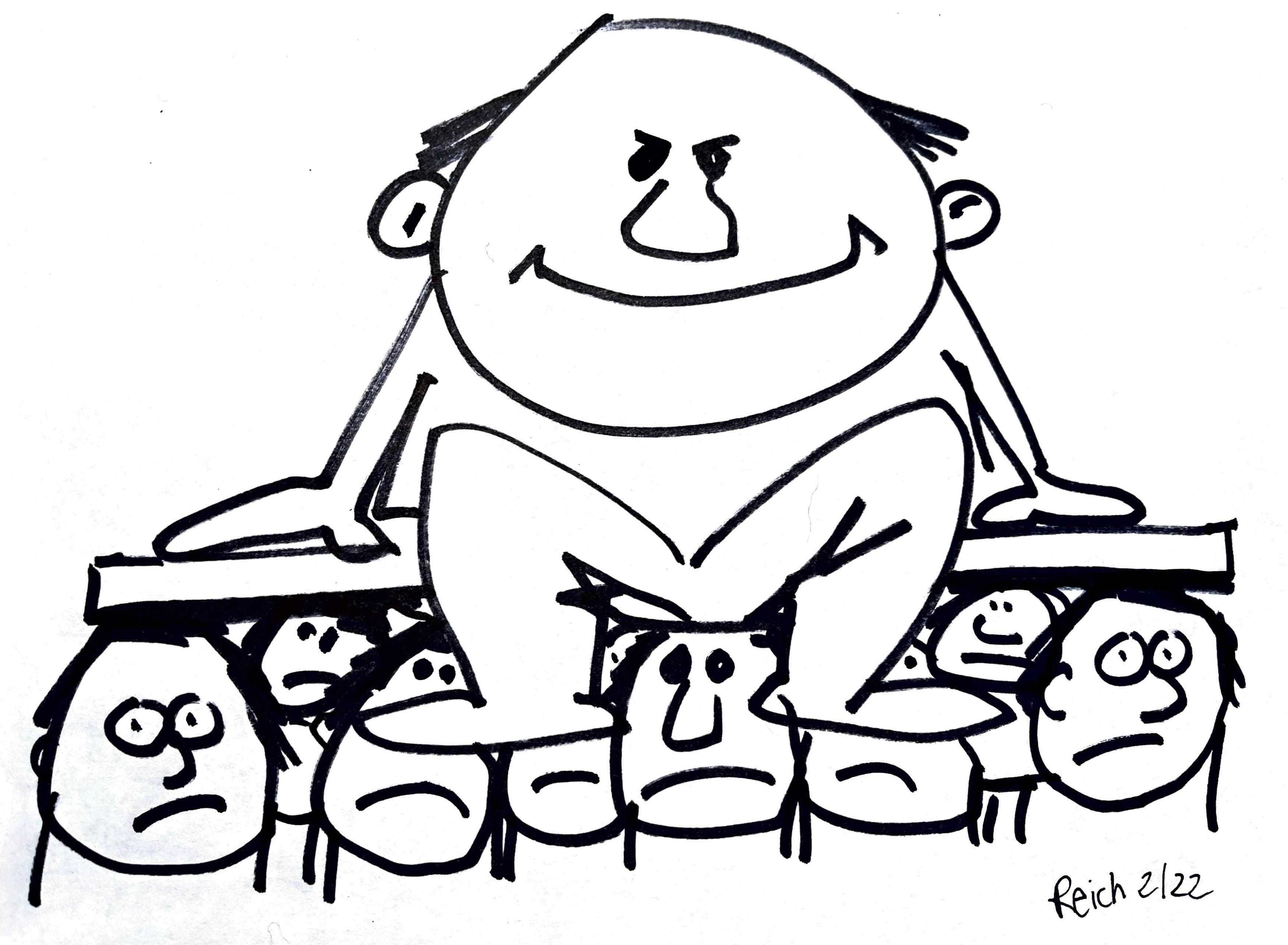
To comprehend the nature of their influence over the system you need to understand the role of wealth. In the system we now have, power and wealth are inseparable. Great wealth flows from great power; great power depends on great wealth. Wealth and power have become one and the same.
I don’t intend for these underlying realities to make you more cynical about the system or resigned to its intransigence. To the contrary, the first step toward changing the system is to understand it.
If we cannot comprehend the truth, we become entrapped in conventional falsehoods and false choices, unable to envision new possibilities. Seeing the system for what it is will empower you to join with others to change it for the better.
Please join me next Friday when I’ll continue this discussion. I look forward to reading your comments.
RR