A Guide to the 5 Proposals on the Back of NYC Ballots
The five questions this year range from what to do with small, publicly-owned properties to how the city should plan for its financial future via the rainy day fund.

Early voting is underway in New York City, which will continue through Sunday, Nov. 1, and residents will have their final opportunity to vote on Election Day Tuesday.
In addition to races for governor, State Senate and State Assembly, the backs of New Yorkers’ ballots will give them a chance to approve or reject several proposed changes to New York City’s Charter.
The five questions this year range from what to do with small, city-owned properties to how the city should plan for its financial future via the rainy day fund.
Several bundle multiple changes into a single question. The Mamdani administration—which convened a Commission on Government Efficiency (COGE) earlier this year to draft the measures—is pushing them as a way to a “faster government” and to remove bureaucratic red tape. But critics have raised concerns with some of the proposals.
City Limits put together this guide detailing each question, which hundreds of thousands of voters have weighed in on already.
Proposal 1: Revocable consents and public space
When a business wants to construct, operate, or maintain “a structure on, over, or under New York City’s public streets and sidewalks,” it needs to have a revocable consent, approved by the city’s Department of Transportation (DOT).
A revocable consent is a permit to use public spaces, such as sidewalks or roadways, for a long list of structures, like accessibility ramps and lifts, benches, utility poles, planters, bike racks or kiosks, the city’s Commission on Government Efficiency (COGE) explained.
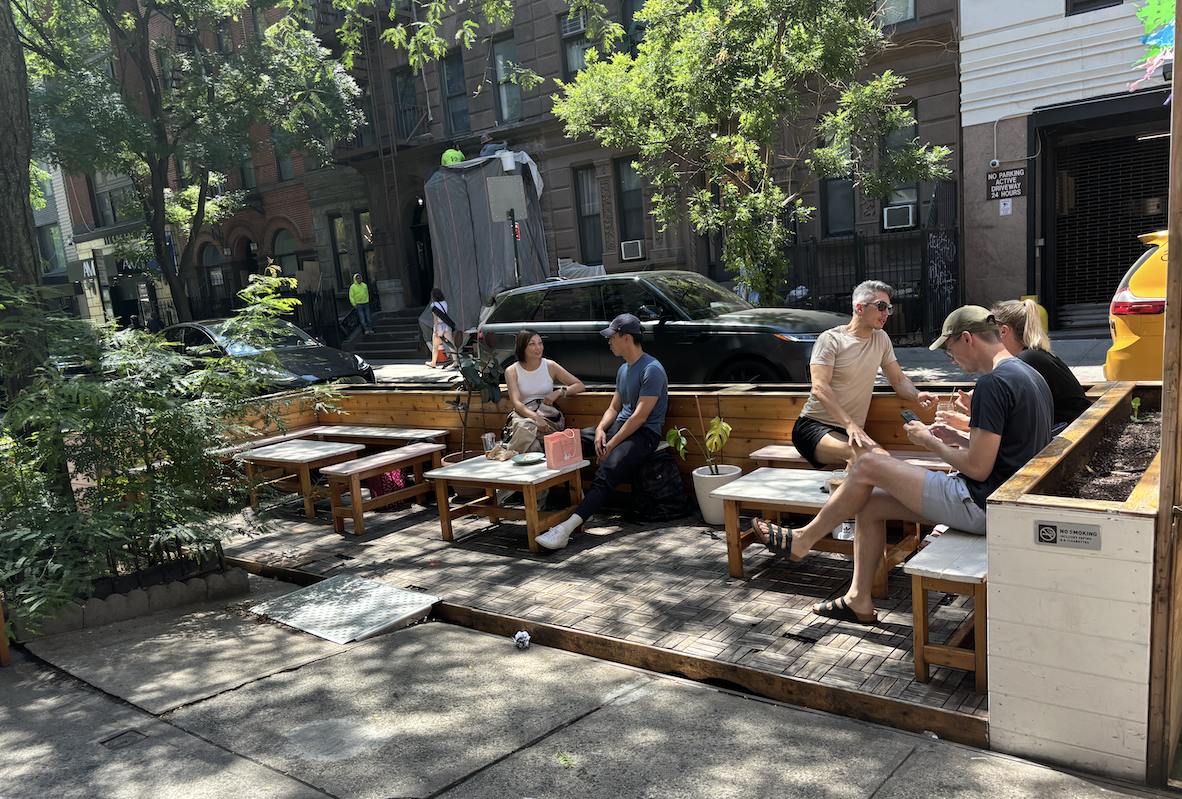
Proposal 1 asks voters if they want to include applications for outdoor dining sheds and sidewalk cafes in the standard revocable-consent process. These currently require a separate, longer approval process with extra steps.
“Restaurants can wait many months, sometimes losing an entire outdoor dining season and the revenue and jobs that come with it,” said Andrew Rigie, executive director of the NYC Hospitality Alliance, a not-for-profit trade association that represents bars and restaurants and supports the ballot measure.
According to COGE, the proposal would replace the required public hearing and newspaper advertisements for revocable consent applications with an online portal, where the public could review and comment on pending applications.
The Center for Independence of the Disabled in New York (CIDNY) and Common Cause New York, a nonprofit watchdog, criticized this element of the plan, saying it comes at the expense of “public participation and legislative oversight.”
But Rigie counters that the streamlined process still preserves “opportunities for community and elected official input,” calling it “a commonsense reform.”
“New York City can protect the public interest while making it easier for neighborhood restaurants to open outdoor cafés and serve their customers,” he said.
Under the proposal, the city could still revoke a permit if it needs to regain the public space. Community boards could still hold hearings, and DOT could decide a hearing is needed when public comments demand it.
“If it passes, it would cut the outdoor dining application process by about 75 percent from eight months to two months, saving small businesses time and money,” COGE’s Executive Director Ann Cheng said.
“It would also cut down the process for building accessible ramps, like ADA accessible ramps, by about two months, and similarly save time and money,” Cheng added.
Proposal 2: Changes to city contracting
Proposal 2 combines several elements. It would authorize the Procurement Policy Board (PPB), which sets rules for city contracting and procurement, to come up with a new pre-contracting form for certain businesses and nonprofits that provide goods and services to city agencies.
It addresses one of the city’s conundrums: that city agencies often find it very difficult to make purchases, while contractors face a complicated system that can cause delays.
The ballot proposal would authorize the PPB to amend the pre-contracting questionnaire—which both small and large companies seeking city contracts must complete, no matter the sum involved in the deal—for efficiency. It would require the board to meet regularly (at least once every three months) to develop the new form.
If this measure passes, PPB could adapt the questionnaire to better reflect the type or size of the contracts in question, COGE explained, and as in any new rule, the public would be able to comment on the proposed changes.
The city estimates that streamlining the questionnaire requirements would save up to 30 days in the contracting process, from its current average of roughly 13 months.
The measure would also reduce the workload for city agencies when it comes to annual reporting requirements on planned client-services contracts.
Instead of having to write a preliminary report, hold a hearing, and then write a final report, as the current process requires, agencies would just issue their reports each year, giving a heads-up to the vendor community about what contracts they plan to issue, the Mayor’s Office of Contract Services explained.
An additional subsegment in this proposal would make permanent a state provision (expected to sunset in 2030) that allows the city to provide online public notice and collect public comments on contracts.
Other provisions would allow the mayor to delegate certain approvals for noncompetitive contracts over $5 million to agencies, with the approval of the agency’s commissioner.
Proposal 3: Street safety projects, city-owned small lots, and office leasing
Proposal 3 combines three different measures: street safety, city-owned property, and office leasing.
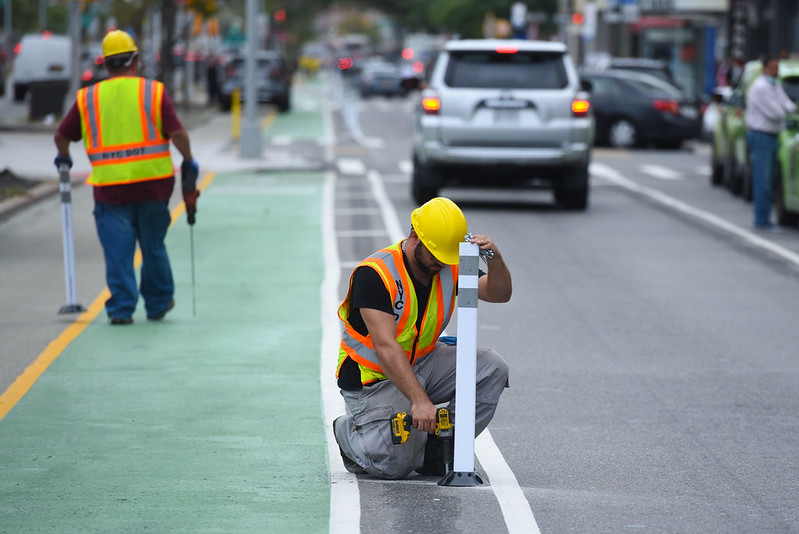
This proposal tries to streamline the city’s process for building new street safety infrastructure, while keeping community input and engagement requirements in place.
Currently, when the Department of Transportation (DOT) is planning “major transportation projects“—like bike and bus lanes that affect four consecutive blocks or 1,000 feet, whichever is less—it is required to consult with four other agencies: the NYPD, Fire Department, Department of Small Business Services, and the Mayor’s Office for People with Disabilities. Certain subunits within those agencies have to sign off on the plans, in very specific ways.
If Proposal 3 passes, DOT would still have to consult with those four agencies, but without the requirement for sub-agencies to weigh in. Instead, it would be up to each agency’s leaders to decide which of their own units or subunits to consult, COGE explained.
The Center for Independence of the Disabled in New York (CIDNY) said they support this ballot proposal, calling it “common-sense efficiency reforms.”
The measure would also allow the DOT to move forward on projects at the same time that it notifies local community boards and elected officials, instead of after, when there’s a situation of immediate need, like street changes made in response to crash and safety data. Supporters say it would protect new bike and bus lane plans from being delayed or blocked by lawsuits, saying opponents often take advantage of mistakes and technical errors in the interagency consultation process to lodge legal challenges.
The city has 1,500 surplus lots, according to the Department of Citywide Administrative Services (DCAS), and City Hall says about 6 percent of them would fall under the 10,000-square-feet category that could be sold.
Under Proposal 3, plans for these lots would no longer undergo the Uniform Land Use Review Procedure (ULURP), the city’s public approval process for certain development projects, and instead go through the new Expedited Land Use Review Procedure (ELURP), which compresses the seven-month review timeline to 90 days.
The Municipal Art Society (MAS) of New York criticized the measure, not only for sausaging “three loosely connected proposals” into one ballot question, but because they say it fails to address “two of the city’s essential needs: open space and affordable housing.”
“New York City’s public land is one of its most valuable—and finite—resources,” MAS Communication Manager Viviane Eng said via email sent to City Limits. “Once sold or transferred, it can be difficult or impossible to reclaim. Decisions about its future must be guided by a comprehensive, long-term vision for the public good, not simply by short-term revenue opportunities.”
A spokesperson for COGE, Jimmy Wyderko, said the proposal would still maintain two key steps of the process for selling city-owned land. The “proposal does not change the public auction requirement nor the land use requirements on the new purchaser (i.e., if the new purchaser wants to build something beyond as-of-right, they would need to go through a ULURP),” Wyderko said in an email.
Marcel Negret, Regional Plan Association’s director of land, said the current rules make these small lots less attractive to potential developers, at a time when the city is trying to facilitate as many new apartments as possible to address the housing shortage. “One way to look at it is like putting them [these lots] in a better market position,” Negret said.
COGE officials said the measure would reduce the administrative burden to sell small lots.
Another part of this ballot proposal would remove City Council and the City Planning Commission approvals when the city leases office space for government employees. Currently, the city notifies the local community board and the borough president about such leases, followed by a public hearing and a vote at the City Planning Commission, and then the City Council.
Instead, the Department of Citywide Administrative Services commissioner would provide the community board, local council member, and borough president with a notice of intent to acquire the new office space ahead of time. Then the city would need to notify the Council and comptroller.
Proposal 4: Moving waterfront permitting and building permitting
Proposal 4 would create a one-stop, centralized online construction permitting hub, overseen by the Department of Buildings (DOB), for applicants looking to do construction on an apartment or storefront, or to build affordable housing. COGE says this would give applicants an easier route to getting construction permits than the current process, which requires the involvement of dozens of different city agencies.
The DOB would have until 2030 to get the hub running. If passed by voters, it would also allow additional DOB staff to approve certificates of occupancy.
Another point of this proposal would transfer responsibility for waterfront construction permits from the Department of Small Business Services to the Department of Buildings, where the expertise lies, officials and advocates explained.
“Right now, the process can be confusing,” said Tyler Taba, Waterfront Alliance director of policy and government affairs. “Moving that responsibility to DOB is a practical step toward reducing confusion, delays, and unnecessary costs for waterfront projects.”
Proposal 5: Setting a goal for the city’s rainy-day fund
Through a 2019 ballot proposal, New Yorkers took the first steps toward creating a “rainy day” fund to help the city fill budget gaps during economic downturns.
The city’s existing fund, formally known as the Revenue Stabilization Fund, has nearly $1.7 billion in it. But there are no specific goals for how much the city should be saving with it.
If Proposal 5 is approved, the city would set a savings target for the fund at 12 percent of prior-year tax revenue. But that doesn’t mean the city will contribute that 12 percent all at once: the Office of Management and Budget (OMB), in consultation with the comptroller and the public, would be required to develop a plan by May 2027 that would outline when the city needs to contribute and if so, how much in a given year.
The city will contribute every year as long as that criteria is met, until the 12 percent threshold is reached. Once it hits that goal, the city no longer has to contribute to the fund, but still could if officials choose to. “That is like the city’s savings account, and so it would establish a target of 12 percent of the city’s prior year tax revenue, in order to work towards long-term fiscal stability,” Cheng said.
Good government groups like Reinvent Albany and The Citizens Budget Commission (CBC) are urging people to vote “no,” on Proposal 5, saying it doesn’t do enough to force the city to beef up its financial reserves.
“Voting no on Proposal 5 does not oppose strengthening the Rainy Day Fund. It is a vote declaring the status quo is not good enough, and the city should do better,” CBC President Andrew Rein wrote in an Op-Ed in October.
Comptroller Mark Levine’s office put out a report in April suggesting that a 16 percent reserves target would suffice to help the city weather an “entire below-trend period” like a recession.
You can read the five ballot proposals in full here.
To reach the reporter behind this story, contact Daniel@citylimits.org. To reach the editor, contact Jeanmarie@citylimits.org
Want to republish this story? Find City Limits’ reprint policy here.
The post A Guide to the 5 Proposals on the Back of NYC Ballots appeared first on City Limits.
Check this story
Ask the guide
The guide explains what to check and where. It cannot see this article or recent news.
Is this AI-made?
AI checkers give a likelihood, not proof.