Dolores Huerta’s luminous story, told through a prism of performers
Nobody would ever say that Oakland Theater Project lacks ambition or courage. The stalwart initiative was founded in 2012 under the name of the Ubuntu Theater Project thanks to co-founders Michael Socrates Moran, William Hodgson, and Colin Mandlin. They envisioned a radically inclusive company that brought experienced and novice actors together on the same stage to present fully produced classic and contemporary works.
In the early days, the project offered pay-what-you-can pricing and performed in unconventional public spaces: a city salvage yard, an auto machine shop, unheated church rooms, an active airplane hangar, and more.
In the 2020s, the company changed its name to its current moniker, mounted fuller seasons, and established a permanent home in downtown Oakland. It chose a converted loading dock in the Flax Art & Design building at 1501 Martin Luther King Jr. Way, where She Se Puede (A Chorus of Huertas) will make its world premiere Fri/20 through December 6, closing out OTP’s 2026 season.
True to the company’s traditions, its new play written by co-artistic director Lisa Ramirez and directed by Karina Gutiérrez brazenly dares to tell the life story of the late American labor leader and feminist activist Dolores Huerta. The co-founder of the United Farm Workers of America, who advocated for decades for migrants, the economically marginalized, and women, died on October 28 at age 96.
Ramirez has titled the work with a twist on Huerta’s famous call “Sí, se puede,” which became a multipurpose rallying cry for countless civil rights, labor, and political movements. In the telling of the monumental story of Huerta’s life and legacy, Ramirez wisely avoids presenting a linear, chronological recap of history. Instead, the new play is what OTP describes as “a theatrical poem for multiple voices.”
In an interview, director Gutiérrez says the six women cast to portray Huerta are like a collective voice, each carrying a facet of Huerta. “The eldest is the constant who sometimes joins in the chorus. The others float in and out and play different characters. Among the chorus, we represent the youngest Dolores, prior to becoming a teacher; the Dolores teacher who sees inequities firsthand when children come to school without shoes and unfed; we have the activist at early age, then Dolores in her forties and fifties, then Dolores at 96. Those are the snapshots we see.”
Gutiérrez says the six-member chorus is composed of “brilliant Latiné actors” whose age range from twenty-to-sixty-something, who bring their individual identities and lived experiences and activism to the play. “You can’t divorce the body from the work,” she says. “There’s a Dolores in all of us.”
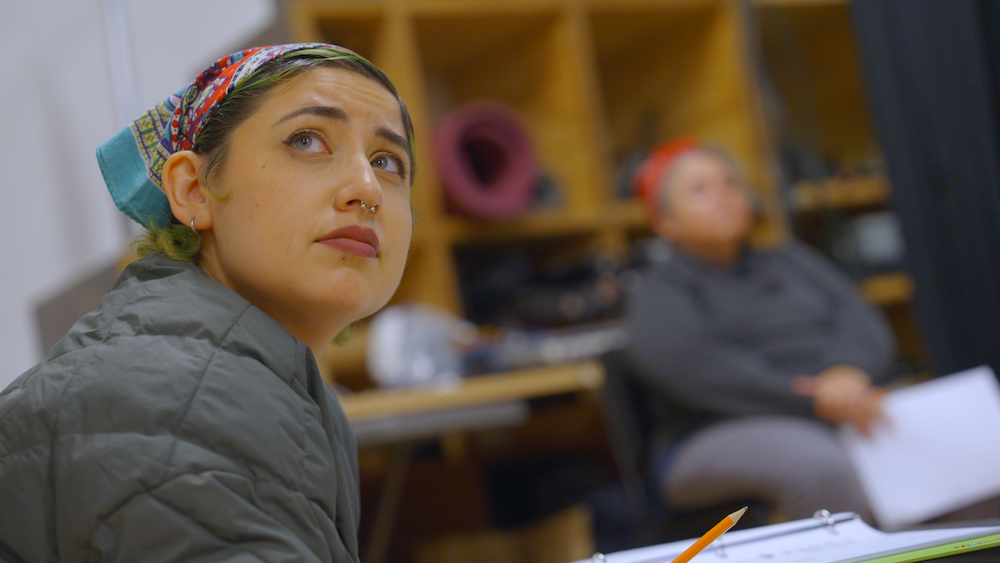
“We talk about how the more things change, the more they stay the same,” Guitiérrez continues. “We’re approaching this looking forward, through the lens of a younger generation. The anger, the fervor, the hunger to make things right looks different as much as it overlaps with Dolores’ time. It’s exciting and it’s vital we have intergenerational conversations.”
Shaping the women’s individual voices into cohesive expression for the 90-minute memory play relies in no small part on the language of bodies in motion. The series of vignette-style scenes forms a roadmap, and its rate of travel reflects the rhythms of bodies laboring during a harvest. This means its action can be fast-paced and exhilarating, but also heavily weighted and slowed by the exhaustion of working 12-hour shifts in agricultural fields.
“When you see the body in labor, you see a dance,” says Gutiérrez. “You hear the breath sounds of bodies working. The actors move literal earth—yes, there’s soil on stage. It’s important for audiences to see not just labor stories of unsung heroes, but also the labor of creating theater. The laboring body is the constant for migrant workers who follow seasonal cycles.”
It almost goes without saying that this new OTP production comes at a perilous time. People are already feeling the loss of leadership brought by Huerta’s recent death. The emotional ante is upped by public debates raging around immigration, economic inequity, and racial parity in theater.
“All art is political,” Gutiérrez says. “The polemics are inherent in this show. Dolores Huerta comes with politics. And the show centralizes bodies of color. Even in 2026, we don’t do it enough in American theater, and so it’s a political act. We don’t shy away from problems here. In theater, we statistically don’t feature bodies of color versus cis white bodies on stage. That we have five femme-identity characters of color is amazing.”
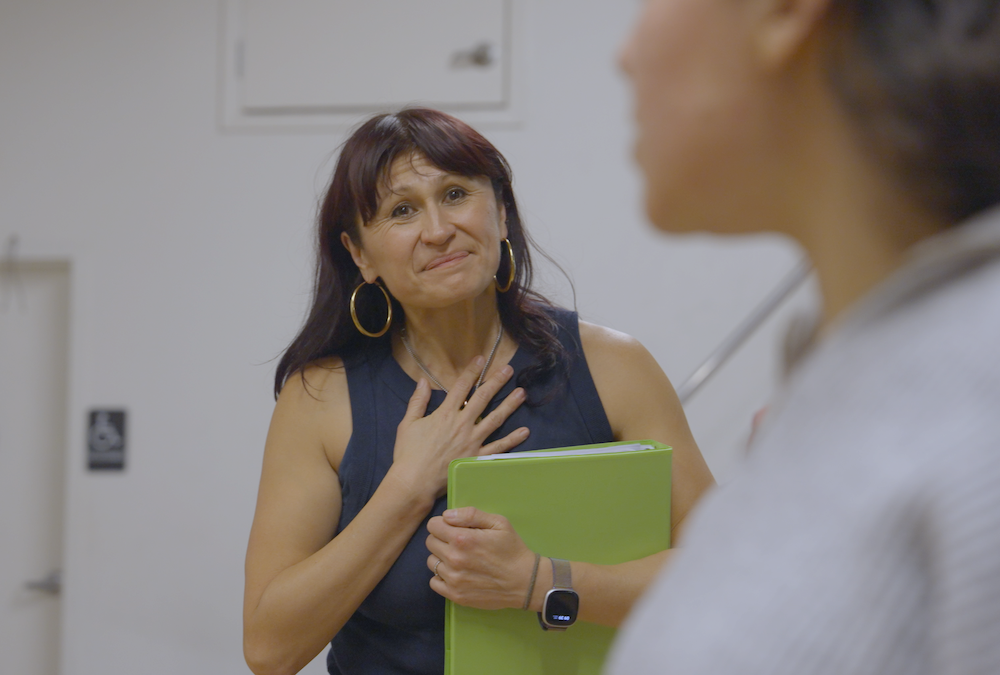
Rehearsals began with the cast building what their director refers to as “building a community altar.” The process reminds everyone that the work they do is a thing larger than themselves.
“Dolores is a part of that,” the director says. “We remember who we’re doing this for. She is no longer with us, and at the same time, her life and legacy remain. She’s not completely gone. She left us words to learn from and good deeds and actions. And like any human being, she left us complications to disentangle.”
While tracing Huerta’s life, Gutiérrez’s appreciation for the leader’s ability to change has increased. “She shows us it’s positive to learn, integrate new knowledge, and adapt. I think she felt a responsibility as an iconic leader to change, and she did so. Recent complications of her life are yet unresolved, but because of that we’re allowed to come into a space of self-reflection. This show doesn’t answer every question, nor should it. If you can hold onto the complicated questions and visceral joy you experience in a theater piece, then it’s done its job,”
For OTP to do its job, it must continue to be ambitious and courageous. Its recent announcement of plans to leave the Flax and establish a new home in a building that formerly housed The New Parish and Sweet Jimmie’s in Oakland’s Uptown Arts and Entertainment District leaves little doubt that it is staying on mission. When completed, the renovation project will be the permanent home for OTP and also, a community performance center offering affordable professional performance, rehearsal, and creative space for local musicians and arts organizations.
The move comes with various associated bells and whistles, such as partnerships with other organizations, and a lease with an option to purchase the building. OTP leaders say they plan to make the purchase of the new building a reality by the end of 2027.
SHE SE PUEDE (A CHORUS OF HUERTAS) Fri/20 through December 6, Oakland Theater Project. Tickets and more info here.
The post Dolores Huerta’s luminous story, told through a prism of performers appeared first on 48 hills.
Check this story
Ask the AI guide
The guide explains what to check and where. It cannot see this article or recent news.
Is this AI-made?
AI checkers give a likelihood, not proof.