Devices aren’t lasting as long as they should. Here’s why

Is your new phone already slowing down or your expensive earphones acting up?
You’re not imagining it. Our products are no longer designed to last, with some barely working a few years before ending up in landfill.
Shortening the lifespan of a product is a strategy known as planned obsolescence.
My new research takes a closer look at this concept and argues that, by strengthening existing laws, it is possible to make products that last while reducing costs for consumers and the environment.
Ladislav Kubeš/Getty
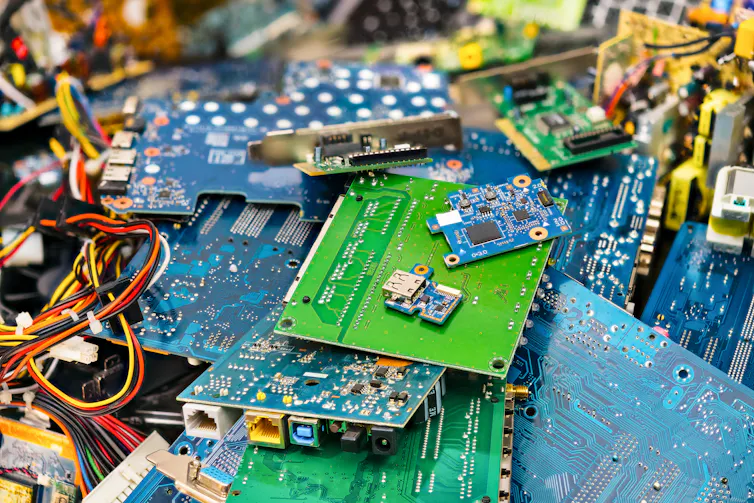
Mountains of e-waste
Modern devices like laptops and smartwatches are made of a combination of rare materials, toxic substances and flammable batteries, such as mercury and arsenic. When released into the environment, these toxic chemicals can pollute the soil and waterways.
This should make us think twice about throwing out broken devices. Yet, Australians produce almost three times the global average of electronic waste, known as e-waste. Globally, we generated 62 million tonnes of e-waste by 2022. That amount could fill more than one million trucks, about enough to wrap around the earth’s equator. E-waste worldwide is set to rise by another 32%, reaching 82 million tonnes by 2030.
In Australia, reducing waste must be a priority if we’re to meet our net zero goal and transition to a circular economy, where our belongings are reused, repaired or recycled instead of piling up in landfill.
Read more:
Humans generate 62 million tonnes of e-waste each year. Here’s what happens when it’s recycled
Faulty by design
Planned obsolescence is one way technology companies pull people into a loop of constant consumption. When our new device quickly breaks, we simply buy a new one.
But planned obsolescence is one problem with many facets.
For starters, companies can design products that aren’t sustainable. Think wireless earphones with batteries that quickly break down. Their design can make it very difficult to replace the battery, making them “disposable gadgets” once they’re unable to hold a charge.
Manufacturers may also make it harder to repair their products. For instance, parts of a device can be glued together so it can’t be taken apart and repaired. What’s more, some companies require a repairer to be “authorised” to get access to the parts, software locks or information needed to repair a specific product. You can try and fix a device yourself, but repair manuals can be subject to copyright and manufacturers may prevent third parties from sharing them online.
Beyond the actual product, there’s the behavioural side of planned obsolescence. Technology companies regularly update models so your current device quickly looks out of date, a strategy known as psychological obsolescence. Companies use advertising to convince you to buy their latest product and market newer devices as status symbols, such as a smartphone with accessories that are only compatible with the “new generation” of phones.
Read more:
Sustainable shopping: if you really, truly need a new phone, buy one with replaceable parts
A systemic problem
Planned obsolescence is typically viewed as a company strategy.
In Europe, consumer associations launched a complaint against Nintendo for premature obsolescence, claiming its Nintendo Switch controllers were quickly becoming unresponsive. After the European Commission and other authorities contacted Nintendo, the company agreed to offer free repairs.
The federal court of Australia ordered Apple to pay A$9 million for making false or misleading representations to iPhone users affected by a software fault about their rights to have their device repaired or replaced under the Australian Consumer Law. These rights don’t simply stop applying because your phone has been repaired by a third party.
But planned obsolescence is not necessarily the fault of any one person or company. Rather, it’s the result of our current produce-and-consume system. Fixing such a complex, systemic problem will require intervention from various sectors, including product design, consumer law, competition law and intellectual property law.
We must also factor in consumer behaviour. After all, it’s ultimately the consumer who decides whether a broken product goes to a repair shop, in the junk drawer or straight in the bin. But consumers can’t always make an informed decision. For example, a person may be forced to replace a product because they can’t afford to repair it.
Read more:
Inside the new repairability scores for smartphones and tablets in the EU
So, what can we do about it?
Stronger laws are key to ensuring products last. However, it’s difficult to change legislation. What’s more, lawmakers often fail to recognise the many aspects of planned obsolescence.
Consider Australia’s first right to repair law. This legislation aims to help people repair their vehicles more easily and at a lower price. This is a win for motorists, who would otherwise be forced to go to authorised dealerships.
The government recently asked for public feedback on whether the law should be expanded to agricultural machinery. But there has been no discussion about repairing devices and other everyday products. Importantly, this law doesn’t address what happens to products that simply can’t be fixed or help consumers tell if a product can be repaired before they buy it.
The European Union has made some progress. New rules aim at making all products placed on the EU market sustainable by design. It has also introduced a right to repair law with stronger rules around certain electronics, including mobile phones and washing machines, and a reparability score to help consumers choose fixable products.
We know our devices don’t last forever. But too often they break down in a few short years or even months, leaving consumers with little choice but to throw them away. It’s time Australia tightened its laws around planned obsolescence – for the sake of people’s hip pockets and the planet.

Margherita Feleppa is a lecturer at the University of Wollongong. This article is based on Margherita’s recent paper, which builds on her PhD research. Her PhD was the result of a collaborative research program between the University of Roma Tre and the University of Technology Sydney. She received a European Union-linked PhD scholarship for the promotion of green objectives.
Check this story
Ask the guide
The guide explains what to check and where. It cannot see this article or recent news.
Is this AI-made?
AI checkers give a likelihood, not proof.