Jim Hightower’s Revenge? A Long-Shot Bid Could Restore Left Populism to the Agriculture Commissioner’s Office.
There used to be a sense among Republicans that they needed to keep up some semblance of looking out for the public interest.
That’s all fallen by the wayside with our “weaving” president, who recently had a message for the nation as data center outrage grows: Sit back and “let Data Reign.” That probably isn’t a winning GOP message when data center backlash has reached a fever pitch. In fact, the anger over the AI-related buildout has even gotten Governor Greg Abbott to scramble to reinvent himself on the issue. Whether or not a critical mass of rock-ribbed Republican voters will break ranks is an open question, but, if so, Democrat Clayton Tucker, who has made opposition to data centers perhaps the core plank of his run this year for agriculture commissioner, will be happy to collect.
In late September, Abbott ordered the Texas Commission on Environmental Quality (TCEQ) to pause all data center permits to align with his earlier announcement of a statewide moratorium. It should be a pretty embarrassing pivot from the governor who just last year bragged about Texas becoming the “epicenter of AI development.”
While much of the Texas GOP is trying to redefine itself, the populist Democrat candidate for ag commissioner, Tucker, has built his campaign around the data center issue, taking an expansive view of the Ag commish position. As the AI backlash boils over, it could prove to have been a smart bet. In politics, you reap what you sow, and favorable conditions may be leading democrats to quite the fall harvest.
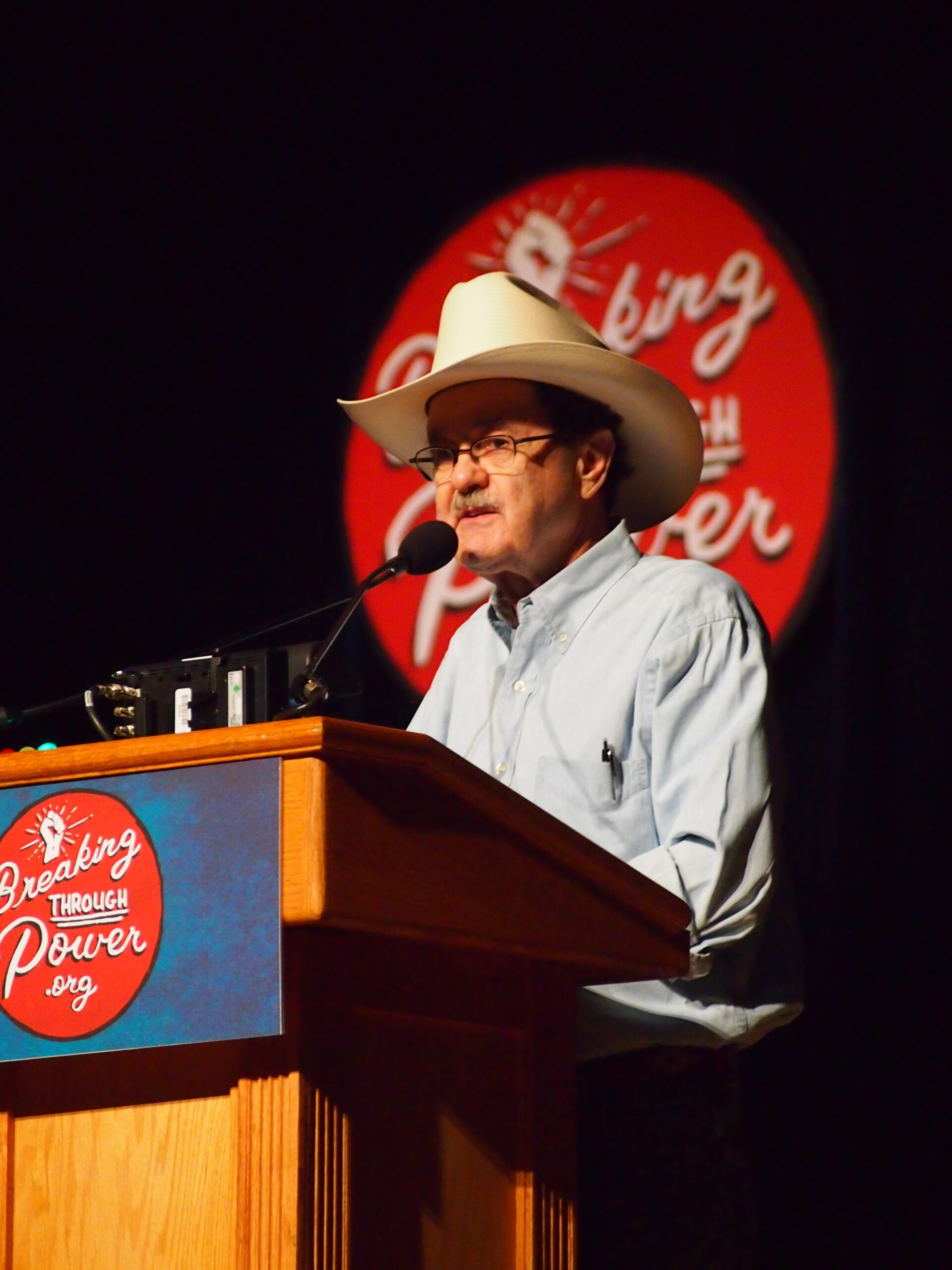
Clayton Tucker describes himself as a populist, and it’s fitting on two counts. One, he is a protégé of Jim Hightower, the agriculture commissioner himself from 1983 to 1991 (who was ousted by an up-and-coming Rick Perry as the GOP’s takeover of the state advanced). A former Texas Observer editor, Hightower to this day is armed with a voice and manner so distinctly Texan you can hear the cowboy hat, and he helped define a short-lived period of hopeful progressive populism in Texas. Tucker is also from Lampasas, the humble birthplace of the Farmers Alliance, founded in 1877, that Hightower drew inspiration from. Not that lineage means anything on its own.
Populism is probably one of the most abused words in politics today, describing everything from Bernie Sanders to Donald Trump. But populism is more than rhetoric or an us-versus-them style. It’s a movement that deeply shaped Texas politics. With the populist People’s Party becoming the second major party in Texas in the 1890s, it sent a host of sun-battered everyday people to Austin and fought against the corporate takeover of the state. This real populism was deeply rooted in the lives of its members, who’d attend regular meetings, read movement papers, and gather in the summer in the hundreds to debate and celebrate. It was not a top-down movement of demagogues, but bottom-up in a way that very rarely happens. In a world of camera-ready celebrity politicians who promise so much but deliver so little, we could do with a lot more true populism today.
Those who take a literal view of the ag commissioner’s role may scratch their heads looking at Tucker’s major planks. His issues page lists everything from water access and food affordability to Flock cameras and data centers. In defense of this wide view of the office, Tucker has noted the importance of the office’s role as a voice for rural Texas and pledged to use “the power of the bully pulpit to help locals organize.” In this, he might be taking a page from his mentor, Hightower, who, when running in 1982, noted this view of the office: “I’m a populist, and I believe we’re being screwed by the big boys. … This office has the power to do something—a fleet of cars and planes, large staff, a daily radio show, field offices. It provides a forum.”
The commissioner race pits Tucker against Nate Sheets, a well-funded honey dealer and connected Republican. You’d be hard-pressed to draw up a storm more perfect for Democrats, both in this race and generally this year, to take the advantage back from Republicans. A self-inflicted economic disaster caused by the unpopular and unasked-for war in Iran has exploded the cost of living nationally, with farmers facing high costs on everything from fertilizer to diesel to electricity, leading many to turn to bank loans to get through the year. Speaking of bloodsuckers, the New World Screwworm, a nasty critter that burrows into open wounds to live and breed, nearly half a century since it was eradicated, is at large in Texas, jumping from cattle to horses. There’s plenty to be up in arms about.
In the GOP primary, Nate Sheets beat out the incumbent commissioner Sid Miller, an eccentric figure and rival of Abbott, who backed Sheets. The bad blood hasn’t subsided: The lame-duck Miller, never one to keep quiet, has decried the Republican Party regarding everything from the screwworm to beef to data centers.
On the Big Data question, Miller has surprisingly found common cause with Tucker, appearing with him at a June forum in Matagorda County. He recently told The Source, “I think we could possibly lose some statewide races as Republicans,” adding, “we’re on the wrong side of this data center issue.”
If you follow Clayton Tucker’s social media, you’ll see plenty of evidence of the frustration in rural America over the AI boom playing out in their backyards, with packed rooms roaring with anger over these developments. A Texas Politics Project poll claims 60 percent of rural Texans oppose data centers in their communities. The outrage is in stark contrast to the welcome mat that Texas Republicans gave to the industry.
The issue is tricky for Republicans following years of the GOP centralizing so much power in Austin. The Legislature has passed a host of laws that restrict local governments from passing environmental regulations and labor protections.The so-called “right to farm” law, from 2023, is in practice set up to prevent localities from regulating Big Ag. The Texas GOP has fully embraced a plan to centralize as much power as possible in Austin.
This means even if the GOP wants to change course, they’ve created a legal and political web that makes empowering communities to regulate data centers difficult. And that isn’t even mentioning the general timidity toward taking on the well-funded industry. When Hood County and San Marcos enacted data center bans, Texas GOP Senator Bettencourt challenged them, claiming they were in conflict with state preemption laws.
While data centers have unexpectedly taken a front-and-center role in the campaign, agriculture issues still appear. Tucker points to the 30-year-old North American Free Trade Agreement for hollowing out Texas farming and opening the door for rapid monopolization. Talking about monopolization is where Clayton Tucker’s populist heritage comes through most clearly. Writing on X, Tucker notes the similarities between our time and the Gilded Age: “Today’s monopolists hide behind shell companies and corporate paperwork, but the game hasn’t changed.” The campaign even sells “Bust Monopolies” stickers.
The influence doesn’t stop there. While populism is often boiled down to a few major policies—anti-monopoly, free silver, regulation of the railroads—it was always more than policy. It historically connected frustrations with a larger critique of the economic system that was leaving most Texans behind and the culture of corruption of the major “interests.”
Tucker’s planks may seem disparate and even beyond the purview of the office he seeks, encompassing everything from soil health, which is certainly under the Ag commish mandate, to Flock cameras, which is not really. But throughout all these positions is a damning portrait of a democracy that isn’t working for working people—and a call for everyday people to reclaim the power. This is the heart of the populist appeal.
Still, some of the arguments Tucker’s campaign makes walk the line between conspiratorial or, at the very least, dubious. One alarming claim on his website about Flock cameras connecting to personal phones through Bluetooth cites only a Reddit video posted on r/diabetes as evidence. Even anti-Flock activists have called this out as false. And the site’s stated opposition to proposed 765-kilovolt transmission lines in Texas lines warns misleadingly plays up the threat of “electromagnetic radiation.” Outrage around both these topics is palpable: Abbott yanked state funding for the cameras, leading to some of the dystopian surveillance system being unplugged, and the proposed transmission line buildout is strongly opposed by rural landowners, including country star Tanya Tucker.
These embellishments, on the other hand, may be little compared to Sheets’ platform, which includes paeans to the 2nd Amendment and anti-abortion politics and dedicates an entire section to confronting Chinese “agro-terrorism.”
When Jim Hightower announced in 1982 that he was running for Ag commissioner in the pages of the Observer, he reminded readers, “there’s a lot more to being agriculture commissioner than sticking a straw in your mouth and humming, ‘Thank God I’m a country boy,’ but that’s about all the people of this state have had for the past few years.” Hightower revolutionized the office, using it to promote workers’ rights, cooperatives, and organic farming. He also tried to rebuild populist politics through his personality and organizations like the New Populist Forum.
There are plenty of similarities between Hightower and his would-be successor, though two operate in radically different times. When Hightower was first running, a New Deal and Great Society coalition and historic remnants of populism, still existed. Though limited, Hightower was attempting to rekindle those ashes. In our time, that ember has gone out. Tucker is in the difficult position of trying to both create and mobilize a populist coalition at the same time. The fact that someone is trying, and seriously threatening the Republicans, is an encouraging sign that there is still life in this idea long thought dead.
One thing missing from Tucker’s campaign, when compared to the historic populists and even Jim Hightower’s campaign, is farmworkers. To be fair, Tucker uses the term working-class, and often in contrast to the monopolists and big Tech. But for someone whose platform includes so much, it is glaring that farmworkers—not small farmers, but those employed for a wage—are less of a focus. While Texas does have a fair amount of small family farms, most do not actually subsist on farming. Farmworkers, on the other hand, are the backbone of Texas’ agricultural economy, and they face abuse on everything from stolen wages to worker protections to profiling. While the ag commissioner can be no stand-in for the Texas Workforce Commission, it does oversee protections for these workers, and they are as worthy of a voice and of the “bully pulpit” as any other. Between the official positions of the Texas Farmers Union, which Tucker is the secretary of, and his association with Hightower, there’s plenty to show where a Tucker ag department might stand, but there is a missed opportunity to highlight and champion the needs of the people who feed us.
Going into November, Texas has a real chance to do something that hasn’t been done in a long while. And, with a win, populism has a chance to return to its roots.
The post Jim Hightower’s Revenge? A Long-Shot Bid Could Restore Left Populism to the Agriculture Commissioner’s Office. appeared first on The Texas Observer.
Check this story
Is this AI-made?
AI checkers give a likelihood, not proof.