‘American Doctor’: Racing against death and dehumanization in Gaza
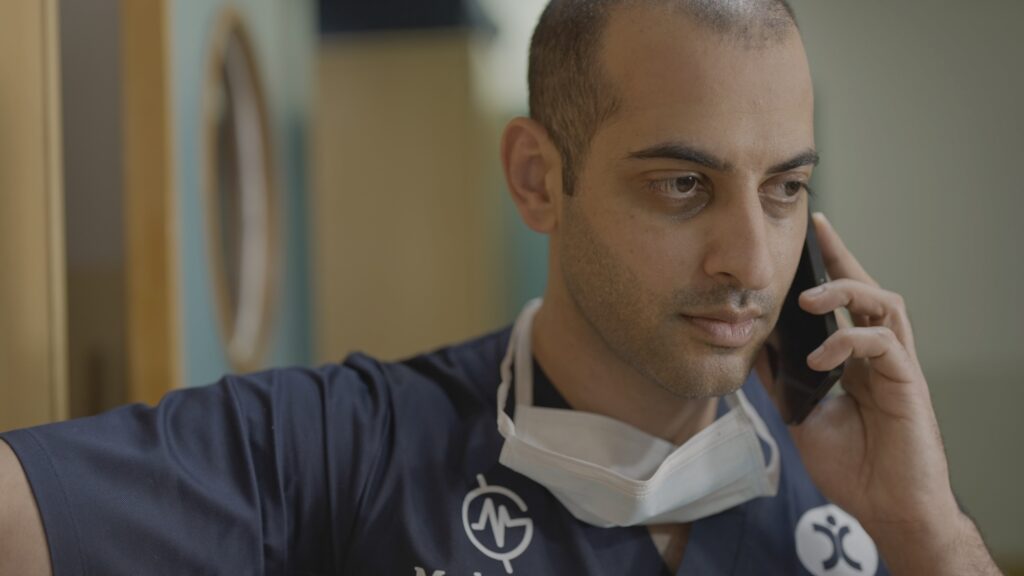
When Dr. Thaer Ahmad, a Chicago emergency room physician, started working with director Poh Si Teng as one of the subjects of her documentary American Doctor, he noticed the difference in her approach to his work compared to other journalists he had encountered.
The Cook County native volunteers his skills in high-conflict zones, including Gaza, Lebanon, and Syria. He is also a professor and a board member of the Palestinian American Medical Association. He’s used to talking to the news media in soundbites. “They’ve got to get that 30 seconds of, like, a Palestinian in Chicago, because it’s the largest diaspora,” Ahmad said during a visit to San Francisco with Teng where American Doctor screened during the SFFILM Festival.
But Teng was different. Her documentary’s focus is on the work of American doctors risking their lives and volunteering their time in Gaza during Israel’s bombardment, a group that includes Ahmad, Jewish hand surgeon Dr. Mark Perlmutter, and Zoroastrian trauma surgeon Dr. Feroze Sidwa. But she’s not just interested in their work, but also in who they are when they aren’t putting it all on the line.
In Ahmad’s case, that meant capturing him at the mosque, at a public speaking engagement talking to members of the diaspora, and even following him home, observing him with his wife and young daughters. “I didn’t want to intrude,” said Teng. “But at the same time, I just realized that, if we were going to get people to relate to it in a very real way, we had to show what a Palestinian American family in that diaspora was going through.”
The path to American Doctor did not begin with doctors. One of Teng’s first jobs was as a cameraperson for the Associated Press, and she also worked for a time as a documentary commissioner for Al Jazeera English. She has what she describes as a “soft spot” for camera people. It was the early days of the war in Gaza, just over two months after the Hamas attack on Israel, igniting an Israeli response of relentless assaults. Samer Abu Daqqa, an Al Jazeera camera person, was killed in a drone strike.
“Back then, people were still speaking in hushed tones about the targeted assassination of journalists because they were Palestinian, and that hurt a lot,” said Teng.
Daqqa’s death inspired Teng to want to make a documentary, but what cemented her subject was seeing Perlmutter interviewed on television. The reporter asked him why he thought there was no ceasefire in Gaza, and the doctor let fly with his moral diagnosis. His frankness was striking, leading Teng to seek him out. It wasn’t long before he introduced her to Ahmad and Sidwa. She was struck by the differences between the three of them.
“It just got me thinking, how do people who seemingly are so different, how are they able to work together?”
That was the start of American Doctor. Ahmad remembers his wariness when Teng first approached him about the project. “I was skeptical that something like this could transcend the existing barriers that were in place for a lot longer than October 2023,” he said. “I think that’s the mentality of the diaspora community here in the United States. Rarely are you going to get any real airtime to be able to talk about what’s going on and conditions on the ground.
“But I think one thing, after having been on the ground and coming back, I think all of us are in agreement that you have to try everything. So, even if you don’t think there’s a chance that something like this could reach broader audiences—I wouldn’t be able to sleep at if we didn’t at least try everything we could.”
Early in American Doctor, Teng debates whether a particularly gruesome image should be included in the film. Perlmutter argues that she needs to include it. The image is awful, but essential. From those opening frames, the tone of the documentary is set that this is a film that doesn’t hold back. And it doesn’t. When so much of even news footage is bowdlerized in day-to-day news reporting, the story Teng relates is striking.
That was important to her. When she came to the United States from Malaysia to study journalism at San Francisco State, she was leaving a country where the media was heavily censored for one with the promise of a free press. But as she worked in various newsrooms, she realized how often media outlets practice self-censorship, especially when it comes to hot-button topics like Gaza. That, too, is a thread in American Doctor.
“When it comes to certain topics, something’s got their tongues,” Teng said. “I’ve seen Gaza, the West Bank, Palestine and Palestinians, even the diaspora, and how it’s heavily censored. And that’s why it’s part of the film.”
“This is something that’s been in place, this sort of dehumanization that exists,” adds Ahmad. “It’s also about keeping things short, keeping things superficial, not really addressing the core issue of it all.
“I think this is what this film can do for everyday folks. It’s like, can you be able to recognize it now? And all you can ask for is to keep people informed and to be able to recognize when you see somebody doing that.”
AMERICAN DOCTOR opens in Bay Area theaters on Fri/28. More info here.
The post ‘American Doctor’: Racing against death and dehumanization in Gaza appeared first on 48 hills.
Check this story
Ask the guide
The guide explains what to check and where. It cannot see this article or recent news.
Is this AI-made?
AI checkers give a likelihood, not proof.