Corporate America EXPOSED! (In the most unlikely place)
Friends,
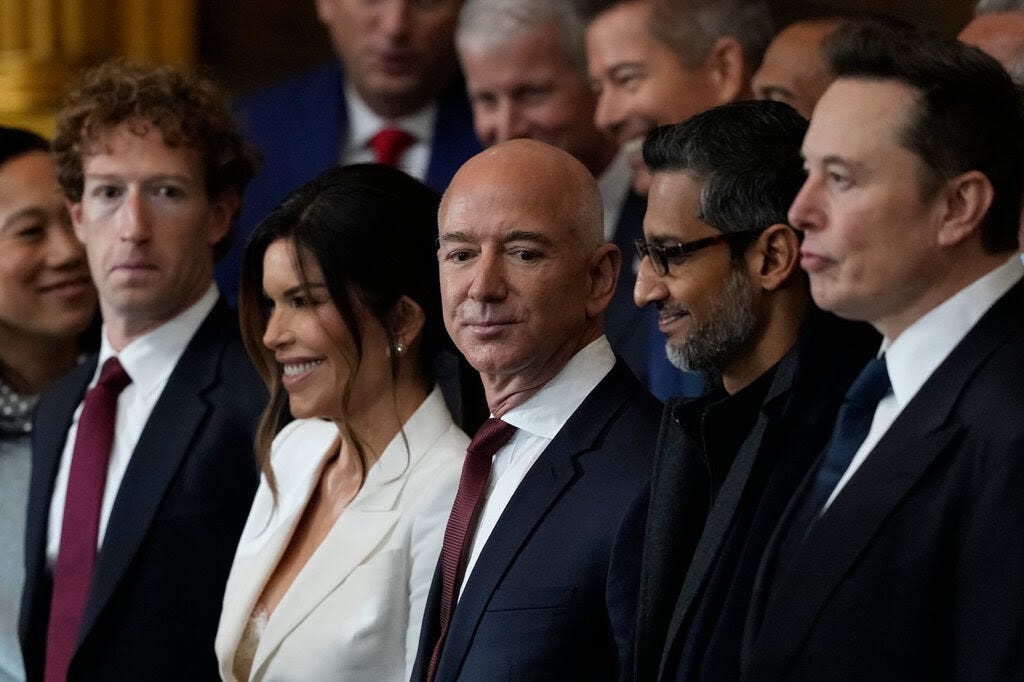
As I mentioned in yesterday’s post, the only good thing to come out of the catastrophe of Trump is the exposure of the greed, venality, cupidity, and corruption of America’s corporate elite.
By giving CEOs of giant corporations and the titans of Wall Street free rein to do whatever they want — as long as they suck up to Trump — plus all sorts of added corporate welfare to those who richly bribe him, Trump has unveiled a truth that the captains of industry have long tried to suppress: that they’re willing to throw average working Americans under the bus to make more billions.
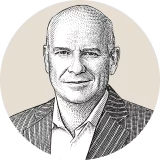
Don’t just take my word for it. I want to introduce you to Gerard Baker, editor-at-large of The Wall Street Journal, who used to be Editor-in-Chief of that distinguished old rag. I have read Baker for years, during which time he has predictably and defiantly extolled the wonders of American capitalism.
But in a recent editorial, Baker says something quite different and remarkable, at least for the editorial pages of the Journal. Although his sympathies most assuredly do not lie with socialism (which he opines is “always and everywhere a disaster”), he makes one of the strongest and most cogent statements I’ve read of what’s wrong with America’s current corporate capitalism.
He starts by conceding that, and I quote: “The widespread popular dissatisfaction with the working of modern American capitalism may be the product of some real, objective problems in the way American capitalism is working: income and wealth inequality on a scale not seen in a century; the concentration of economic, cultural and increasingly political power in a class of technology leaders whose products are dissolving the bonds that keep society together; the tightening nexus between business elites and the people who control the political process; rampant corruption and a political establishment that doesn’t seem interested in accountability; the revival, after decades of stable prices, of inflationary pressures that are pushing the cost of living to painful levels.”
I swear I didn’t ghostwrite this.
The editor-at-large of The Wall Street Journal goes on to note, correctly, that “these are the conditions that historically have made for collapsing popular faith in the system and demands for something radical to replace it.”
Baker points out that as inequality widens, social solidarity diminishes. “At some point disintegrating cohesion produces costs — social, economic and political — that undermine the benefits of the inequality and erode support for the system itself.”
He then admits — in contrast to Trump’s nitwitted lapdog secretary of the treasury — that “by almost all measures, American income and wealth inequality have been increasing sharply in recent decades and social and economic mobility falling.”
Baker reviews the evidence: “The New York Federal Reserve reported in June that the labor share of income — wages and salaries — fell to its lowest level in 80 years as returns to capital continue to soar. Studies of intergenerational mobility suggest the inequality is becoming embedded in what looks increasingly like a class-based socioeconomic model. The proportion of Americans earning more than their parents has dropped precipitously in the past 50 years and is expected to drop further. With the adoption of artificial intelligence promising — or threatening — to return ever greater rewards to a diminishing number of those best placed to exploit it, the trends will intensify.”
Finally, The Wall Street Journal’s editor-at-large concludes (and, again, I promise I did not ghostwrite this. I don’t even know the man):
“Most of the causes of America’s economic dysfunction are the result of a capitalism that has mutated into a system run by and for large corporate interests. If you look at America today and see a perfectly functioning free-market economy, a ‘neoliberal’ utopia guided by the invisible hand of Adam Smith, then you need to take off those rose-tinted spectacles and take a closer look: oligopoly-level industrial concentration in almost every sector, endemic cronyism, the application of regulation, legislation and policy for the benefit of big companies, a ruinously expensive healthcare system run principally for the benefit of insurers and pharmaceutical companies. In short, the steady accretion of market, economic and political power by a business-political class that promotes its own well-being at the expense of competition, the market and ultimately the people.”
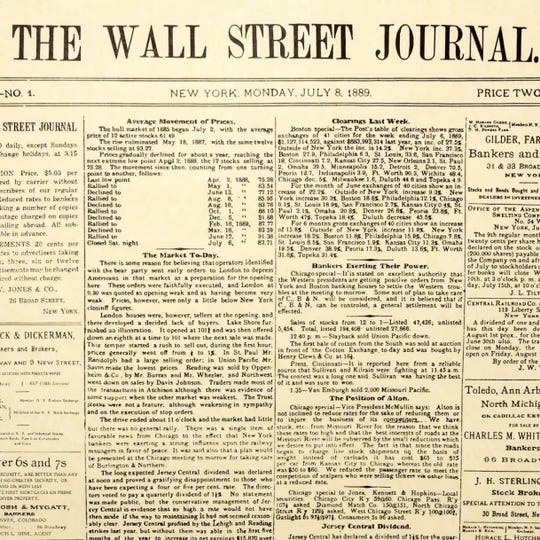
My friends, when the editor-at-large of The Wall Street Journal — a newspaper that’s been devoted to extolling the virtues of capitalism for most of its 137 years — scolds America’s business-political class for promoting its own well-being at the expense of the American people, well, we’ve come to a giant fork in the road.
For which I credit Trump and the noxious people around him. Were it not for this detestable regime, the top reaches of America’s business-political class would not have gone to such wild extremes and been so garishly exposed — and the Wall Street Journal wouldn’t be rebuking them for threatening the well-being of Americans.
The question now is whether progressives will take up the invitation that the editor-at-large of The Wall Street Journal has so graciously laid out for us: to devise and implement a system that works for the well-being of the people.
We could start with what Gerard Baker seems to suggest — the need for more powerful anti-monopoly measures, including busting up the biggest corporations and banks. Also: a single-payer “Medicare for All” system. Regulations that prevent giant corporations and Wall Street banks from shafting average Americans. And laws that stop big corporate entities from making huge campaign contributions.
Hey, not a bad beginning for The Wall Street Journal.
Check this story
Ask the guide
The guide explains what to check and where. It cannot see this article or recent news.
Is this AI-made?
AI checkers give a likelihood, not proof.