Dirty queens done dirt cheap: GayC/DC hits with queer ‘refresh’ of classic rockers
Few tribute acts have expanded beyond their niche as successfully as GayC/DC, whose queer reimagining of AC/DC has won over fans well beyond LGBTQ spaces.
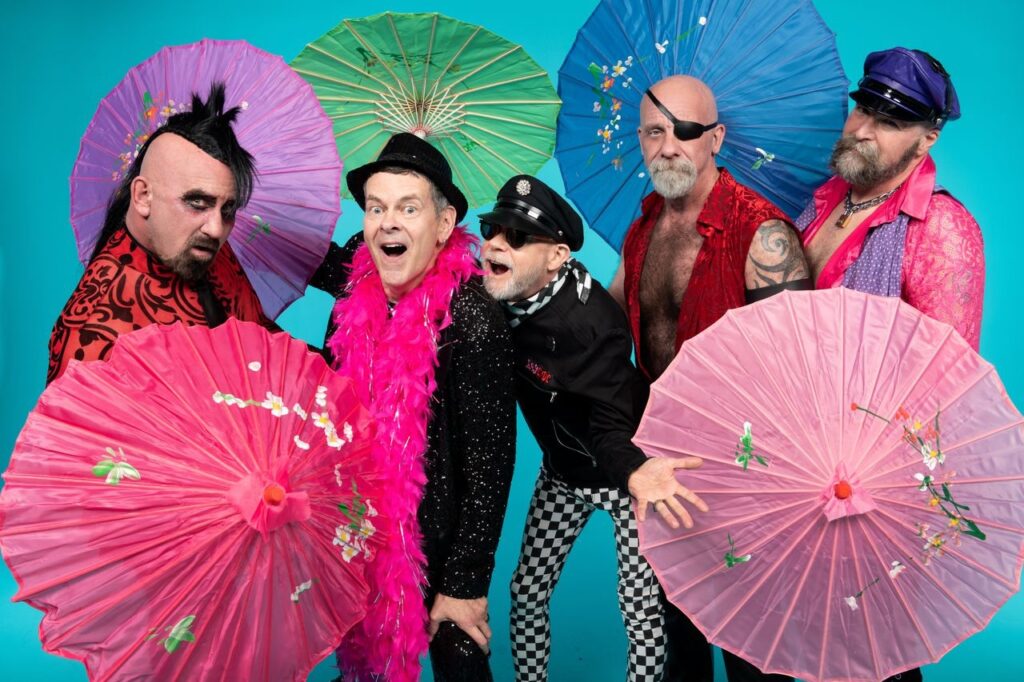
The hard-rock group, headlining this weekend’s Pride Fest (Sat/20; DNA Lounge), describes itself as the world’s first all-gay AC/DC tribute band, although its vocalist, Chris Freeman, prefers a different description.
“We’re a refresh, not just a tribute,” he says.
Taking songs from one of rock’s most famously heterosexual bands and filtering them through a queer perspective, GayC/DC keeps AC/DC’s music largely intact while reimagining some lyrics and stage presentation with equal parts humor, camp, and affection for the source material.
Its shows feature leather, boas, costume changes, and plenty of audience participation, but the musicianship is treated seriously—a choice that was intentional from the beginning.
The project emerged in 2013 after another band involving several members—an all-gay Go-Go’s tribute called The Gay Gay’s—came to an end. When someone jokingly suggested the name GayC/DC, the group immediately recognized the potential. Just as quickly, they realized the challenge.
“There are probably hundreds of AC/DC tribute bands,” Freeman says. [San Francisco’s AC/DShe is another notable example.] “We knew we had to be good.”
According to drummer Brian Welch, the band spent months rehearsing before ever playing a public show.

“We said we were going to do the music spot on,” he says. “We’re not going to do anything that takes the piss out of one of our favorite bands.”
The members were all longtime hard-rock and metal fans, and AC/DC provided common ground. “AC/DC runs in our DNA,” Welch says.
Rather than replicating AC/DC visually, GayC/DC imagines an alternate version of the band. The music remains recognizable, but the context changes—a formula that has helped win over audiences who might initially be skeptical.
Freeman describes the formula simply. “As soon as they hear those guitars, it has to hit them over the head,” he says. “And then we hit them with the feathers.”
Along the way, the band has attracted support from several musicians whose records its members grew up listening to. Its videos have featured appearances from King’s X bassist and vocalist dUg Pinnick, Armored Saint singer John Bush, and L.A. Guns bassist Johnny Martin.
Last year’s “Gay Boy Boogie,” a reinterpretation of AC/DC’s “Bad Boy Boogie,” caught the attention of Twisted Sister frontman Dee Snider, who publicly praised the video after seeing the band’s homage to “We’re Not Gonna Take It.”
Freeman and Welch also count Styx co-founder Chuck Panozzo among the band’s friends and supporters. Freeman, through his work with Pansy Division, also developed a long relationship with Judas Priest singer Rob Halford after meeting him at a late-’90s performance by Los Angeles queercore band Extra Fancy at San Francisco’s now-defunct Transmission Theater.
Halford was on an extended break from Judas Priest at the time and part of industrial metal project 2wo with guitarist John 5 (now a member of Mötley Crüe).
“We said, ‘Look, you’re not in Judas Priest right now, so it’s the perfect time for you to come out,’” Freeman recalls. “So he did, and within a handful of years, he was back in Judas Priest and has been since. He’s the metal god again.”
Perhaps the most unexpected endorsement came from former Skid Row singer Sebastian Bach.
Bach joined GayC/DC onstage at the Viper Room in Los Angeles, a performance that helped raise the band’s profile. The appearance carried additional significance because Bach has spent years addressing criticism over a notorious late-’80s photograph showing him wearing an anti-gay T-shirt.
Bach was roughly “18 and Life” years old at the time, and both Freeman and Welch say he has repeatedly apologized for the incident and has long expressed support for the LGBTQ community.
“He wanted everyone to know that he’s not a homophobe,” Welch says. “He did a stupid thing in the late ‘80s. He was a kid.”
For Welch, moments like that remain somewhat surreal. “We never would have thought in our twenties and thirties we’d be playing these venues as out gay musicians,” he says.
That perspective is shaped by the era in which both musicians came out. Freeman moved to San Francisco in 1987 during the height of the AIDS crisis and later helped establish Pansy Division as one of the first openly gay punk bands to achieve national visibility. Welch spent years touring with major rock acts including Extreme as a crew member before coming out publicly.
For Freeman and Welch, those relationships reflect broader changes within hard rock and metal. Questions about whether the genre could become more welcoming to LGBTQ artists were still being debated in the mid-2000s. Two decades later, openly LGBTQ performers remain relatively uncommon in metal, but artists such as Halford have become some of the genre’s most visible advocates, and bands like GayC/DC have found audiences in spaces that once seemed less welcoming.
Both men say Pride carries different meanings now than it did when they were younger, but neither sees GayC/DC primarily as a political project. They describe the band first and foremost as a rock band.
“There are no tapes we’re playing, and there is no Auto-Tune,” Freeman says. “We’re just getting up there and blowing it out.”
That emphasis on performance may explain why the group, which recently completed a new video for “Whole Lotta Jose,” a riff on AC/DC’s “Whole Lotta Rosie,” has found audiences both inside and outside LGBTQ communities.
While the camp elements often attract initial attention, Welch believes the songs are what keep people engaged.
“When they hear those opening chords,” he says, “they’re right there with their fists in the air.”
PRIDE FEST: GAYC/DC June 20. DNA Lounge, SF. More info here.
The post Dirty queens done dirt cheap: GayC/DC hits with queer ‘refresh’ of classic rockers appeared first on 48 hills.
Check this story
Is this AI-made?
AI checkers give a likelihood, not proof.