Who was First Nations resistance fighter Musquito? A historian investigates a legend
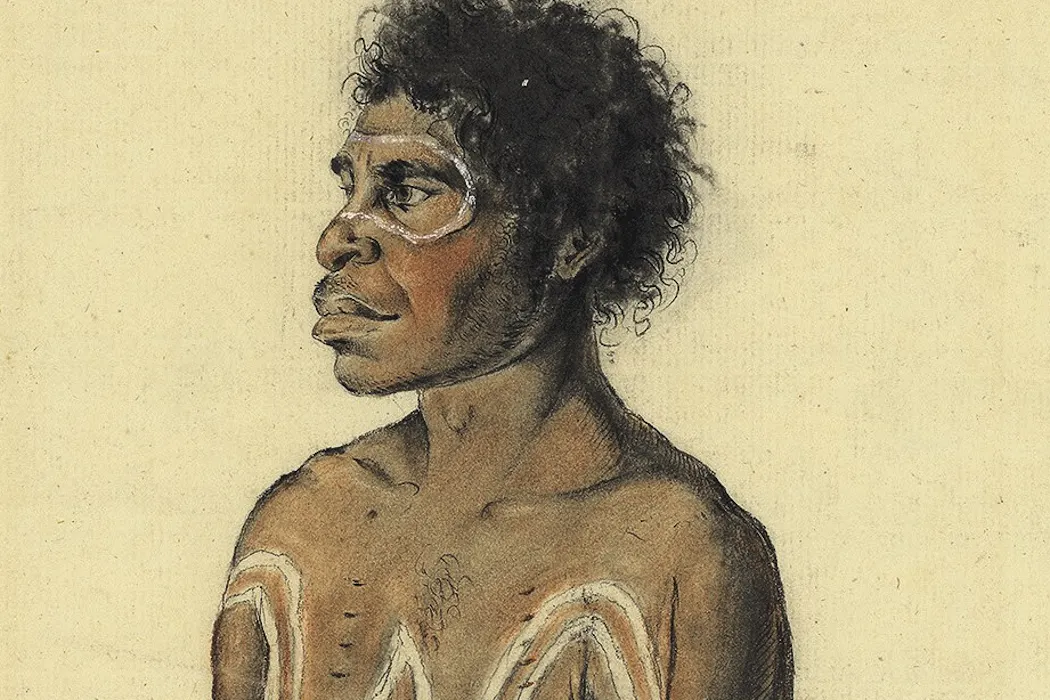
Not much is known about the Aboriginal man known as “Musquito” (c.1780–1825). This does not make him unusual among the Aboriginal people who faced the first 40 years of British colonisation of eastern Australia. But in three respects, his life is noteworthy.
Review: Musquito: a real story of a legendary colonial warrior – Naomi Parry Duncan (Allen & Unwin)
One is that the French naturalist Nicolas-Martin Petit drew him in 1802 – the basis of an engraving by Barthélemy Roger published in France in 1807. (Both images are reproduced in this book.)
Another is that, although he was born in the Sydney region, Musquito, who the historian Naomi Parry Duncan describes as an early First Nations resistance fighter, lived for many years away from his Country. This means he is more connected to the story of Van Diemen’s Land than to what we know of New South Wales’ colonisation.
Third is Musquito’s place in the history of criminal law: a fledgling Hobart Supreme Court found him guilty of abetting murder. He was one of the first Aboriginal people to be hanged.
As she explains in some detail, Duncan is descended from colonists who occupied Musquito’s Country: now Sydney’s northwestern suburbs. A sense of obligation to Musquito and his kin has sustained her across two of decades of labour, assembling what little we can know.
Much of the book is lyrical: Duncan does not mask her own delight in “Country”. Her narrative – in both third and first person – is alive to the natural history of the places of Musquito’s “bright” and “multifaceted” life. She quietly celebrates what links her and her readers to the dispossessed: the material world of non-human creatures and cultivated landscapes that was Musquito’s is now hers.
Duncan subtly invites us to consider how dispossession enables sensuous inheritance, prolifically evoking her own inhabitation (actual and imagined) of the places Musquito trod.

Joy Lai/Naomi Parry Duncan
Exiled to Norfolk Island
Duncan devotes many more pages to Musquito’s physical and social setting than to Musquito himself.
She also takes us back to the parts of England where her convict ancestors (with the surnames Mobbs, Grono and Bateman) committed the crimes that secured their passages to Port Jackson. They were part of the invasion of Country between Parramatta (Baramada) and Dyarubbin (the Hawkesbury–Nepean rivers).

She also devotes a chapter to the portraits of Musquito. This positions him – or at least his representation – in the story that historian Bernard Smith told in his book European Vision and the South Pacific (1960).
Aboriginal people worked for and fought with colonists, including the author’s forebears, in the first few years of the 19th century. They sometimes fought each other, too. Reports in the Sydney Gazette in 1803 and 1804, quoted by Duncan, gave names to some protagonists of such street violence: Musquito, Musquetto, Musketer.
Duncan suggests that in these clashes the combatants were applying their customary law. One thing we can be sure of is that after August 1805, Duncan’s “Musquito” could not have been among any brawlers so named by the Gazette, for in that month he was exiled to Norfolk Island.
His exile came about because in May 1805, a party of settlers and constables patrolling the Pennant Hills area had been addressed defiantly and in English by one “Bush Muschetta”. For Duncan, this was “a defining moment”, one “of real power”, in which Musquito “spurned British law and asserted Aboriginal law”. What soon followed was perhaps more “defining”.
On July 2 1805, “white men” assisted by two Aboriginal prisoners arrested this “Principal in the late Outrages”, as Governor Philip Gidley King put it, along with a man called Toulgra (later known as Roy Bull). They were imprisoned for 47 days, then banished to Norfolk Island. “Musquito would never hear a flying fox chitter again,” Duncan writes.
For almost eight years on Norfolk Island, Musquito was “quiet and orderly”, in King’s words. Musquito adopted a skilled trade: charcoal burning. Duncan has visited what she believes to be one of his work sites, Australian’s oldest surviving lime kiln. Then, in January 1813 – listed as “Moschitto” – he was among those transported to Port Dalrymple (Launceston).
“Musquito could see and smell eucalyptus, but this was nothing like his home Country.”

Allen & Unwin
Seeking autonomy in ‘tame’ survival
Musquito was not a convict, but a free man. He told Lieutenant Governor William Sorell in 1817 that he wanted to go to Sydney, but he remained in Van Diemen’s Land.
Without land title, he was valued as a tracker by colonists troubled by bushrangers. Duncan credits him with assisting in the arrest of bushranger Michael Howe, in September 1818. The next documentary trace of Musquito is in 1822 and 1823, in writings by Methodist clergy Nathaniel Turner and William Horton.
Turner had met Musquito in November 1822 and referred to him as a “chief”. Horton used the expression “Muskitoo’s tribe” to refer to a “tame” mob of “individuals who have absconded from their proper tribes in the interior”. When Horton asked Musquito if he was “willing to till the ground and live as the English do”, Musquito responded that he might, but his companions would not. That reply places him on the boundary between two social orders.
Duncan puts much effort into contradicting stories about “Musquito” told by 19th-century observers of Tasmania, such as writer Henry Melville, Danish adventurer Jǿrgen Jǿrgensen and teacher, author and archivist James Bonwick.
Her refusal to repeat what these writers had heard (but not observed first hand) yields a thinner account of Musquito than theirs. But the great strength of her book is her account of the colonial society at whose edge Musquito, along with others in “tame” survival, sought autonomy.
Named as a killer
What caused Musquito to return “to the ways of the spear” in November 1823?
Duncan attempts to answer this question by reading the diary of Adam Amos, constable at Swan Port, in the territory of the Oyster Bay Nation. From other settlers, Amos heard about incidents of violence, including the slaying of two settlers in November 1823, at Grindstone Bay.

His diary records that “a native of Sydney Mosketty […] a dangerous fellow as he is ackwainted with fire arms” was involved. The testimony of a man who had fled, John Radford, was the basis of a January 1824 arrest warrant, naming Musquito and “Black Jack” as killers. Soon there was another warrant, for there had been another killing; Musquito was named as leader of “a party of the natives”.
Duncan believes that scared and bewildered colonists sought explanation for a series of killings by Aboriginal Tasmanians in 1824 – and found it in the story that Musquito was leading other Aboriginal people astray.
Only one spearing is acknowledged by Duncan as credibly attributable to Musquito – his non-fatal attack on emancipated convict Joseph Jerome, in July 1824. “This was payback,” she comments, “although there is nothing in the records to tell us what for”. Musquito let Jerome live, and the incident made his whereabouts known.
In August 1824, “an alliance of colonial chancers and an Aboriginal guide” shot and arrested Musquito, Duncan writes. His familiarity with the colonists’ ways meant that – unlike Aboriginal people assessed as too “savage” to understand that they were British subjects – he could stand trial for murder.
His indictment on a capital offence was not the first for an Aboriginal man. That “honour” belongs to “Mow-watty”, convicted of raping and robbing a 15-year-old white girl near Parramatta. Mow-watty was the first convicted Aboriginal person to be hanged, in 1816.
A life with many meanings
In December 1824, Musquito pleaded “not guilty” to “aiding, helping, abetting, comforting, assisting Black Jack”, the killer of William Holyoake and “Mammoa” (a Tahitian), at Tasmania’s Grindstone Bay. Duncan dismisses the terms of the indictment as “gobbledygook”.
She does not say whether this refers to her own dismay that he was so charged, or to Musquito’s. The Hobart Supreme Court did not appoint defence counsel or interpreter. We do not know whether Musquito’s reputed command of English enabled his knowing participation in the trial. With John Radford as credible witness, Musquito was found guilty of “abetting” (then a capital offense) the killing of Holyoake.

Allen & Unwin
Duncan does not dispute the verdict. However, she frames her account of his culpability within the larger story of Britain’s imposition of criminal law in Van Diemen’s Land and its confident disregard for what Aboriginal Tasmanians must have felt about this.
Musquito would be hanged on February 25 1825, along with “Black Jack” (who was found guilty of abetting the murder of another colonist, Patrick Macharty) and six white bushrangers. As the executioner placed hoods on their heads, “perhaps” Musquito and Black Jack “accepted their fate as the cost of their struggle”, Duncan speculates.
The fact that we know so little of Musquito’s life enhances, rather than diminishes, its allegorical significance. Musquito’s life and death can be emblematic of a history of invasion and resistance. This seems to be Duncan’s preference.
Or it can be read as an instance of the difficulty of managing your associations and loyalties when your life has placed you at the interface of two worlds – the British and the Aboriginal – and of their rapidly escalating mutual fear.

Tim Rowse does not work for, consult, own shares in or receive funding from any company or organisation that would benefit from this article, and has disclosed no relevant affiliations beyond their academic appointment.