What will a rebuilt Altadena look like? Residents push a state bill that would limit density
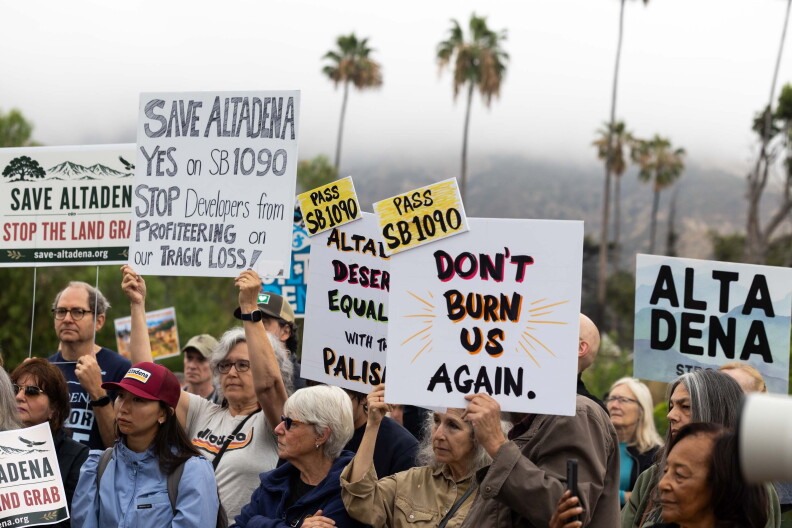
A year and a half after the Eaton Fire burned thousands of homes, Altadena residents are grappling with a question shaping the community’s future: Should rebuilding efforts make room for dense, more affordable housing, or should they seek to recreate the same kind of single-family housing that existed before the fires?
The debate has triggered advocacy around a new bill, lawsuits against L.A. County from developers, petitions from neighbors and emergency town council meetings.
On one side are Altadena residents rallying behind proposed state legislation to temporarily block developers from using California density laws to build multi-unit housing on single-family lots.
They say they want to stop out-of-town developers from building structures like duplexes and bungalow courts, which residents say threaten the neighborhood’s identity and will lead to congestion on narrow roads.
On the other side, developers are looking to build denser housing under existing laws that expedite lot subdivision.
But the county has delayed or denied some of their applications, leading at least three developers to file lawsuits in L.A. County Superior Court.
How we got here
In July 2025, Gov. Gavin Newsom issued an executive order allowing local governments to prohibit new duplexes in burn zones such as the Pacific Palisades and Malibu. But the order didn’t include most of Altadena, which technically isn’t in a very high fire-hazard severity zone.
“When residents from my community had initially seen this executive order, they were pretty concerned and upset that they were not included,” state Sen. Sasha Renée Pérez said.
“We need protections as well,” said the senator who represents the area.
That’s why some residents are supporting Pérez’s Senate Bill 1090 — which is headed to a full Assembly vote in August.
On the ground
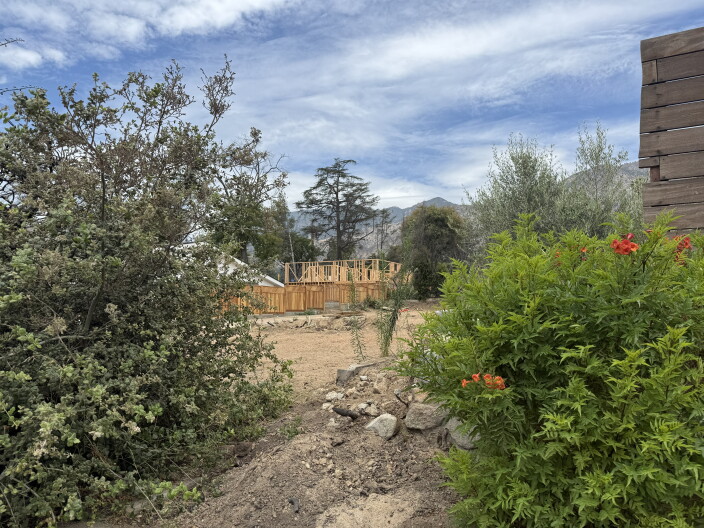
On Punahou Street, near Farnsworth Park, nearly every single-family home was destroyed by the Eaton Fire.
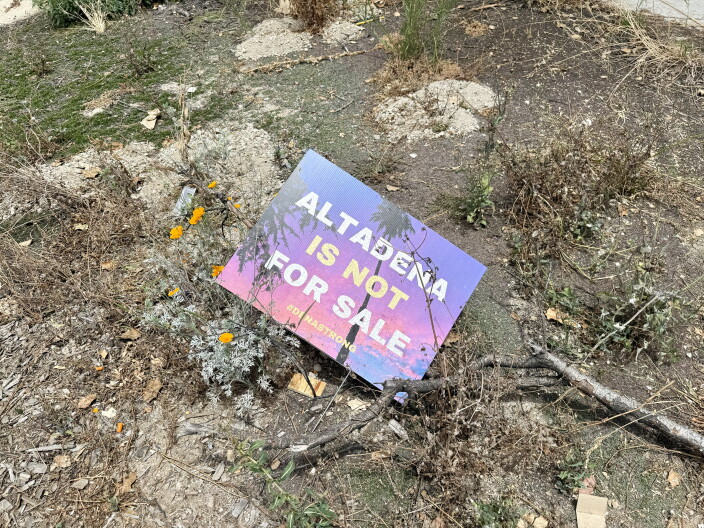
More than a year and a half after the fire, rows and rows of empty lots remain scraped raw and swallowed by untended weeds. “Altadena is not for sale” signs lay strewn among fallen branches and charred shrubs.
On a handful of properties, wooden frames are beginning to take shape.
Altadena residents began noticing plans to build multi-family complexes this spring.
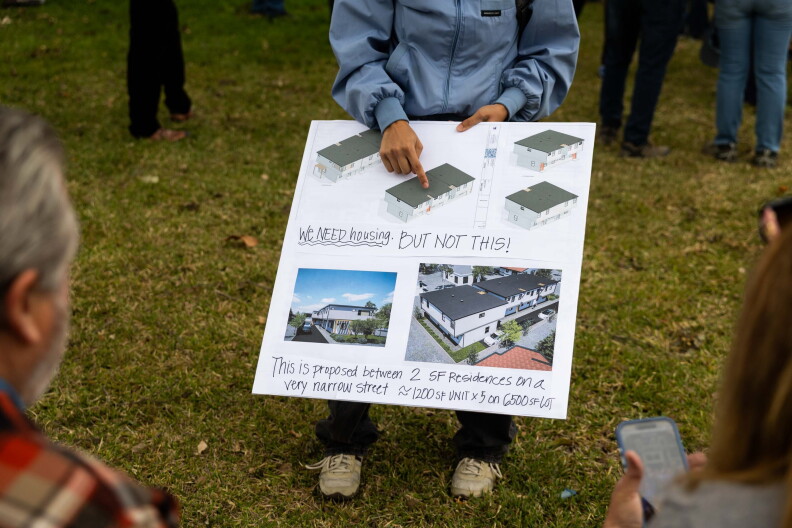
Their focus was drawn to 411 Punahou St., where a single-family home once stood. In March, neighborhood captain Angela Uriu spotted digital renderings showing a sleek, multi-unit complex with parking spaces.
Her home on the same block, a one-story Cape Cod-style house built in 1939, burned to the ground in the fire.
“We have a small street, and it felt like [the developers] made no attempt to be neighborly in the aesthetics of the structure and how they faced our street or the neighbors on either side,” Uriu said.
She soon started a petition opposing the development, which was one signature shy of 1,500 on Thursday.
Uriu is among a growing number of residents who say the rebuilding process has opened the door to predatory outside developers.
“You have speculative developers for whom their entire business plan relies upon purchasing these lots, getting plans approved for the lots, and then flipping them,” said Shawna Dawson Beer, who founded the community activism group Beautiful Altadena in 2015.
“That should not be easier than getting people home and getting people to rebuild their homes,” she added.
A legal battle brews
Recently, developers in Altadena haven’t gotten housing applications approved under SB 1123, leading some to sue the county. Only a few SB 1123 applications were approved after the fire, according to the county’s permit finder.
This spring, L.A. County sent out one-paragraph rejections of SB 1123 applications to developers, saying that the properties’ perimeters were not substantially surrounded by developed parcels — a requirement for projects to qualify for SB 1123.
“We actually voided all applications because [SB 1123] was meant to be infill building, and there’s nothing around,” L.A. County Supervisor Kathryn Barger told the California Assembly at the beginning of July. Barger’s district includes Altadena.
The decision to void the applications was based on guidance from the state’s Department of Housing and Community Development, according to Anish Saraiya, the director of Altadena recovery in Barger’s office.
Kensington Homes, Caldev and other development companies quickly sued the county, alleging that the rejections were based on “a pretextual political decision to prevent increased density in post-fire Altadena.”
The county Department of Regional Planning wrote in a statement to LAist that new applications for multifamily projects under SB 1123 can’t be approved “based on current law.” The department did not elaborate.
At least three lawsuits allege that the delay and denial of these applications were inconsistent with the county’s past actions and messaging.
Brick Work, a land use startup suing the county, submitted applications to build multifamily homes in late 2025.
“We were just going about business as usual,” founder John Jung said.
But county officials in March declared the project ineligible due to the urban infill requirement, Jung said.
Multiple lawsuits cite a now-offline brochure published by the L.A. County Planning Department, which provided guidance on using SB 1123 and SB 9 to split lots for Eaton Fire survivors. They allege that the county changed its position by replacing the brochure this spring.
“Content on the Disaster Recovery webpage is updated regularly to reflect the latest information in the most accessible form, and this particular brochure has been replaced by other content,” the Department of Regional Planning wrote in a statement to LAist.
At the heart of the lawsuits is a thorny question: What counts as urban infill after a neighborhood has burned?
One lawsuit filed by Kensington Homes argues that the definition of a “qualified urban use” can also include remnant residential structures left following the fire. Therefore, it argues, “virtually all of the land in Altadena qualifies for the program.”
Jung argues that although the lots are currently vacant, “the use is still residential, and they’re all in the midst of rebuilding — they’re not going to stay vacant,” he said.
The county’s current interpretation stands contrary to the purpose of SB 1123, according to Jacob Pierce of Abundant Housing L.A., a pro-housing nonprofit.
“The county’s interest in reading a temporary post-disaster condition as disqualification does not pass the smell test,” he said.
But supporters of SB 1090 say that SB 1123’s urban infill requirements were never intended to include burned lots. They argue that fire-scarred blocks should not be treated the same as intact urban neighborhoods.
“There is no question that an entire town that was wiped off the map overnight is not urban infill,” said Dawson Beer, the community activist.
UC Davis law professor Christopher S. Elmendorf says that the statute doesn’t directly address the issue.
But, Elmendorf noted, “it would be strange for the city to declare that the sites are ‘not urban’ because the existing uses burned, while at the same time it issues permits for the rebuilding of single-family homes.”
Rebuilding on their own terms
SB 9 projects, on the other hand, are still being approved by the county. More than 5,600 parcels were damaged or destroyed in Altadena. Fifty-seven, including 411 Punahou Street, have active permits invoking SB 9. Only two have been completed, and 14 are under construction.
But this was enough to unite Altadena residents in opposition. Similarly, a handful of SB 9 applications brought the Palisades community together against “opportunistic developers” last year, leading L.A. Mayor Karen Bass to suspend SB 9 in very high fire-hazard severity zones.
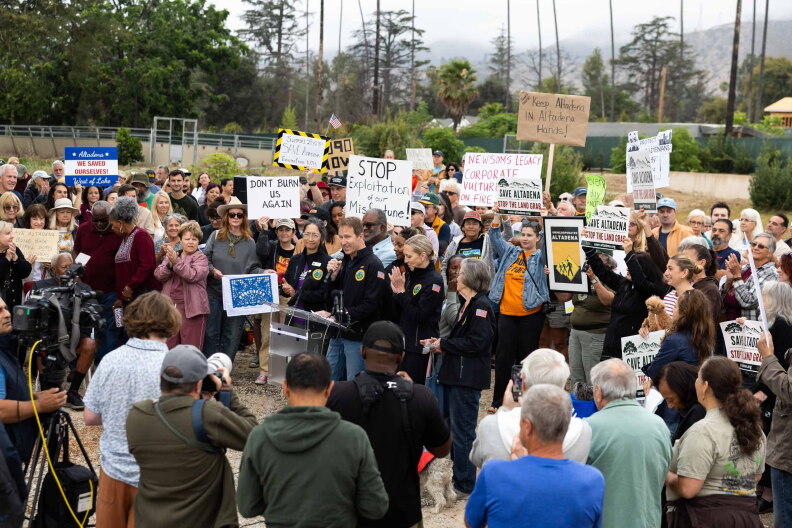
At a June 16 town council meeting in Altadena, more than 450 residents packed the overflow space to voice concerns about the developments and push for housing density exemptions under SB 1090. An “emergency” community meeting on Zoom was held later that month, gathering more than 100 residents.
Recovering and rebuilding after a traumatic event like a large-scale fire can cause friction within communities, said Megan Mullin, a public policy professor at UCLA.
“There can be a tension between what individuals and households need for their own recovery and the vision that a community has for what it wants to be in the future,” Mullin said.
Among those who are critical of SB 1090 are residents who plan to earn additional income by renting out secondary units.
Geoff Ramsey-Ray’s insurance claims were not enough to cover the cost of rebuilding his home on two acres of land, leading him to pursue a lot split under SB 9. Selling the second lot is “the only feasible way” he can stay in Altadena, he said.
The SB 9 approval process has been slow, Ramsey-Ray said.
“Ironically, preventing the speculators is also hurting some of us in Altadena who are trying to find a way to afford to rebuild here,” Ramsey-Ray said.
Many SB 1090 advocates say they’re targeting only out-of-town developers, and the latest version of the bill carves out an exemption for community land trusts and affordable housing organizations.
Veronica Jones, president of the Altadena Historical Society, hopes for a middle ground.
“We just want to protect what makes Altadena Altadena,” she said.
Whether that middle ground can be reached — or even exists — remains a question.
What comes next?
After swiftly passing two committee votes in the state Assembly in early July, SB 1090 awaits a full Assembly vote in August. Then it would go to the Senate and, if passed, on to the governor for his signature.
If passed in its current version, the bill would go into effect starting Jan. 1, 2027, which residents say leaves too much time for developers to continue building. They’re now fighting to get an urgency clause added to the bill, which would have the moratorium take effect as soon as the governor signs it.
“We might still be able to move forward even if the moratorium passes, because there might be language in there that allows existing projects to still move forward,” said Jung, one of the developers suing the county.
Meanwhile, the land on 411 Punahou Street was sold, with site plans for a multi-unit building approved last December. The empty lot has been cleaned and leveled.
Uriu, the neighborhood captain who lost her home nearby, is distressed.
“To think,” Uriu said, “that I’m spending my retirement and going to have to work the rest of my life to build this new home and have a five-unit complex with two stories next door looking into my backyard — it’s just a really hard pill to swallow.”
Residents say that the debate around SB 1090 is only one piece of a much larger recovery process mired in permit delays and insufficient insurance payouts. More than 18 months after the Eaton Fire, only 1% of homes have been rebuilt, and some survivors have left L.A. altogether.
“Everybody who wants to come home should be able to,” said Katie Clark, the co-founder of the Altadena Tenants Union. “And the reality on the ground is that for many of us, that is an uphill battle.”