Here’s what we do, and don’t, know about what’s in the smoke from the Boyle Heights fire
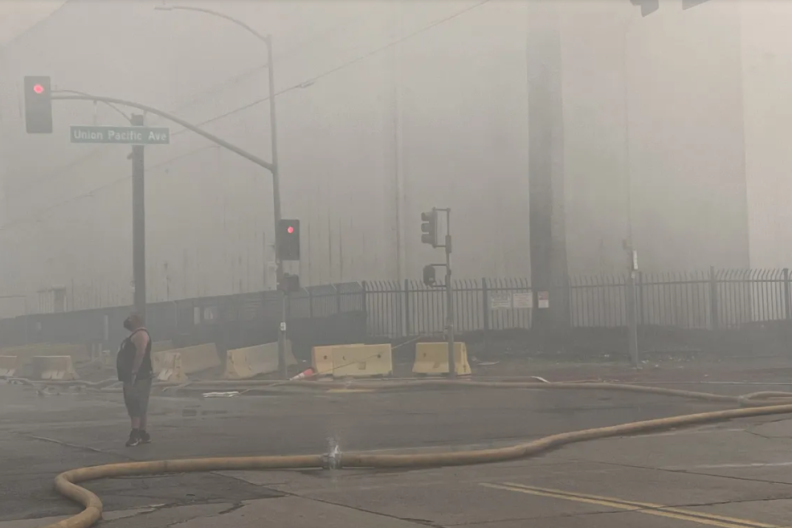
A refrigerated warehouse operated by Lineage Logistics has burned in Boyle Heights for nearly a week. Public health officials are urging residents nearby and downwind to protect themselves from the smoky air.
But what exactly is in the air is still unclear.
Authorities say they’ve cleared the most hazardous materials — ammonia and lithium-ion batteries — from the fire zone. A spokesperson for the L.A. Fire Department said foam insulation, wood pallets of food, and solar panels on top of the 500,000 square-foot building continue to smolder.
Materials including plastics, electronics and even rotting meat are likely burning, which means the pollution particles emitted “tend to be highly enriched with toxic organics, toxic metals, that are above and beyond what just normal, day-to-day air pollution would look like,” said UCLA air pollution researcher Yifang Zhu.
She said air quality indexes may capture the concentration of particulate matter in the air, but not necessarily the specific toxins in them.
“You’ll have almost like a double jeopardy in a sense that the levels [of particulate matter] are higher, and the toxicity is also higher,” she said.
Measuring heavy metals or volatile organic compounds requires special monitoring equipment, Zhu said.
“It’s very difficult to measure,” she said.
But she suspects at least some types of health-harming heavy metals are likely to be in the smoke.
Los Angeles City Councilmember Ysabel Jurado on Monday called for more specifics about what is in the smoke.
People “shouldn’t have to guess about what they’re breathing or rely on rumors, scattered information and updates, and incomplete information,” she said at a news conference. Jurado, whose council district includes Boyle Heights, added that data from regulators, such as the South Coast Air Quality Management District, should be released in clear, understandable language in English and Spanish.
The South Coast AQMD told LAist before Jurado spoke that the agency has monitors that measure particulate matter, ozone, carbon monoxide and nitrogen dioxide, but not other types of pollutants. The agency said it has set up additional monitors at Eastman Avenue Elementary and Robert Louis Stevenson Middle School. The agency added that the Environmental Protection Agency is also monitoring air quality at the fence line of the facility. LAist has reached out to the EPA for details.
Zhu added that even when the fire is eventually put out, the cleanup can kick up even more pollution — a lesson learned through her research after the L.A. fires.
“ I think people really need to take precautions,” Zhu said, emphasizing that those closest to the fire and downwind should avoid being outside as much as possible, keep windows closed, run a HEPA or MERV 13 air filter, and wear an N95 or similar mask otherwise.
UC Irvine toxicology professor Michael Kleinman said if thawed meat is also burning, that could lead to further toxic gases being released.
Experts urged precautions, especially if you smell smoke.
“ For people who are very close to the fire, like the firefighters themselves, they have exposure to both particulate matter and potential toxic gases, and that’s why you’ll see them wearing respirators,” said UC Irvine chemistry professor Suzanne Blum. “But once you’re some feet away from the building, then the primary concern is the particulate smoke that is coming from this fire.”