Donald Trump and Wars of Choice
The Me, Me, Me Presidency
There’s no I in war. But there is in Iran. And in Iraq, too. Both these wars were about ME — that is, the Middle East. It’s a region rife with supposed American security interests, but this wordplay points to another very all-too-real dynamic: These wars are as much about the “I” and “ME” of the White House as they are about the countries we attack. Or to put it another way: It’s the presidential psyche, stupid.
Way back in 2002, then-President George W. Bush warned that Iraq, Iran, and outlier North Korea comprised a grave threat. “States like these, and their terrorist allies, constitute an axis of evil, arming to threaten the peace of the world,” he warned. “By seeking weapons of mass destruction, these regimes pose a grave and growing danger.” North Korea built a nuclear arsenal, and with it, purchased a guarantee of security. The other two countries produced no nukes, and the story has been radically different.

The U.S. invaded Iraq in March 2003. Two months later, the war was won. Except it wasn’t. Despite President George W. Bush’s unforgettable May 1, 2003, “mission accomplished” moment when, from the deck of an aircraft carrier off the coast of San Diego, he declared “major combat operations in Iraq … ended,” the American war there somehow never actually stopped. An insurgency was raging, U.S. bases were being mortared, and American officials feared a civil war between the country’s formerly reigning Sunni minority and its rising Shiite majority was brewing. It became a forever war that lived up to the moniker. Last week, almost a quarter century since Bush made the case for war in Iraq, a U.S. soldier was killed in an Iranian attack on an American base there.
President Donald Trump was elected on a promise to say goodbye to all that. American-style wars of choice were going to be a thing of the past: “I will not send you to fight and die in stupid foreign wars that never end.” And yet Trump’s America is now deeply involved in a seemingly ever-escalating and never-ending conflict with — yes! — Iraq’s neighbor, Iran.
No one, I suspect, not even Trump, has the faintest idea why he did this, though maybe he felt left out of the club of forever-war makers, co-chaired by Russian President Vladimir Putin and Israeli Prime Minister Benjamin Netanyahu. Maybe he just sensed that he had to give this country a shot at being globally competitive when it came to making endless (and endlessly unsuccessful) war, if the U.S. was to remain the superpower on this planet.
Not everyone thinks, however, that you need to fight ruinous wars to be a superpower. There’s China, which is the quietest rising power in recent history because — except for a few border flare-ups with India early in this decade, and saber-rattling when it comes to Taiwan, the island nation off the coast of the mainland — it hasn’t been at war since 1979.
In lieu of pursuing fruitless conflicts around the world, it’s been silently leading the global production of green energy technology. China’s exports of green tech shot up by more than a third in the first six months of the year. This included a reported rise in shipments of lithium batteries and wind turbines by 38 percent and 36 percent, respectively. “In the first half of this year, the situation in the Middle East was tense and global supply of chemical products was tight,” Wang Jun, deputy director of China’s General Administration of Customs said at a recent press briefing. “China, with its complete industrial system and full-chain supporting capabilities, quickly seized the sudden external demands.”
And this Chinese green technology boom was in full swing even before Iran’s Houthi allies in Yemen declared a maritime embargo against Saudi Arabia and began attacking the kingdom’s oil ships in the Bab el-Mandeb Strait, briefly driving the price of oil back above $100 per barrel, about 40 percent higher than before the conflict began.
As his war with Iran has gone off the rails, Trump has begun redefining the conflict from a war to “a little excursion,” which just kept going on and on, leading him in March to sum things up this way: “We’ve already won in many ways, but we haven’t won enough. We go forward more determined than ever to achieve ultimate victory that will end this long running danger once and for all.”
You’ll recall that Trump also said on March 2 that the war was set to last “four to five weeks.” And three days later, that the U.S. and Israel continued “to totally demolish the enemy far ahead of schedule.” By March 9, Trump said that the conflict was “very complete, pretty much.” And two days later, the president declared victory. “Let me tell you, we’ve won. You know, you never like to say too early you won,” Trump announced at a rally in Kentucky. “We won.”
Like Bush’s “mission accomplished” moment, Trump’s was also decidedly short-lived. On March 15, the president said Iran still had “a little bit of fight back, but not much.” In a Truth Social post five days later, he wrote: “We are getting very close to meeting our objectives as we consider winding down” the war. On April 1, Trump announced the U.S. was “on track to complete all of America’s military objectives shortly” and on the 6th said the war “could end very quickly.” But it didn’t. “The war in Iran is going along swimmingly,” he declared on April 16. And in a May 1 letter to Congress, Trump said: “The hostilities that began on February 28, 2026, have terminated.” Except Iran never got the memo.
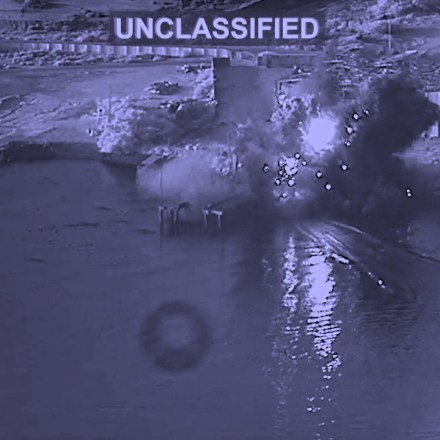
As the war has simply gone on and on, Trump has continued to tweak his terminology and rebrand the conflict with Iran as “a skirmish.” (Tell that, of course, to all the dead Iranian children!) Here’s how he put it, in fact, on July 22: “I call it a skirmish. This is, with this skirmish we have with the Islamic Republic of Iran, and I call it that, because, let me tell you, they’re getting hit so hard and they want to make a deal. But I say they’re not ready to make a deal.” And if the Iran war doesn’t end in the coming weeks, Trump will undoubtedly have to tweak terminology further, perhaps relabeling his skirmish with Iran a tussle, a scuffle, or even a full-scale kerfuffle.
As Trump insists the war is a minor engagement, he continues to dish out immense amounts of pain on Iranians and threatens even worse. He seems increasingly eager to blast civilian infrastructure and smash Iran into submission. As he put it all too bluntly when it came to those civilian targets: “Any time the Islamic Republic of Iran shoots at a ship in the Strait of Hormuz, whether it be by missile, rocket, drone, or any other device or weapon, the United States will bomb and destroy one bridge or power plant.” And he’s also been threatening to launch “a massive attack. Bigger than ever before.”
His Secretary of War Pete Hegseth certainly understands the president, or why would he start insisting on checking the testosterone levels of American troops and begin referring to what, in the Trump years, had already gone from the Department of Defense to the Department of War as “the High-T Department of War”?
Available on Bookshop.org
But while Hegseth is hoping to amp up the military’s potency, Americans want to bring the Iran war to a close. Only 29 percent of Americans approve of the way Trump is handling the Iran war, according to a recent Washington Post poll. Even a Fox News survey (yes, Fox News!) found disapproval ratings hit a record high in July, with 56 percent of Americans opposing U.S. military action against Iran, including 40 percent who “strongly” oppose it. Nearly two-thirds of respondents now think the conflict will last at least a year.
Even worse was a recent CBS News/YouGov poll that found 21 percent of Americans think the conflict will last multiple years! That same poll found that 67 percent of respondents say the U.S. should end the war with Iran now. Young people are the most fed up, with 83 percent urging the president to stop the war posthaste.
And even among his most fervent followers, support had already dropped by 13 percent over the previous two months, according to a Politico poll, while almost 1 of every 5 MAGA voters had come to believe that the U.S. should end its war in Iran, no matter the cost or results.
Of course, Trump doesn’t really care about young voters or Republican voters or even MAGA devotees. As he put it last week: “A poll just came out: Americans don’t want high gasoline prices, but they’re not against the war.” His war in the ME is wrapped up in his egocentric narcissism and his me, me, me world. The phrase “wars of choice” now means wars of Donald’s choice. But the Iranian government has a say in the matter and has made a choice to hold out amid renewed threats and attacks. And despite what Trump seems to think, the public in the U.S. can make choices, too. If Trump keeps on fighting in Iran, he may sooner or later also find himself in a distinct “skirmish” with the American people.
The post Donald Trump and Wars of Choice appeared first on The Intercept.