Trump imposes new host of tariffs on trading partners, alleging they use forced labor
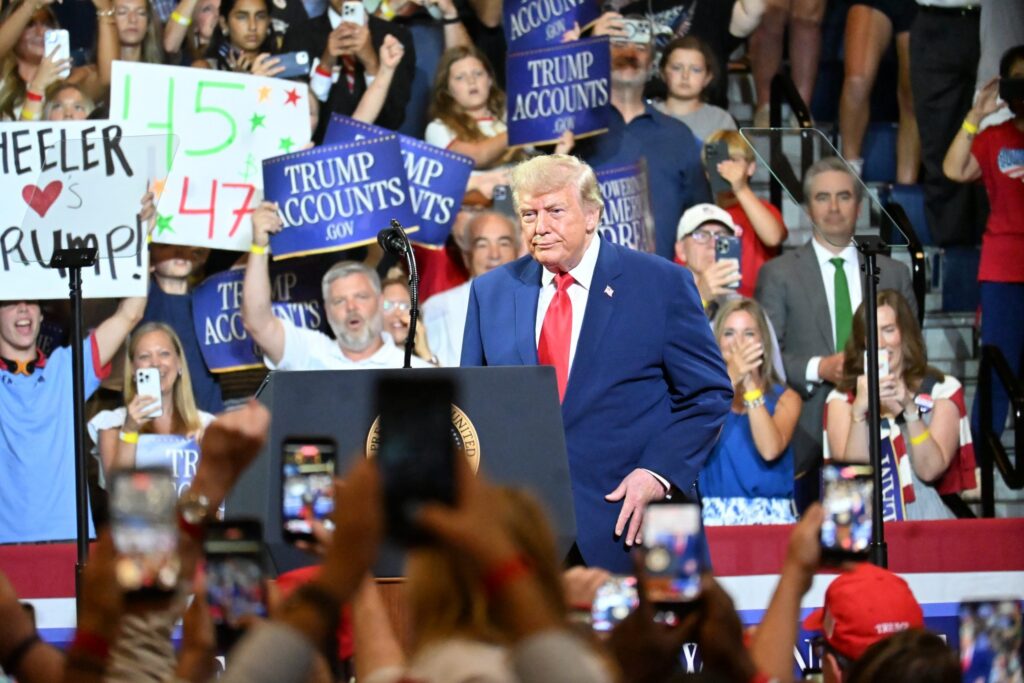
President Donald Trump imposed new import taxes on products from dozens of top U.S. trading partners on Friday, July 24, 2026. In this photo, Trump spoke before a friendly crowd at Wheeler High School near Marietta, Georgia, on July 22, 2026. (Photo by Ross Williams/Georgia Recorder)
WASHINGTON — President Donald Trump reignited his tariff agenda Friday by imposing new import taxes on products from dozens of top U.S. trading partners, immediately replacing temporary global tariffs he levied after the U.S. Supreme Court delivered a major blow to his sweeping “Liberation Day” duties.
As of Friday morning, American importers will now pay an extra 10% to 12.5% of a product’s value on most goods from nearly 60 countries, including Canada, the European Union, Japan, Mexico, South Korea, Taiwan and the United Kingdom, among dozens more. The tariffs could affect 99.4% of imports, according to U.S. trade authorities.
The fresh round of import taxes, first announced late Thursday afternoon, replace a blanket 10% tariff on global goods under Section 122 of the Trade Act of 1974, which expired at midnight Friday. Those tariffs invited new legal challenges, including from Democratic-led states.
The latest tariffs were imposed after the Office of the United States Trade Representative allegedly found forced labor conditions in all of the economies investigated under Section 301 of the Trade Act of 1974.
U.S. Trade Ambassador Jamieson Greer said in a statement Thursday that Trump “recognizes that decades of moral suasion have not eradicated forced labor from global supply chains. The United States has had a forced labor import ban for nearly a century, and rigorously enforces it; it’s well past time for our trading partners to do the same.”
Supreme Court ruling
The Office of the United States Trade Representative announced two broad investigations in March, less than one month after the Supreme Court struck down Trump’s unprecedented global tariffs under the 1977 International Emergency Economic Powers Act, commonly called IEEPA.
Shortly after the Supreme Court’s blow to his IEEPA tariffs, which he announced in early April 2025 on what he dubbed “Liberation Day,” the government was on the hook for roughly $166 billion in refunds to American importers who already paid the duties.
The latest batch of duties, in effect as of Friday, is the second round of import taxes the Trump administration announced this week. The White House introduced 50% tariffs on most Canadian imports Monday, triggering the duties under Section 338 of the Tariff Act of 1930.
The Depression-era provision, which has never before been enforced, authorizes the president to impose duties up to 50% of a product’s value in response to discrimination against U.S. commerce.
States Newsroom has spoken with numerous small business owners since 2025 about the effects tariffs have on their capacity to keep prices steady, hire employees, invest in new equipment and inventory, and just generally remain in operation.
‘Ridiculously blunt’
Critics slammed the administration’s new series of sweeping duties on a large swath of the country’s imports.
Scott Lincicome, vice president for general economics at the libertarian Cato Institute, wrote Thursday the outcome of the Section 301 investigations were “clearly predetermined” and “both ridiculously blunt and wildly out of proportion to any measurable economic distortion.”
“And the whole thing establishes precedent for an ‘automatic tariff generator’ that Trump or a future president can deploy at will. It makes a mockery of a real issue and might poison legitimate reform. And Congress probably won’t do anything about it,” Lincicome wrote.
Some Republicans in the U.S. House rebuffed Trump’s tariff agenda in February, but legislative change has not emerged.
Senate Minority Leader Chuck Schumer said in a statement Thursday the president has “has bled the inflation-battered American people dry with his tariffs.”
“Now he’s coming back for more. Trump’s chaotic tariff taxes have made life harder and more expensive for the American people. Families are paying more for everyday necessities. Small business owners are struggling to keep the lights on. Manufacturers are shedding jobs and farmers are getting squeezed. Meanwhile, Trump and his billionaire family and friends get richer on the backs of working families,” Schumer, D-N.Y., said.
The Yale Budget Lab estimates consumer prices could rise up to 1% under the new tariffs, increasing household costs by roughly $1,100.
If the duties remained in place, the U.S. would gain about $2 trillion in revenue over the next decade, though the number would likely be lower after accounting for negative impacts on the economy, according to the Yale Budget Lab.