The Oregon prosperity council’s bait-and-switch
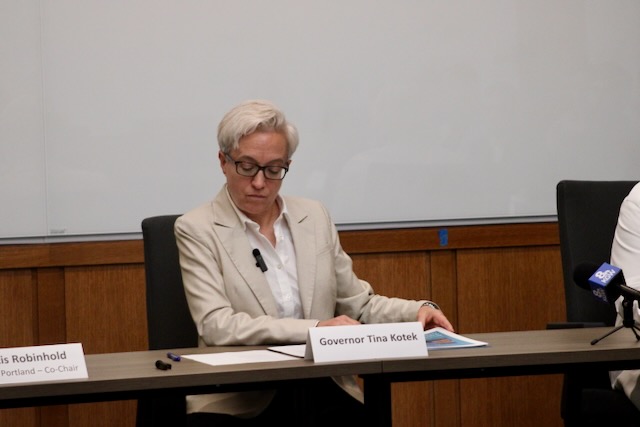
Gov. Tina Kotek reviews a report from her prosperity council on July 25, 2026. (Photo by Julia Shumway/Oregon Capital Chronicle)
An appliance store advertises an amazing deal on a particular dishwasher, only to tell you when you walk through the door that the model is sold out. But wouldn’t you know it, they’ve got this other pricey machine they’re happy to sell you.
That’s the classic bait-and-switch, and it’s basically the same move Gov. Tina Kotek’s prosperity council is trying to pull when it comes to Oregon tax policy. Its recently released recommendations advertise concern about taxes on the middle class, only to try to stick Oregonians with more tax cuts for the rich and corporations.
This is how the prosperity council defines, in part, the problem when it comes to taxes:
The current state tax structure places a higher burden on middle-income households than all of our neighboring states. This structure underpins the state’s lack of competitiveness and limits its ability to balance budgets, sustain essential public services, and invest in long-term economic growth.
It bears mentioning that the claim that Oregon’s middle-income households pay more in taxes than similar households pay in California and Washington is doubtful. An analysis that combines all state and local taxes shows Oregonians in the middle quintile (the middle fifth) pay less than their counterparts in those states.
Putting aside the accuracy of the claim, if the problem is that middle-class families in Oregon pay too much in taxes, shouldn’t that be the focus of the recommendations? But that’s not what the prosperity council is selling.
In the near term, for the next Oregon legislative session, the prosperity council proposes:
- reinstating a tax cut for wealthy investors which delivers 94% of all tax benefits to people making over $1 million in income a year;
- weakening Oregon’s only tax on the wealthy, the estate tax, which only the richest 5% of Oregon estates pay;
- weakening the Corporate Activities Tax;
- expanding a tax subsidy for corporations.
There’s no tax cut for the middle class anywhere on that list. Instead, the proposals would deliver pain to the vast majority of Oregonians in the form of reduced funding for schools, child care, health care and other essential public services.
It gets worse. With language likely vague on purpose, the prosperity council calls for a new “broader-based” revenue source — a euphemism for a sales tax — as well as an across-the-board reduction in personal income taxes. Sales taxes weigh much more heavily on low- and middle-income families than on the rich, so this proposal amounts to a tax shift from those flush with cash to those scraping by. The prosperity council concedes as much by acknowledging that this move would be “regressive.”
And what about the prosperity council’s call to reduce income tax rates “for all income brackets”? Again we see the misguided priorities of the Prosperity Council.
If your concern is that middle-class families are paying too much, then including the rich in an income tax cut is poorly targeted and costly. Because the personal income tax is progressive, an across-the-board rate cut would mean the rich would get the biggest tax cut out of any income group.
When you strip the rhetorical ornaments out of the prosperity council’s document, it’s clear that Oregonians are being sold tax cuts for the rich and corporations, paid for by either reducing state investments in education and other essential services, or higher taxes for low- and middle-income Oregonians.
The tax recommendations of the Council are, in other words, the same old failed playbook of trickle-down economics. As the state’s big business lobby, Oregon Business and Industry, put it following the release of the Council’s document: “The recommendations in this report echo what OBI and businesses throughout the state have been saying for years.” That’s no surprise, given that the governor filled nearly every seat on the Prosperity Council with corporate representatives.
Trickle-down economics, neoliberalism, or whatever you want to call it, has led to more than four decades of rising economic inequality and concentration of power in the hands of corporations and the super wealthy. It has led to widespread economic insecurity for many hardworking families. Adopting the Prosperity Council’s recommendations would only add more fuel to this raging fire.
Oregon needs a new playbook focused on investing in our people. Investing in education, child care, health care, and other essential programs strengthens the economy and ensures we all share in the prosperity we create together.
Let’s hope the governor and Oregon lawmakers don’t fall for the bait-and-switch, that they see past the rhetoric in the Prosperity Council’s document and recognize this agenda for what it is: more failed trickle-down economics. Policymakers should go shopping elsewhere, where the offer on the table truly centers the needs and aspirations of hard-working Oregonians.