‘The Last Human Bear’ came to Jack Kerouac Alley
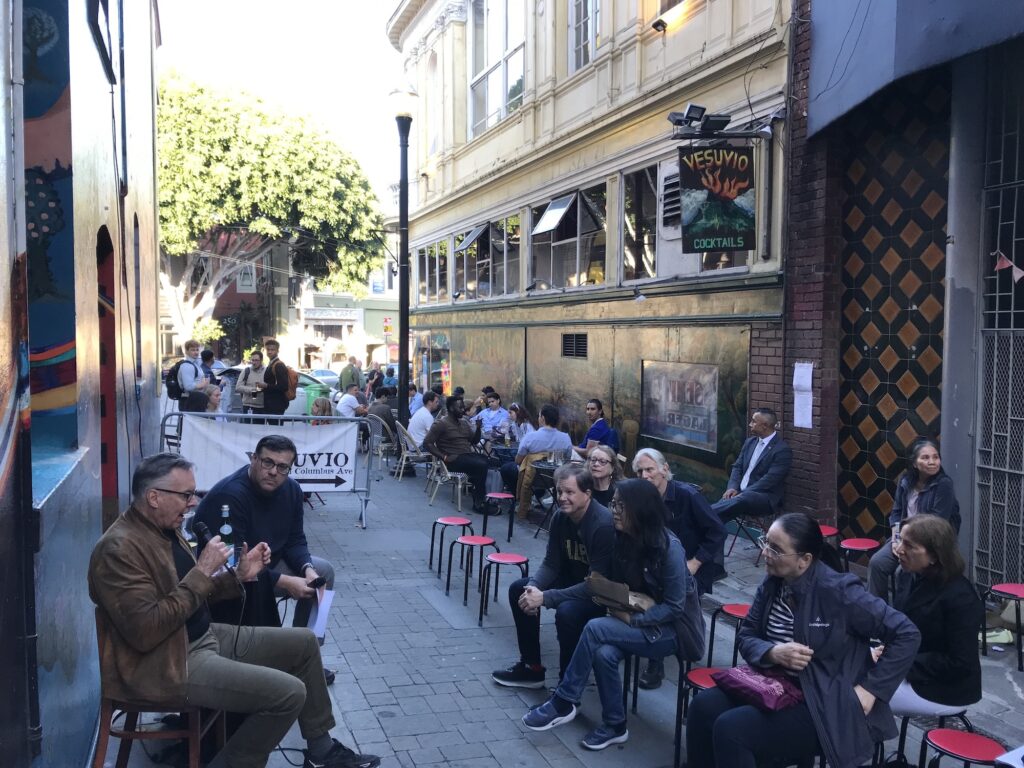
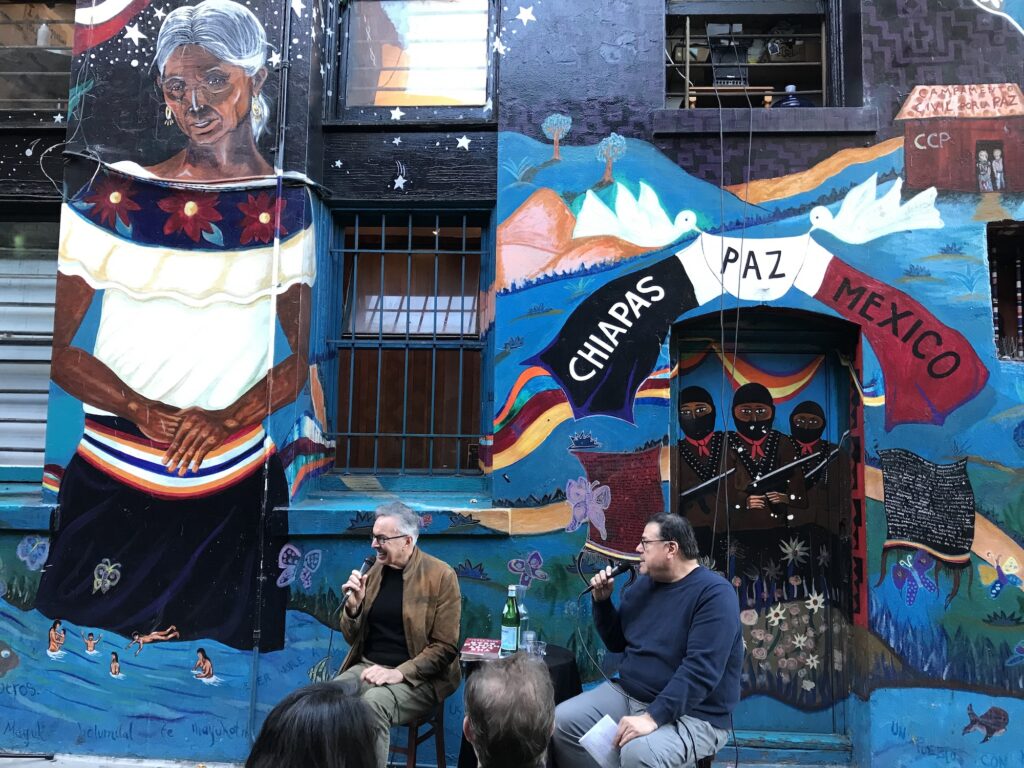
“I feel as though I should be three pints in and yelling at you from across the table,” Oscar Villalon, grinning, said to Greg Sarris, also grinning, as they conversed in Jack Kerouac Alley. To hold a literary discussion between a bar (Vesuvio) and a bookstore (City Lights), with happy hour revelers actually enjoying pints on one end and the occasional thump of a Chinese drum on the other, takes a sense of humor. Sarris is more than game; his Native American sense of humor might only be exceeded by his sense of occasion. Book talk versus bar talk was on.
City Lights Bookstore organized July 23’s discussion of The Last Human Bear, the acclaimed author’s first novel in nearly 30 years. The book shares the story of Mary Hatcher, a Pomo from Santa Rosa looking back on her life and wondering whether or not she had the power of a tolik, or human bear, which enabled her to “poison” others. The expansive tale, hailed by Rebecca Solnit as “lush and gripping,” is mostly set in Sonoma County in the 1930s, and explores themes like place and identity with an exquisite braiding of natural setting and cultural identity.
“At the time of contact, there were approximately 20,000 of us in Northern Marin County,” Sarris said of his Native American heritage. “And today, we have just over a thousand. There were more indigenous people in this area, Central California, than anywhere else in the New World outside of the present site of Mexico City, which was the Aztec capital.”
Sarris, as informed and engaging in-person as he is on the page, summarized the brutality of what happened after Spanish contact: systematic erasure of Native American culture through forced indoctrination in the missions, which then devolved further into slavery during the Mexican Rancho period, when “General Vallejo, along with John Sutter, had anywhere from 600 to 3,000 Indian slaves at a time.”
“The first piece of legislation enacted in the state of California was the Act for the Government and Protection of Indians, which legalized Indian slavery. That was not repealed until 1868, and convict leasing in California with Indians continued until 1930.” His protagonist, Mary, survives all this.
Villalon, the managing editor of ZZYZZYVA magazine, rifled through his pages of notes and landed on more questions about Mary. “Could you tell us exactly what, or who, is a human bear?”
Sarris explained that, unlike the buffalo-hunting Plains tribes glamorized by Buffalo Bill, who Europeans identified with because “they had what Europeans recognized and honored, which is organized warfare,” Sarris’s ancestors on the Central Coast were much more subtle.
“We poisoned you,” Sarris said with his arresting smile and sly humor. “You dropped dead the next day. The ethnographers characterized us as cultures predicated on black magic and fear. No, we were cultures predicated on profound respect, because anything you violated, it would come back on you. If you violate it, it will cause problems.”
A few attendees who were trying to listen to Sarris appeared as if they’d like to “poison” some of the louder drinkers in the immediate vicinity. Sarris, unperturbed, glanced around and tapped into bigger ideas. “If you look around today, there is no air, there is no water, that’s not poisoned. That has come back on us. So again, I think the old timers really had it right.”
There’s another blare in volume as more revelers arrive. They may have numbers, but Villalon has a mic, and we moved on to questions of identity. “There are many themes to the novel, but I think the grand theme to me is identity. Mary isn’t certain who her father is. He could be Native, or he could be Mexican.”
Although it’s a work of fiction, Mary’s identity reflects, in some ways, Sarris’s identity. “I was adopted by white people, and then learned later that I was Indian. I always said I was Mexican, but I grew up around Indian people and Mexican people. There’s that constant thing about who has the right to speak.” Another pause and sly grin set up a zinger. “And remember, folks, blood never presupposes point of view. Clarence Thomas case in point.”
Sarris added that Native Americans weren’t recognized as US citizens until 1924. Before that, “a [Natove American] woman could be raped, and she’d have no recourse in the courts. So her only safety, and the safety for her children, was to say she was Mexican. At least she would have some protection. Because Mexicans could get citizenship when Indians could not.”
Villalon asked why Sarris singled out Mabel McKay, a world-renowned basket weaver and medicine woman and subject of a 1994 biography by Sarris, in the acknowledgments. “Mabel McKay taught me more than all the professors at Stanford. And I will say this: she had more wisdom in her little finger than all of them.” Sarris described how McKay “fixed” him when he was a lost and broken man at age 19.
“She said, ‘With all that’s happened to you, you have two choices on this earth. You can let holes open up in your heart, and you can poison yourself and hate yourself, and poison and hate other people. Or you can use all of that to understand others.’
“You’ve already got hate,” McKay told Sarris. “That’s easy. Try the other.”
“I like to think that in the best moments of my life,” Sarris said. “I’ve tried the other.” The author’s temperance for others seemed on full display, as more Vesuvio customers spilled out into the alley.
Villalon had one more question before the audience Q&A started. “Mary Hatcher… she’s not a nice person. So we talked about identity. There’s cultural identity, then there’s our innate identity. Could you talk a little about Mary’s innate identity?”
Sarris didn’t disagree with the characterization—even the alley’s namesake would agree that mad people are the interesting ones. Mary’s flaws make her complicated and absorbing, and Sarris drew a comparison to one of modern literature’s most unlikeable but unforgettable characters.
“I was teaching Flannery O’Connor’s story, ‘A Good Man Is Hard to Find,’ at Stanford, a big class of 200 undergraduates, and they were just shocked. They thought the story was awful because a grandmother gets killed. And I said to the class, ‘Oh, come on! Who hasn’t at least once thought about killing someone?’ And I remember this very small lady in the front row raised her hand and said, ‘Does maiming count?’”
The small group of listeners in the noisy alley laughed with Sarris. If just for the thought of it.
The post ‘The Last Human Bear’ came to Jack Kerouac Alley appeared first on 48 hills.