Seattle Seeks to Broaden Climate Action Plan, with Adaptation in Mind
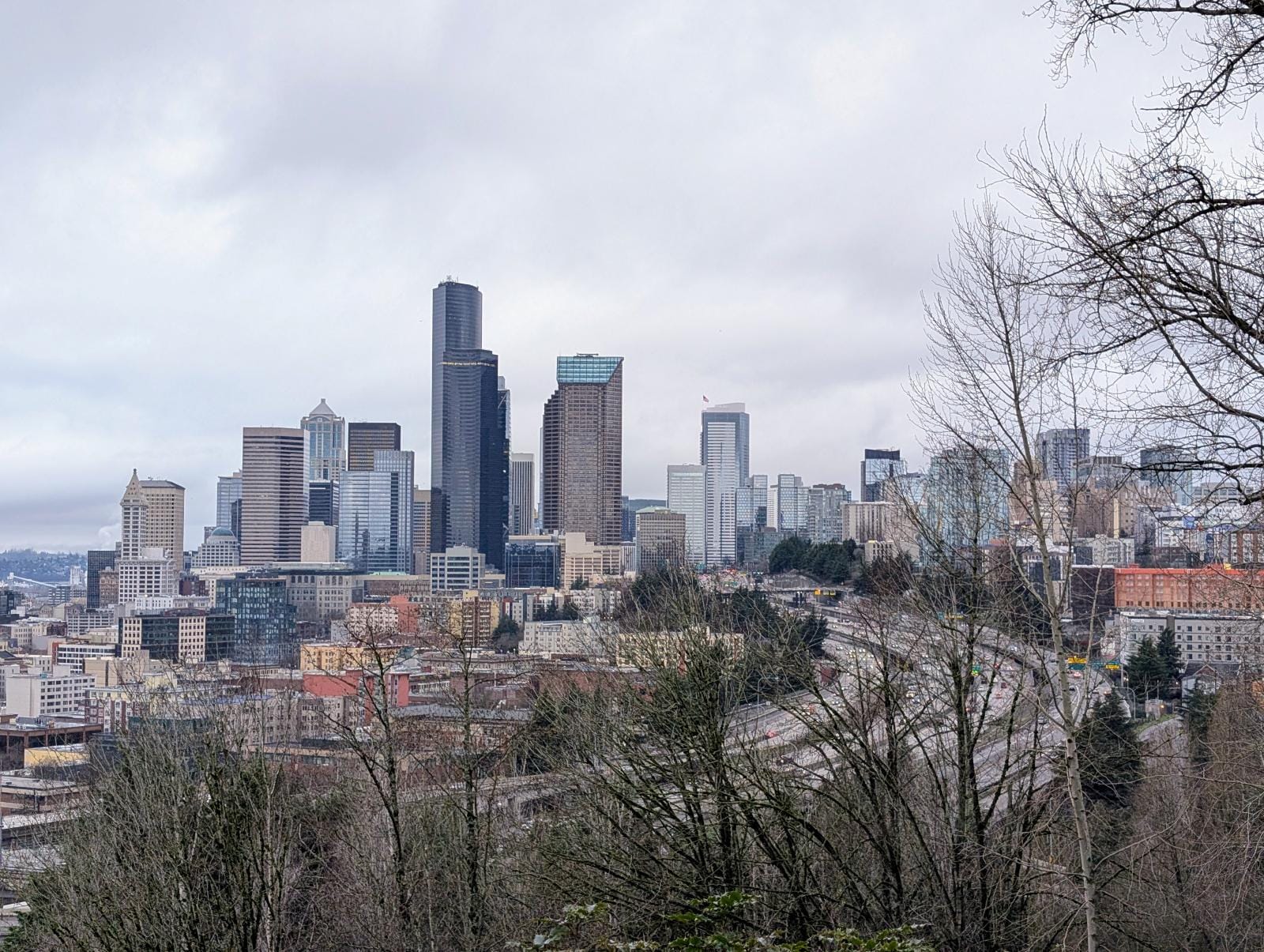
Note: This article is part three in a three-part series on Seattle’s Climate Action Plan. Read part one on the history of climate action in Seattle here and part two on the process of updating the climate action plan here.
University of Washington’s wǝɫǝbʔaltxʷ Intellectual House bustled on July 15 during Pacific Northwest Climate Week as more than 100 local academics, philanthropists, climate professionals, environmental leaders, and staff from City departments and other surrounding agencies gathered for the Seattle Regional Partners Forum. The Office of Sustainability and Environment convened the event for an afternoon discussion about the city’s ongoing update to its climate action plan.
“Our goal in updating the climate action plan,” the project’s manager Narita Ghumman told attendees, “is to create a plan that reflects today’s challenges and prepares us for the future.”
In doing so, the developing plan is shaping up to build on the previous plan, adding a focus on resilience and cross-governmental collaboration. If Seattle is to fulfill the climate goals cemented in its 2013 plan, emissions must plunge to 58% by the end of the decade — just three and half years away. The new climate plan is seeking to invigorate more momentum on emissions at the same time it fills other, urgent gaps.
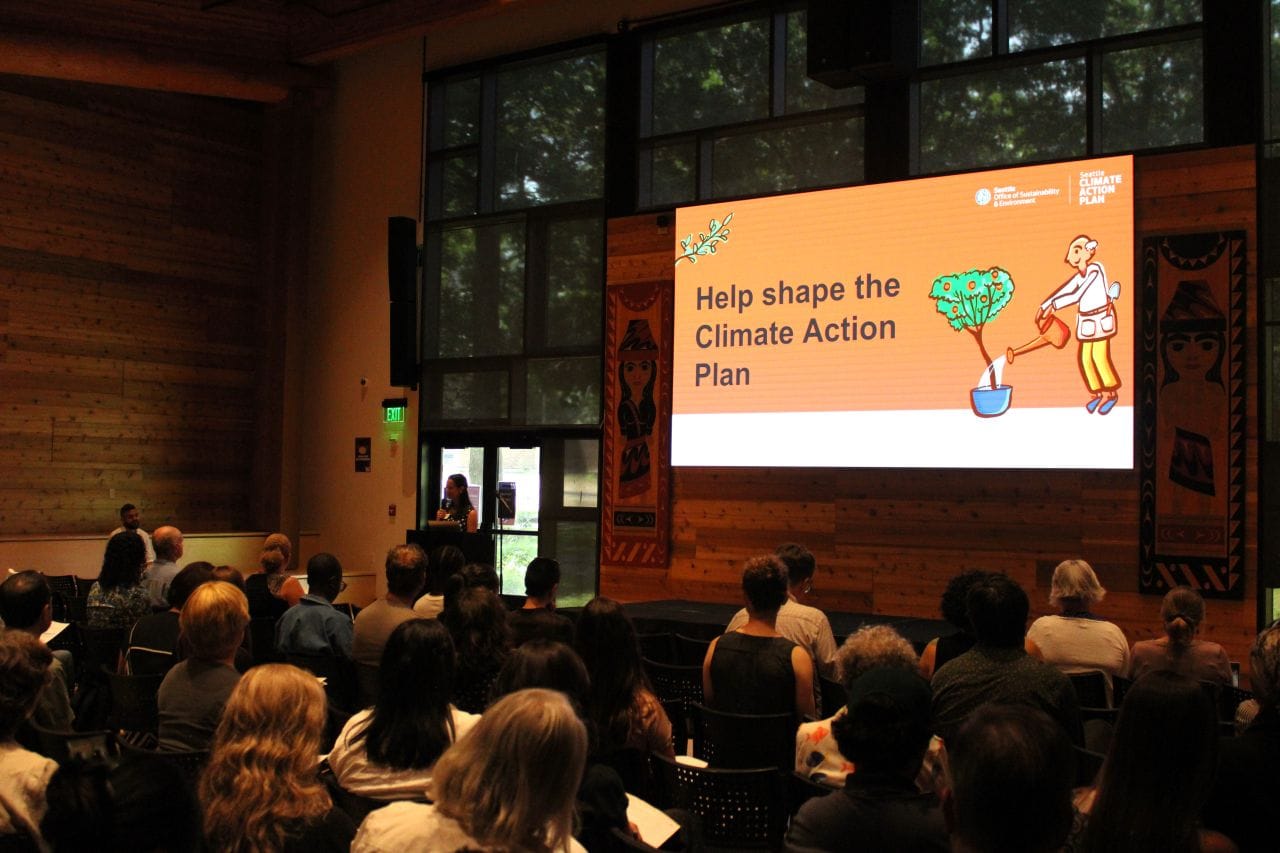
Susan Dickerson-Lange, director of UW’s climate impacts group, and Stefan Wheat, director of the planetary health program in UW’s School of Medicine, broke down the present impacts of climate change and what they mean for people’s health and wellbeing today and into the future.
“We’re moving out of the world of projections of what the future looks like,” said Dickerson-Lange.
Many people are experiencing those changes in their daily lives. Yearly temperatures are two degrees warmer across the Pacific Northwest than a century ago, she said, and average August highs have risen four degrees in the same period, elevating the risk of heatwaves and the hazards they bring, especially for a region that lacks widespread air conditioning.
These temperature changes have diminished snowfall throughout the state’s mountains and caused the snowpack that does form to melt earlier, which is changing how the region’s rivers flow — even causing some to run dry in late summer — with implications for both agriculture and ecosystem health. The recurrent droughts across the state in recent years have also made our landscapes and cities susceptible to wildfires of increasing severity and intensity.
“The key takeaway message here,” said Dickerson-Lange, “is that we are experiencing these impacts right now, and that continued action is needed to reduce harm to people, to ecosystems, and to infrastructure.”
Washington state was recently reminded of this lesson due to wildfires in Spokane and the winds that lofted the ashy remnants of several Spokane neighborhoods to mix in the atmosphere with soot from flame-engulfed forests in Oregon, British Columbia, and Central Washington to spread a blanket of smoke across the region in early August.
With 154,000 deaths around the world attributable to wildfire smoke every year, “this is not a 2050 problem,” added Wheat, a practicing physician. “This is a right now problem, and it’s showing up in emergency departments like mine.”
But the deaths and adverse effects associated with smoke and heat and other climate impacts aren’t shared evenly across a city like Seattle, he said. “There is a clear pattern: Age, chronic illness, outdoor work, housing insecurity, and race compound climate risk in overlapping and often reinforcing ways.”
For these reasons, both Wheat and Dickerson-Lange emphasized how crucial it is that Seattle seeks to build its resilience to climate change at the same time it aims to stem the tide of the forces driving the crisis forward. “Investing in adaptation is not conceding defeat,” said Wheat. “It’s a recognition of our responsibility to protect people from the harms that are already happening, and from the harms that, frankly, are already locked in no matter what we do on emissions today.”
After Ghumman, Wheat, Dickerson-Lange, and others concluded their remarks, the forum dispersed into breakout groups. Each group discussed two out of 10 “families” of possible climate actions that thematically capture the priorities the city will likely pursue through the plan. These included health, buildings, transportation, waste, water, food, energy, community preparedness, and more.
“In the action families, I was happy to see some of the actions actually resonated intimately with the recommendations [of community members],” Faduma Fido, a leader with People’s Economy Lab, told The Urbanist after the forum. Fido has provided technical assistance to the groups hosting the community assemblies that were funded by OSE and the city’s Green New Deal Oversight Board.
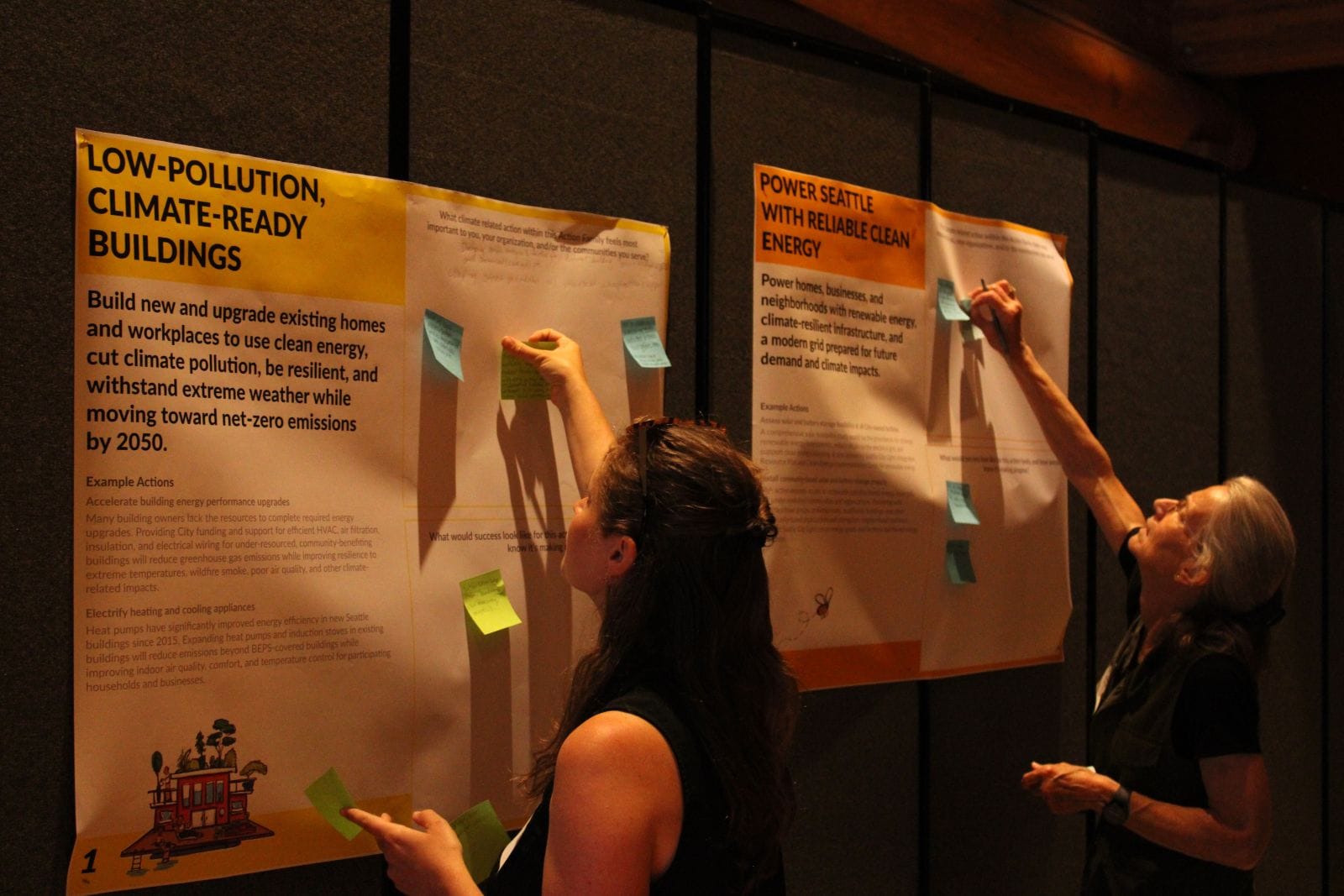
The category-based approach appealed to many of the attendees.
“I was really interested, seeing how they’ve taken a new approach with the action families,” Shemona Moreno, executive director of 350 Seattle, told The Urbanist. “It really is that broad. There are 10 areas [of action], and you could probably add 10 more.”
Even though 350 Seattle has long been focused on addressing the root causes of the climate crisis, Moreno had resilience and adaptation front-of-mind coming out of the forum, in part because she has seen how chronic illness has made people within 350 Seattle particularly vulnerable to heat.
Even in discussions of action families not explicitly about adaptation, participants proposed ideas that would address the topic. For instance, in a group discussing how Seattle can maintain and bolster its supply of reliable clean energy, multiple people proposed ideas that would strengthen the grid and local resilience at the same time. One suggested helping neighborhood groups to get solar power stations in case of blackouts; similarly another proposed providing community centers with battery backups. Others proposed things like community solar, balcony solar, battery installations, and other kinds of distributed energy resources that support moving toward a decentralized grid that would likely be well situated to withstand the strains of extreme weather.
Another recurrent theme was the need for the city to find ways to partner with surrounding agencies and municipalities. For instance, on the topic of food systems, one participant highlighted the need to recognize that most of the food that Seattleites eat is grown outside city limits but nonetheless remains relevant to the city’s broader climate goals, and the city must find ways to encourage both eating habits and farming practices that are planet-friendly.
Consumption-based climate pollution is something that OSE, Seattle Public Utilities, and King County have been studying, as well. In 2023, the city released a “consumption-based emissions inventory” that accounts for climate pollution produced directly within city limits as well as any and all emissions associated with a Seattleite’s activities, whether that be buying a car, grabbing groceries, or ordering off Amazon.
“A consumption-based emissions inventory opens up the scope a little bit more to see what else is happening in specific sectors,” Ani Krishnan, OSE’s climate data and policy manager, told The Urbanist. “So for buildings, it shifts the conversation from operational emissions to thinking about the energy and emissions expended to put that building there.”
Such inventories also would account for emissions and waste from demolitions as well. This then forces the city to think not just about incentivizing heat pumps and other electric appliances but also promoting green construction practices, like shifting from concrete to cross-laminated timber, or even second-hand building materials salvaged through deconstruction.
This consumption-based approach inherently requires the City to expand its approach to action beyond its city limits, and with King County, Puget Sound Clean Air Agency, and the Washington State Department of Ecology all having adopted their own climate action plans within the last year, the time is ripe for fostering regional partnerships.
Any collaborations should not just be about infrastructure resilience and emissions reductions, but also stewardship of the environment and crucial watersheds. “Wind blows. Water flows,” Emily Pinckney, co-founder of the nonprofit Breaking Barriers Collaborative, told The Urbanist.
Sean Dixon, executive director of the nonprofit Puget Soundkeeper, also emphasized the importance of a regional approach to water stewardship.
“We keep deciding how we govern the built environment based on artificial lines on a map drawn a century ago, as opposed to the way things work in the real world, which is watershed by watershed and microclimate by microclimate,” Dixon told The Urbanist. “If you’re not planning by the watershed, then you’re not accomplishing your goals of protecting this receiving water or protecting this community.”
This kind of approach matters across the country, he added, “and here it’s even more required because of the geology of our basin, thanks to the glaciers and how our systems work.”
As someone with a long career working to clean up and defend waterways and water bodies in Seattle and elsewhere — including in New York during the response to Hurricane Sandy — Dixon regularly thinks about climate resilience, particularly for the Duwamish Valley. The valley has already had to cope with tidal flooding, but as sea levels rise, it will only get worse. South Park and Georgetown need to be meaningfully prepared for this, he said. To Dixon, the sandbags and pumpstations that SPU has so far deployed are “literally the opposite of resilience. That is just another thing that can fail.”
As he and Puget Soundkeeper see it, meaningful solutions would involve investing in nature-based efforts that slow the flow of rainwater, threading it into the ground, and restore portions of the marshlands that were filled in across the river valley. This would in turn create bulwarks and diversions against the floodwaters.
But whether in the Duwamish Valley or elsewhere, it is becoming increasingly clear that fostering resilience to climate extremes is critical — as is eliminating emissions. So the challenge going forward for climate-concerned community groups, for the city, for the county, and for the state is to mitigate the drivers of climate change at the same time that they adapt to its dangers.
“Climate catastrophe is here,” Pinckney said, “and we have to prepare for it.”
Disclosure: Reporting for this story was funded by the Seattle Office of Sustainability and Environment, with the understanding that Syris Valentine and The Urbanist will be allowed editorial independence on the contents and language of the published story.