Rise in US preteen suicide rate alarms mental health experts
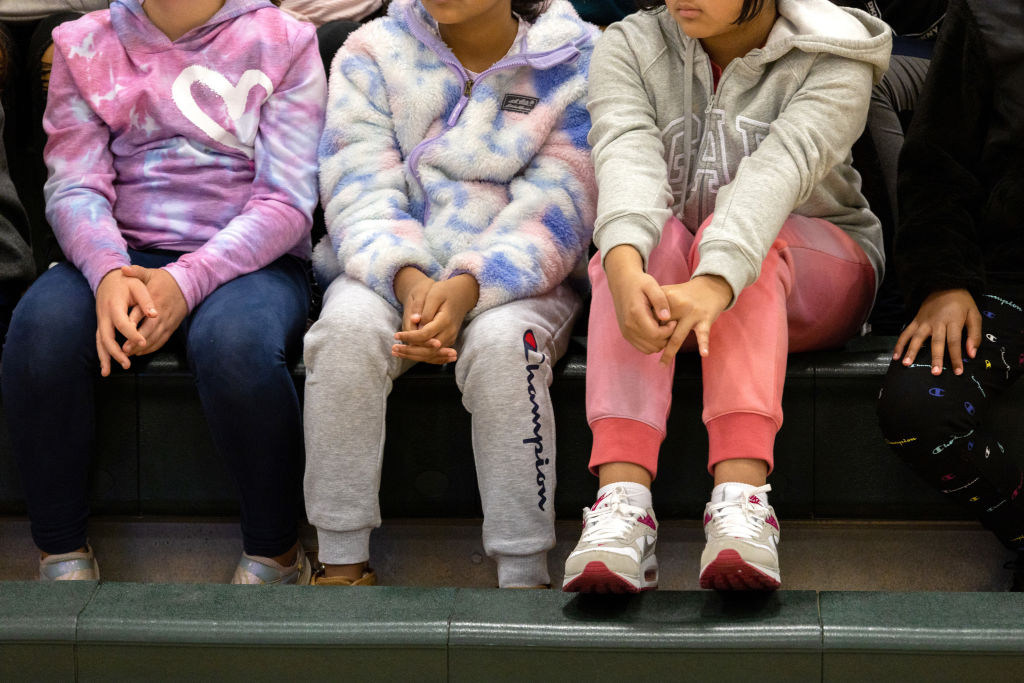
Eighth-grade students listen to a lecture on internet safety and cyberbullying at a middle school assembly in Connecticut in 2022. Experts studying the rise in pediatric suicide point to many stressors for preteens, including COVID-19 fallout, social media use, lack of sleep, bullying both online and in person, and policies restricting gender-affirming care for trans kids that have created fear for some LGBTQ+ youth. (Photo by John Moore/Getty Images)
Editor’s note: If you or someone you know needs help, call or text 988, the U.S. suicide and crisis lifeline, or access online chat at 988lifeline.org.
For months, Marie’s 11-year-old daughter wasn’t acting like herself. The fifth grader was often fatigued, sleeping more. She wasn’t eating enough, and spent more time alone.
“She wasn’t really motivated to do things with her friends,” Marie said.
The Chicago girl had been overwhelmed with worry for her father, who was recovering from diabetes complications after a serious infection. She also felt intense pressure at school, aiming for straight As.
“Ever since Dad went to the hospital, it just made it more intense,” she told her mom in a written note. “I don’t know how to feel. I’m having thoughts about hurting myself. I’m tired, and afraid of death.”
Earlier this year, she told her mom she’d tried to cut herself in the bathroom, and said she was hurting herself at school. Stateline is withholding Marie’s full name to protect her daughter’s privacy.
Marie took her to the emergency room. The ER staff tried to transfer the girl to a psychiatric facility, but several refused to take her. Most only served teenagers, while others didn’t accept her insurance plan. The emergency department team finally found a place for her at a child psychiatric facility nearly an hour away.
Marie’s daughter recently finished an intensive outpatient therapy program, and is seeing a therapist regularly.
“We were able to get her the help that she needed,” Marie said. “But a lot of the times, there’s kids that struggle and unfortunately, do end up taking their life.”
In the past several years, numerous studies have pointed to a mental health crisis among America’s youth. Much of the attention has focused on teenagers, who have higher suicide rates.
But preteens are struggling, too.
The number of preteens — ages 8 to 12 — who die by suicide in the United States each year is relatively small. But the total in 2025 was 194 — the most since at least 2001, according to preliminary data from the federal Centers for Disease Control and Prevention.
Since 2008, the rate of preteen suicide has increased by an average of 8.2% annually, according to researchers at the National Institutes of Health. Their analysis, published in 2024, found that Black preteens had the highest overall suicide rate, while girls and Hispanic preteens had the greatest percentage increase. Native American preteens also saw some of the most pronounced increases.
Suicide is complex and is often the result of a combination of factors. Talking with trusted adults and connecting kids with help can aid in prevention, and research shows most who have suicidal thoughts do not carry through with them. Mental health experts and advocates are calling for more mental health check-ins with preteens, earlier screenings and tailored interventions for Native, Black and LGBTQ+ preteens.
Jenny Britton, chief clinical officer at the Washburn Center for Children in Minneapolis, a nonprofit mental health practice, has noticed the long-term trend during her 25-year career.
“I’ve watched the age of kids who struggle with suicidal ideation and suicidality get younger and younger over that time,” she said. “Now, we’re seeing even as young as our 7- and 8-year-olds.”
Last year, the overall suicide rate in Minnesota increased by 4% compared with the year before, according to preliminary state data. But the suicide rate among children ages 10 to 14, the youngest age group included in the state’s report, more than doubled compared with the five years prior, from 2.2 per 100,000 people to 5.8.
Kids are feeling unsupported. They have more alone time. They’re more isolated. People aren’t really picking up on some of the clues of depression as early.
– Dr. Prachi “PJ” Striker, a child and adolescent psychiatrist, Children’s Minnesota
Four years ago, when the inpatient mental health unit opened at Children’s Minnesota, a Minneapolis-based health system, providers mostly saw teenagers, said Dr. Prachi “PJ” Striker, a child and adolescent psychiatrist. That’s still true, but over the past year-and-half, the unit has seen more 10- to 12-year-olds who have harmed themselves, attempted suicide or said they’ve considered it.
“(We’re) seeing more of the younger age group coming in,” Striker said. “Depression, anxiety, hopelessness, feeling overwhelmed, suicidal thoughts.”
The American Academy of Pediatrics now recommends that pediatricians start screening all patients starting at age 12 for suicidal thoughts. But for preteens ages 8 to 11, the academy only recommends a suicide screening if the child is coming to the doctor for behavioral health concerns or has a history of suicidal thoughts.
But Striker said screening as early as age 8 can prevent kids from slipping under the radar.
“How do we start identifying kids who are in trouble faster?” Striker said. “Kids are feeling unsupported. They have more alone time. They’re more isolated. People aren’t really picking up on some of the clues of depression as early.”
Stressors
Many mental health experts point to COVID-19 as a major factor that harmed the mental health of kids who are now preteens.
“You have to remember these kids who are like 10 to 12, their early elementary years were COVID years, and so kindergarten, first grade, second grade were often at home. They didn’t have those normal experiences of going to school, starting to socialize,” Striker said. “They’re going into third, fourth, fifth grade, having been home and quarantined for the first few years of their school lives.”
Thousands of kids lost loved ones to COVID-19, including their parents. Children of color make up a disproportionate number of those whose caregivers were killed by the virus.
“I was hopeful that as people were able to get back to their friends and school and normalize, that that would get better, but it really hasn’t,” said Dr. Maria Hughes Rahmandar, chair of the American Academy of Pediatrics’ Council on Adolescents and Young Adults and an associate professor of pediatrics at Northwestern University’s Feinberg School of Medicine. “Preteens and teens are really continuing to struggle with more and more mental health concerns.”
Experts also point to other stressors for preteens, including social media use, lack of sleep, bullying both online and in person, and policies restricting gender-affirming care for trans kids that have created fear for some LGBTQ+ youth.
Jeremy Pettit, a professor of psychology at Florida International University who specializes in depression, anxiety and suicidal behaviors in children and adolescents, is studying how sleep – and screen time right before bed – relates to kids’ mental health.
“When (sleep is) disrupted, it’s bad for everything – physical health and mental health. The data are pretty clear that our kids are not getting enough sleep at night,” said Pettit, who directs FIU’s Center for Children and Families.
“We’ve got early school times in most of the country, even though the data, the research is pretty clear, it would be healthier for our kids not to have them go to school at 7 every morning,” he said.
Peter Gray, a researcher and emeritus professor of psychology at Boston College, contends that changes in schooling in recent decades, such as the standardization of curriculum, created “a new source of anxiety and depression on top of everything else.” He also pointed to a trend of less unstructured playtime outside.
“That’s normal childhood,” Gray said of unstructured play. “This is how children learn to take charge of their own lives. It’s how children learn to negotiate differences with other people. It’s how children learn that they can solve their own problems.
“We have been gradually, over time, taking that away from children,” he said.
Unlike many other child development experts, Gray argues that computers and smartphones have actually helped children by re-creating some of the social networking that used to happen outside.
But a 2024 analysis by the CDC found that frequent social media use was associated with bullying at school, persistent feelings of sadness or hopelessness, and some suicide risk among students. More than 40 states have sued social media companies over mental health concerns among kids.
Other experts say too much exposure to media of all kinds may also be causing kids stress.
“I think about my childhood in the ’70s and ’80s. I didn’t know all the details of shootings or a bomb going off, or you had to read about it in the newspaper or watch the news,” said Britton, of the Washburn Center for Children.
“Kids are wrestling with things differently than I wrestled with things. They know more, so they’re thinking about more.”
Talking with kids
Experts say parents, teachers, coaches, clergy — anyone who interacts with kids — shouldn’t fear talking to them about suicide and mental health, especially if they notice withdrawal, sadness or stress.
Jamie Freeny, who was the director of the Center for School Behavioral Health at Mental Health America of Greater Houston until earlier this year, said that more elementary schools have started to ask for suicide prevention training.
“If the elementary schools are asking for it, that lets me know that there’s a reason,” said Freeny, who now works as a mental health consultant. “It’s very, very sad.”
There’s this myth that if you talk to kids about suicide, you’re going to put the idea in their head.
– Lisa Horowitz, visiting professor of child psychiatry at the University of Colorado Anschutz School of Medicine
The American Foundation for Suicide Prevention has resources for parents or others who frequently interact with kids, including a toolkit called “Talk Saves Lives” that offers guidelines and tips for steering such conversations.
Lisa Horowitz, a visiting professor of child psychiatry at the University of Colorado Anschutz School of Medicine and who conducts research for the National Institutes of Health, said many parents tell her they’re afraid to bring the topic up with their kids.
“There’s this myth that if you talk to kids about suicide, you’re going to put the idea in their head,” Horowitz said, adding that research shows talking about it can actually help.
“If you can detect suicide risk early, like in preteens or even even younger, then you can intervene early, and and then you can prevent a lot of psychiatric disorders that occur in adulthood.”
Kids may tell their friends and may not necessarily come to their trusted adult first, making proactive conversations important, added Horowitz, who co-authored the study on the annual increase in preteen suicide and has developed screening tools.
“Most parents are surprised by a suicide attempt, and it’s not because they’re a bad parent, and it’s not because they’re not paying attention. It’s because kids keep these thoughts to themselves,” she said.
“It’s an awkward but critical conversation to start. … So even if you say to a kid, ‘OK, this is really awkward, and I’m not even sure how to ask about this, but I care about your life. So, do you ever think about killing yourself?’”
Britton said even just asking about a change in a child’s mood can help.
“Work hard to figure out how to engage with your kids around really hard topics,” said Britton. “It does something so innate within the human experience if another person can say, ‘Today you looked really sad. Is there anything you want to share with me about that?’”
In Chicago, Marie and her husband have started fundraising for the American Foundation for Suicide Prevention. As they’ve shared their story, other parents have opened up to them about the struggles of their own preteen kids.
“My husband and I want to be our daughter’s voice,” Marie said. “To help somebody else — even if it’s one person.”
Stateline reporter Nada Hassanein can be reached at nhassanein@stateline.org.
This story was originally produced by Stateline, which is part of States Newsroom, a nonprofit news network which includes Arizona Mirror, and is supported by grants and a coalition of donors as a 501c(3) public charity.