Republicans in US Senate left in dark by Trump on Iran deal, but want details and a vote
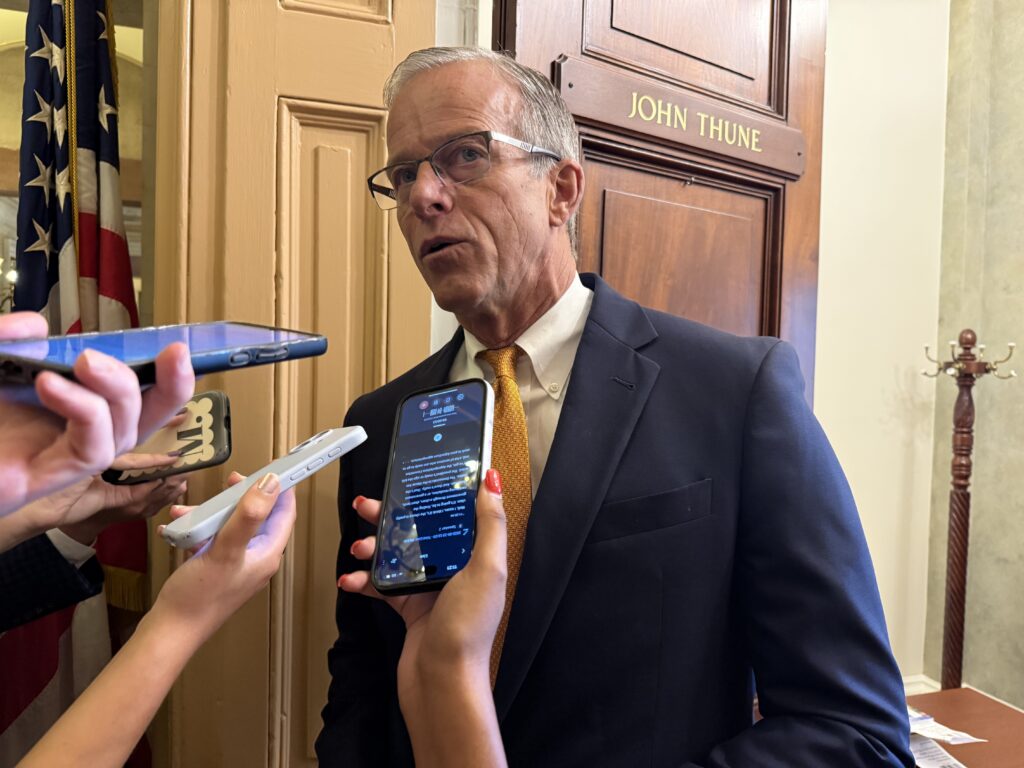
U.S. Senate Majority Leader John Thune, R-S.D., said on Tuesday, June 16, 2026, he’s heard the president’s deal with Iran sets up a 60-day framework for negotiators to reach agreement on more specifics. In this photo, Thune speaks with reporters on Capitol Hill on Sept. 19, 2025. (Photo by Jennifer Shutt/States Newsroom)
WASHINGTON — U.S. senators from both political parties said Tuesday they had yet to see the text of the deal Trump administration officials struck over the weekend to end the war in Iran, though several indicated any final agreement will require their approval.
Senate Majority Leader John Thune, R-S.D., said administration officials have signaled they expect to share the text of the memorandum of understanding with lawmakers, though he didn’t know when.
“Hopefully that’ll happen sooner rather than later,” he said. “But, you know, obviously it sounds like they’re not going public with it until later in the week. So we’ll see.”
Thune said he’s heard the deal sets up a 60-day framework for negotiators to reach agreement on more specifics, including about Iran’s nuclear ambitions.
“I think at the end of the day the goal here is to make sure that Iran ends its nuclear program and whatever financial incentives they have should be conditioned upon that,” he said. “But we’ll see when we know more.”
President Donald Trump, speaking from the G7 convention in Europe, said he may hold a press conference in “a couple days” to release the text of the memorandum of understanding and appeared ready for a vote in Congress.
“What I would like to do is send it to Congress, saying you shouldn’t approve it. And I will get it approved. Whatever I say, they want to do the opposite,” he said. “It is not working too well for them, by the way.”
North Dakota Republican Sen. John Hoeven said he believes the plan is to vote to approve the Iran agreement at some point.
“I think anytime you have Congress ratify something, it gives it longevity,” Hoeven said. “You can’t have the next president come in and change it with an executive order. So I think that’s a benefit. I think it helps strengthen it.”
Hoeven said he hasn’t heard from administration officials why they haven’t shared the text of the memorandum of understanding with senators, even in a classified setting. But he said he’s more focused on U.S. enforcement of agreements on Iran’s nuclear program in the long term.
“The real issue is that we have something that we can enforce and that’s hard with Iran because they don’t honor any agreement,” Hoeven said.
Is the agreement a treaty?
Louisiana Republican Sen. Bill Cassidy said he believes an agreement with Iran would represent a treaty and be subject to Senate approval.
“It sounds like a treaty,” he said. “And if it’s a treaty, it certainly seems like it.”
That would require strong bipartisanship, since the Constitution sets a two-thirds threshold for the Senate to approve a treaty.
Cassidy added it appears the administration will need the Israeli government — which initiated the attack on Iran with the United States — to stop its war in Lebanon in order to reach a final deal with Iran during the next two months.
“To make a deal, it takes two sides. In this case, maybe three, maybe four because you have Hezbollah and Israel,” Cassidy said, referring to a powerful Lebanese political party and militant group opposed to Israel. “Hezbollah can just stir it up with impunity if they want to under certain circumstances. So you tell me, I mean, it takes two to dance, and so now it takes four to dance. Can you pull it off in 60 days? I don’t know.”
North Carolina Republican Sen. Thom Tillis said the administration needs to be as transparent as possible about what exactly is in the memorandum of understanding it’s reached with Iran.
“Minimally, there has to be maximum transparency,” he said.
Tillis said it “makes sense” for the Senate to approve any final deal, saying President Barack Obama made a mistake when he didn’t have lawmakers ratify the agreement his administration struck with Iran in 2015. That deal was named the Joint Comprehensive Plan of Action, or JCPOA.
“I’ve said repeatedly Obama made a mistake when he didn’t do the work to have it rise to the level of a treaty, and I believe that we should here,” he said. “Otherwise, it’s only good for two and a half years.”
Tillis said he wasn’t concerned Congress hasn’t received the text of the memorandum of understanding yet, but that it’s imperative the administration share those documents.
“Trust but verify,” he said.
‘Essentially a surrender’
Connecticut Democratic Sen. Chris Murphy said he “doubts” the memorandum of understanding is actually real, but that if it is, lawmakers should expect there are “side deals” the administration may not share.
“If what’s reported is real, it’s Iran’s terms. I mean, it’s essentially a surrender. But I think that’s the only play we can make at this point,” he said. “We have to end this war and stop wasting money and stop killing Americans and civilians and stop driving up prices. So it’s a bad deal but he’s not going to get a better deal. So we just have to accept the humiliation. But I don’t even know if it’s real.”
West Virginia Republican Sen. Shelley Moore Capito said that lawmakers need to see the memorandum of understanding so she and others can “express our opinions.”
“But right now we can’t because it’s not fully out there,” she said.
Senate Intelligence Committee ranking member Mark Warner, D-Va., said he hadn’t seen the text of the memorandum of understanding or been briefed by administration officials. But he does believe the administration needs to submit it to lawmakers within five days, as outlined in a 2015 law.
“My fear is that the details are not going to be as good as the president represents,” Warner said.
Law requirements
Congress approved legislation in 2015 that requires any presidential administration to submit the text of a deal addressing Iran’s nuclear program within five days. Those documents don’t need to be sent to every lawmaker but are supposed to go to the congressional leaders as well as eight committees with jurisdiction.
That transmission creates a 30-day review period for the Senate Foreign Relations Committee and the House Foreign Affairs Committee to hold hearings and briefings.
The law created a pathway for Congress to approve a joint resolution of disapproval for any Iran nuclear deal. The House and Senate would likely need the support of at least two-thirds of members in order to override a likely veto from Trump.
Congress overriding a presidential veto of a disapproval resolution would block the Trump administration from lifting sanctions on Iran, though that seems an unlikely scenario given both chambers are controlled by Republicans.
A report from the nonpartisan Congressional Research Service says a joint resolution of disapproval taking effect “would not invalidate the agreement itself but would affect only the possibility of presidential sanctions relief to Iran; nevertheless, precluding the President from providing such relief would almost certainly result in a dissolution of the agreement by Iran.”
The law, officially titled the Iran Nuclear Agreement Review Act of 2015, also clears the way for Congress to approve a joint resolution of approval.
The CRS report says that “would, upon enactment, allow the President to waive sanctions, apparently even if the review period had not yet elapsed.”
Congress taking no action during the 30-day review period would allow the administration to begin sanctions relief as soon as that deadline passes.