Rent Freeze Kicks In For Stabilized Apartments, And What Else Happened This Week In Housing
“It’s this feeling of relief for so many people at a time when costs are going up for so many other parts of our lives,” said Sumathy Kumar, director of Housing Justice for All, which helped organized tenants to push for a rent freeze.
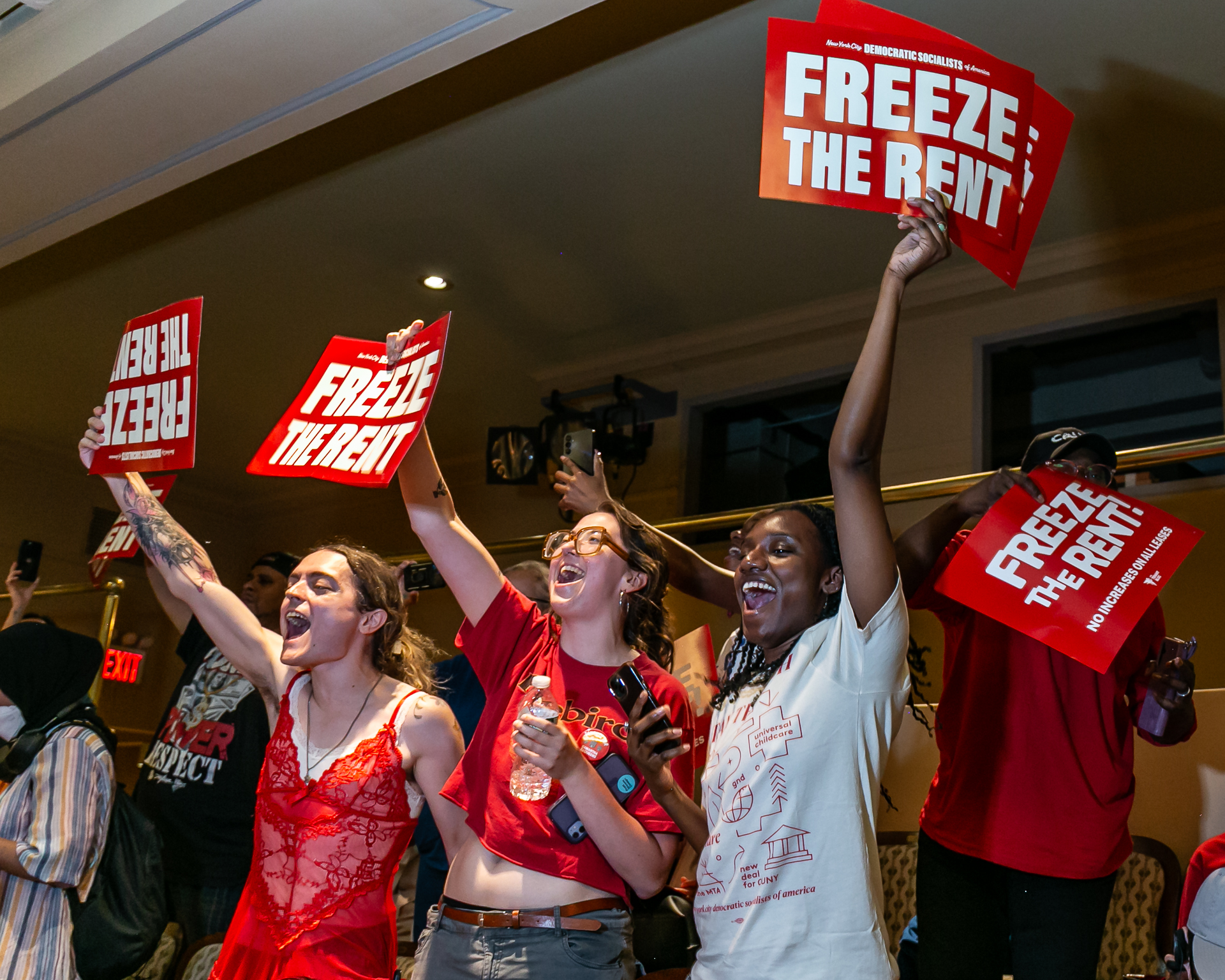
A rent freeze for tenants in rent-stabilized apartments across the city took effect Thursday—fulfilling one of Mayor Zohran Mamdani’s key campaign promises, and marking the first time renters in regulated units were granted a freeze on both one- and two-year leases.
It comes after five years of annual rent increases, hikes that ranged from 1.5 to 3 percent. The board last voted for a freeze during the COVID-19 pandemic in 2020.
“It’s this feeling of relief for so many people at a time when costs are going up for so many other parts of our lives,” said Sumathy Kumar, director of Housing Justice for All and the NYS Tenant Bloc, which has been organizing renters across the city in support of a freeze. “To know that we can sign two-year leases with no rent hikes guaranteed—it’s extraordinary.”
Here’s what you need to know:
- Tenants in stabilized apartments can’t be subject to a rent hike on any leases signed between now and Sept. 30, 2027, according to rules approved by the city’s Rent Guidelines Board in June
- Not sure if your apartment is rent stabilized? You can find out by requesting a rent history of the unit from the state, by filling out this form
- Rent stabilized tenants are entitled by law to the option of signing either a one- or two-year lease, and landlords are required to issue a written lease renewal between 90 and 150 days prior to the expiration of the existing lease. If your landlord doesn’t, you can file a complaint with the state through this form
The Rent Guidelines Board votes each year on whether to allow a rent increase (and how much of one) for the nearly 1 million New York City rentals that fall under the stabilization law (these units are generally found in buildings of six or more apartments constructed before 1974, or in properties that received public financing or certain tax breaks).
Around two-thirds of the more than 2 million New Yorkers living in rent-stabilized housing earn below 200 percent of the federal poverty line, according to the nonprofit Robinhood—equivalent to a family of four earning $66,000 a year or less.
“Rent stabilized tenants are struggling,” said Ellen Davidson, a staff attorney with the Legal Aid Society’s Civil Law Reform Unit. “They are rent burdened, and they are making hard choices. They are having to choose between needed medicine and paying the rent. They’re cutting back on food.”
But the owners of rent stabilized buildings say they’re struggling, too. They point to rising expenses like property taxes and insurance, and say two years of flat rents will make it difficult to cover those costs while maintaining their often-aging properties, particularly for buildings with little or no market-rate units.
In a video posted to social media Thursday, Kenny Burgos, head of the New York Apartment Association, which represents landlords of regulated apartments, pointed to the currently spiking prices for heating oil, spurred by the war in Iran, just as colder weather is setting in.
“Think about what we’re asking these buildings to do: heat the buildings with oil and gas at war prices, which the owner has absolutely no control over,” he said. “The rent, also no control. That stays exactly the same.”
But tenant advocates say the Rent Guidelines Board considers such factors in its deliberations. The board, its members appointed by the mayor, bases its decision on a number of factors, including data about both landlords’ and tenants’ incomes and expenses, economic conditions that year, and testimony from the public.
“The Rent Guidelines Board looks at the net operating income for landlords, which is their profit margins, right? How much money they are making after they pay off their costs, and they found that net operating incomes, aka profit, has gone up this past year. It has been going up steadily throughout the Eric Adams administration and into this one,” Kumar said.
Still, several landlords are currently challenging the rent freeze in court, claiming the Mamdani administration “stacked the deck” by appointing new RGB members sympathetic to tenants, and in doing so “preordained” the outcome of the June vote (the mayor has maintained that the board acted independently).
In Kumar’s view, the mayor merely “appointed people who were going to listen to what tenants had to say.”
“Tenants will say that this is the year, for the first time, they actually felt listened to, and to me that’s about leveling the playing field. It’s not about tipping scales,” she said.
“Every single mayor has the opportunity to appoint people to the Rent Guidelines Board,” tenant lawyer Davidson said.
“When I first started practicing, the chair of the Rent Guidelines Board was named Marvin Marcus, and he was pretty clear that he didn’t think that the data about how tenants were suffering was something he needed to weigh heavily,” she added. “And during the [2008] financial crisis, we saw some of the highest increases.”
Here’s what else happened this week in housing—
ICYMI, from City Limits:
- Officials broke ground on construction of 229 senior apartments on open space at NYCHA’s Morris Houses, part of a city effort to use more public land to build affordable housing.
- The first major repair project for NYCHA financed by the new Public Housing Preservation Trust is kicking off this fall at Brooklyn’s Nostrand Houses.
- The Upper East and West Sides, Elmhurst, and Bayside are among the communities that have built little affordable housing over the past five years, and now will see certain projects fast-tracked under new city rules.
- The Sanitation Department wants to more than double the fine—from $100 to $250—for owners who fail to keep vacant lots clean.
ICYMI, from other local newsrooms:
- The attorney representing landlords in a lawsuit challenging the rent freeze is asking a court to order the Mamdani administration and Rent Guidelines Board members to sit for interview about their communications, Gothamist reports.
- Congress will allocate $600 million to provide rental assistance to people whose emergency housing vouchers are set to expire early, according to The City Reporter—thought it’s unclear how much of that will go to New York.
- A court ordered the Mamdani administration to re-do its rollout of a new tax on pricey second homes, according to the New York Times.
To reach the editor, contact Jeanmarie@citylimits.org
Want to republish this story? Find City Limits’ reprint policy here.
The post Rent Freeze Kicks In For Stabilized Apartments, And What Else Happened This Week In Housing appeared first on City Limits.
Check this story
Is this AI-made?
AI checkers give a likelihood, not proof.