Reflecting Pool damaged before Olympian charged with felony touched it, witness says
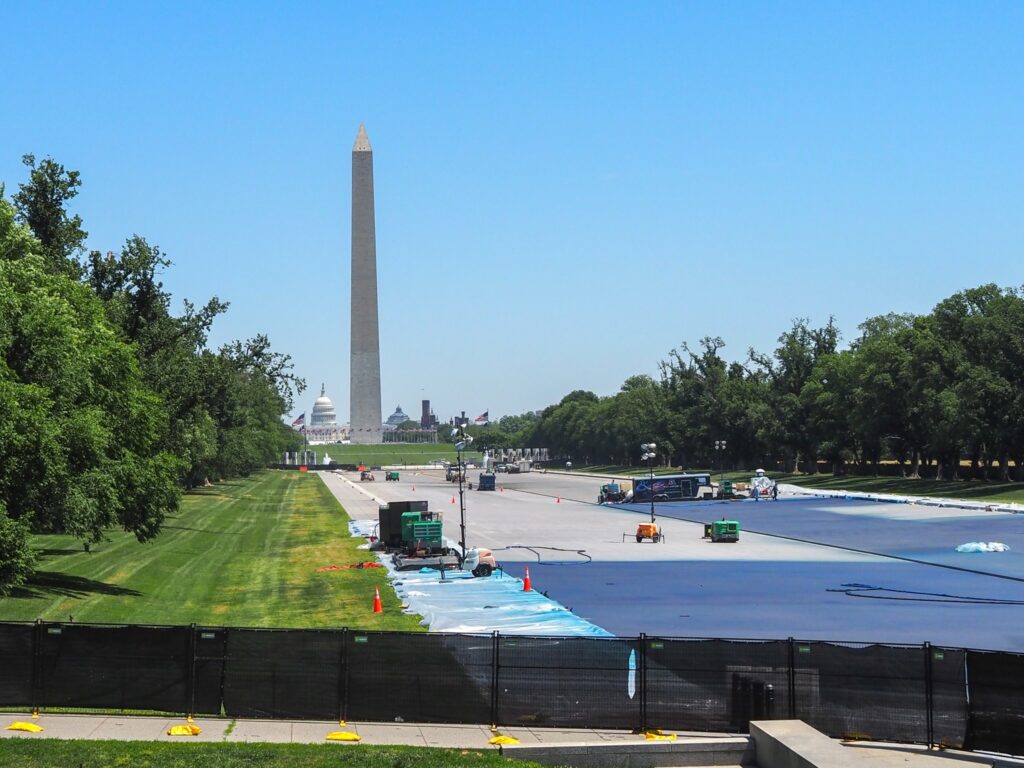
David Hearn, of Bethesda, Maryland, is charged with destruction of property of more than $1,000 for allegedly vandalizing the newly refinished Lincoln Memorial Reflecting Pool on June 19, 2026. Shown is construction at the Reflecting Pool in Washington, D.C., on May 5, 2026. (Photo by Ashley Murray/States Newsroom)
WASHINGTON — Attorneys representing the former Olympic canoeist charged with damaging part of the Lincoln Memorial Reflecting Pool have asked the judge in the case to release more information from the grand jury.
David Hearn’s legal team wrote in a motion that “the Government’s sole grand-jury witness on damages testified that the property was already damaged before Mr. Hearn allegedly touched it; that the same repairs would have been required regardless of Mr. Hearn’s conduct; and that he could not quantify any loss attributable to that conduct.”
U.S. Attorney for the District of Columbia Jeanine Pirro charged Hearn, of Bethesda, Maryland, with destruction of property of more than $1,000 for allegedly vandalizing the newly refinished Lincoln Memorial Reflecting Pool on June 19. President Donald Trump, who has closely overseen the multi-million-dollar renovation of the Reflecting Pool, has blamed vandals for damage to it.
Hearn on July 9 pleaded not guilty during a brief court hearing and was released on his own recognizance.
In the latest motion, the three lawyers defending Hearn asked the judge to release the legal instructions given to the grand jury and a transcript or notes of all grand jury proceedings in the case.
Mary L. Dohrmann, principal attorney at Washington Litigation Group, Steve Levin, senior counsel at Steptoe LLP and Norm Eisen, co-founder and executive chair of Democracy Defenders Fund, wrote in the brief the testimony from the one witness raised questions about whether the grand jury understood the legal standard to charge someone with a felony for destruction of property greater than $1,000.
While grand jury deliberations are normally private, the lawyers wrote a rule “authorizes disclosure of the grand jury materials needed to determine whether a ground exists to dismiss the indictment.”
They argue in the motion the National Park Service official who testified in front of the grand jury didn’t say that Hearn caused that level of damage.
“The witness’s testimony established that the pool had substantial preexisting damage requiring repair before any alleged conduct by Mr. Hearn,” the lawyers wrote. “According to the witness, the pool was leaking more than one million gallons of water per week; its expansion joints had exceeded their service life; and the liner already contained a rip.
“The government’s witness further confirmed that repairs were already necessary to address those conditions.”
That NPS official said repairs costing between $6,000 and $15,000 would have been needed regardless of whether Hearn “interacted with the pool,” according to the motion.
The transcripts prosecutors shared with Hearn’s legal team so far “contain other irregularities that reflect a misleading presentation to the grand jury and a need for review of the entire grand jury record in this matter.”
“For one, the government failed to present the widely available photograph, discussed in Mr. Hearn’s Rule 41(g) Motion, that by the government’s own account was taken by Mr. Hearn before he ever touched the Reflecting Pool—and, accordingly, proves that he caused no damage to the pool,” the legal team wrote. “In addition, the government failed to present its central witness against Mr. Hearn to the grand jury, instead submitting that witness’s hearsay statements through an investigator, who emphasized that it ‘was not a sworn statement’ that he took from the witness.”
Hearn’s legal team added that the information they have so far about the grand jury process “raises the issue of whether the government should have known it was presenting false or misleading testimony to the grand jury.”