Oregon’s western state forests will see more conservation, less clear cutting under new plan
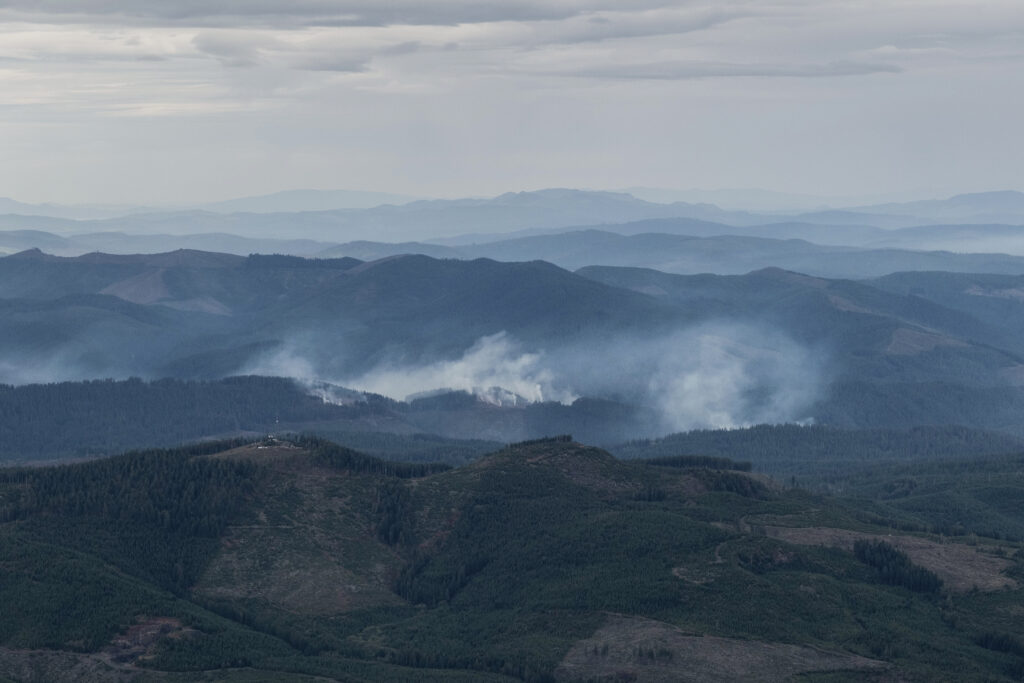
Slash piles burn after clearcutting near the Tillamook State Forest in western Oregon, on Friday, Oct. 13, 2023. (Jordan Gale / Oregon Capital Chronicle)
Oregon forestry officials will need to manage hundreds of thousands of acres of western state forests to better support critical species, water and air quality and to decrease greenhouse gas emissions under a new management plan the Board of Forestry approved Wednesday.
The seven-member board voted 5-2 to pass the 168-page Western Oregon State Forests Management Plan. The new plan, which will guide the Oregon Department of Forestry’s work in 640,000 acres of state forests in 14 counties and mostly in northwest Oregon over the next several decades, will take effect by July 1, 2027.
It lays out the priorities, goals and strategies for the department in those forests, which include supporting economies dependent on timber, forest products, agriculture and mining, and a slate of ecological priorities as well: ensuring clean air and water, adapting to and fighting climate change, and protecting wildlife habitat and plant diversity.
Between the new management plan and its older, bigger sibling — the Western State Forests Habitat Conservation Plan, a 2024 document outlining to the federal government how the state will commit to saving 17 threatened and endangered species in Oregon’s western state-owned forests to avoid losing them — timber volumes from those forests are expected to decline by about one-fifth in the next several decades. Oregon is waiting on final approval of it’s habitat conservation plan from federal science and wildlife agencies, expected later this fall or early winter.
Oregon’s western state forests represent about 86% of the total acreage owned and managed by the state. The plan applies only to state-owned acres, not any private or federally managed forests.
Commission members Heath Curtiss, a lawyer and vice president for Hampton Lumber, and Joe Justice, director of the timber advocacy group Associated Oregon Loggers, voted in opposition. Both insisted that the Trump administration’s recent changes to the federal Endangered Species Act, including rolling back protections for forests, wetlands, deserts and other critical species habitats, will leave Oregon vulnerable to lawsuits under the new plans. Conservation groups are challenging those changes in federal court.
The two management plans have been years in the making, and drafts have received significant input, and ire, from the timber industry and from conservation groups over the years. But on Wednesday, it was clear conservation groups saw the final forest management plan and vote as a win.
“After decades of clear-cutting state forests and driving imperiled fish and wildlife to the brink of extinction, the Board of Forestry has finally taken a step forward to protect and improve essential habitat for their survival,” Joe Liebezeit, conservation director of the Bird Alliance of Oregon, said in a statement.
New priorities
Together, the plans will restrict logging on about 50% of Oregon’s western state forests, deeming them either off limits, inoperable or too expensive to harvest. Overall logging is projected to decline by 20% in western forests in 14 counties during the next 70 years.
The remainder of the acres face fewer restrictions, but about 40% will need to be maintained to support the migration and movement of the endangered Northern spotted owl, and for their potential to absorb and store planet-warming carbon dioxide.
Among the new priorities laid out in the state’s management plan is combating climate change and generating revenue by harnessing the carbon-storing power of trees via reduced logging, protecting old-growth and letting trees grow older. In exchange, the state could enter acreage into a voluntary carbon market generating credits bought by polluting industries hoping to reduce their own emissions by proxy.
The forests in Oregon’s Coast Range absorb and store more carbon per acre than almost any other forests in the world – including the Amazon Rainforest, according to research by Bev Law, professor emeritus of forest ecology at Oregon State University and an expert on global forest carbon storage.
Banking on Oregon forests: In fight against climate change, financial markets see green in Oregon
The 83,000-acre Elliott State Forest near Coos Bay, which is managed by the Oregon Department of State Lands, is in the process of entering a voluntary carbon market for the next 40 years.
Kacey KC, Oregon’s new state forester, offered her support for the management plan ahead of the board’s vote. At the meeting she said that while she acknowledged challenging federal headwinds and rules around endangered species protections, she understood that the board’s job was, simply, to ensure the forestry department manages Oregon’s resources for multiple benefits: economic, social and ecological.
“Not one is stated over another, and we have a responsibility to future generations to ensure that we are doing the best for the future. I think this plan is a good balance,” she said. “We’ve come a long way in eight years, and I don’t think because of a change that might happen at the federal level, or might not, we should completely throw that out in the moment.”
Curtiss characterized the entire meeting and vote as an academic exercise, and said the management and habitat plans would likely be forced to fundamentally change in the near future.
“I think it would be a mistake to conclude that this story is over,” he said. “And it’s never actually over as it pertains to state lands.”