Oregon Health & Science University president says neonatal ICU expansion is a top priority, but offers no timeline
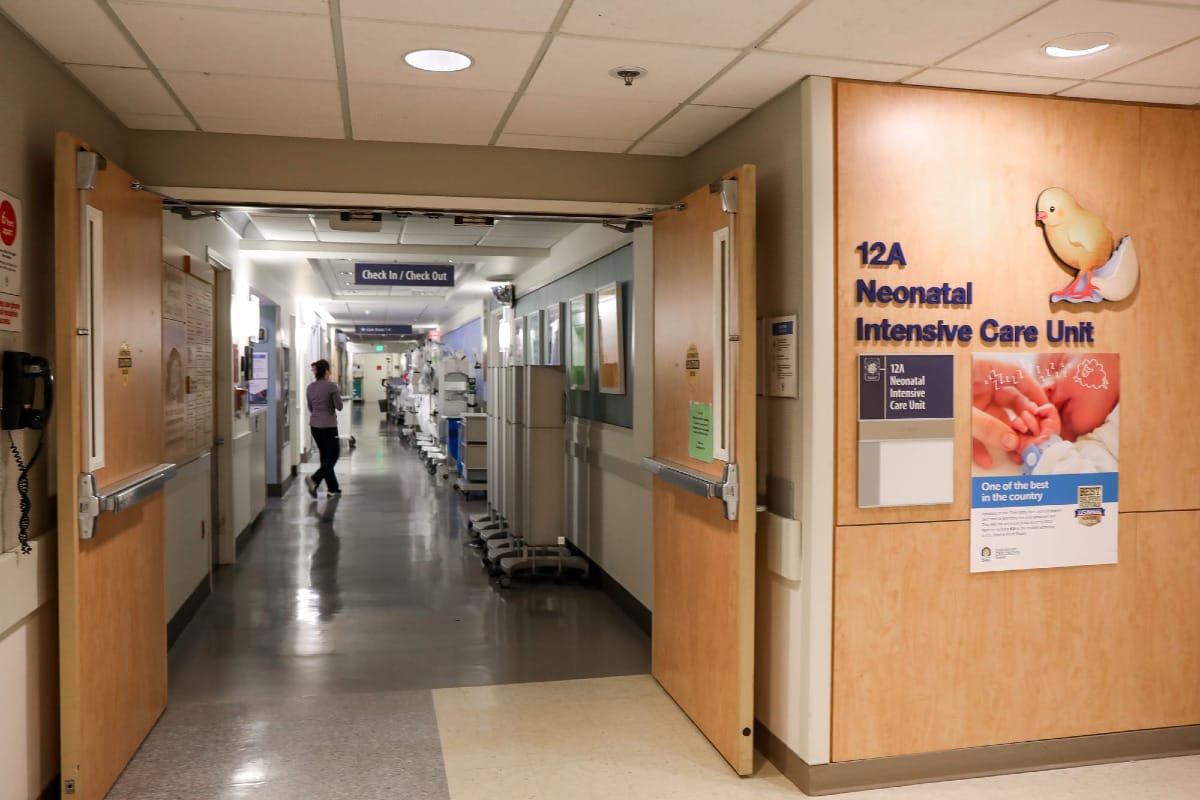
Oregon Health & Science University President Dr. Shereef Elnahal insisted this week that an expansion to its overcrowded neonatal intensive care unit will be a top priority in the forthcoming strategic plan, but said he can’t put a timeline on the project until the university’s finances improve.
Elnahal’s comments came during a press conference that followed reporting by InvestigateWest detailing crowded conditions in the hospital’s 30-year-old neonatal ICU, or NICU, and the university repeatedly delaying plans to build a new facility.
Those plans, which would add a new wing to the Doernbecher Children’s Hospital at the university’s Portland campus, were put on pause indefinitely in April 2025 due to the lack of funding to cover its $425 million price tag.
During the media briefing on Tuesday, Elnahal said that while he could not speak to decisions his predecessors made on the NICU project, he is committed to getting the project across the finish line as soon as they can do so “sustainably.”
“Our staff do not accept and should not accept unsafe care environments,” Elnahal said. “We are listening to our staff, we are listening to our faculty and we will do something about this.”
When he assumed his post in August, Elnahal was tasked with steering a financial turnaround of Oregon’s flagship health system and sole academic medical center, which for years had been operating in the red.
The university needs more financial stability before resuming an “ambitious” project like the Doernbecher addition, Elnahal said, given the likelihood that the system will need to take out additional debt to fund it. Relying squarely on philanthropic dollars to advance the NICU project is unlikely, he added, even though donors have recently expressed interest.
A spokesperson for the union representing OHSU nursing staff said that they are appreciative of Elnahal’s stated commitment to expanding the space for women and newborn services, but it needs to be accompanied with action.
“Frontline caregivers have been raising the alarm for years and asked repeatedly for investment in the unit that cares for premature and critically ill newborns,” Peter Starzynski, director of communications for the Oregon Nurses Association, said in a statement. “We strongly urge OHSU leadership to follow through on that commitment.”
The neonatal ICU was already strained for capacity when leaders at the children’s hospital first pitched an expansion to the board in 2016. Since then, nurses say the unit has been stretched to care for more patients — sometimes as many as 53 babies at any given time, compared to the NICU’s 40-bed capacity a decade ago.
What that care looks like has changed significantly since the NICU space was built in the 1990s, with the introduction of new standards and advancements in neonatal medicine. Demand for neonatal care across Oregon has also grown over time, as hospitals have observed worsening health among their pregnant patients. As one of two neonatal intensive care units in the state that can care for the most medically fragile newborns, OHSU has expanded the services it offers — and has plans to roll out more.
While OHSU’s expansion of neonatal services has not come with new space, the university has advanced other projects in recent years, like the $650 million Vista Pavilion, a new tower dedicated to cancer care.
Jennie Olson, president of Oregon AFSCME Local 328, one of the major unions representing OHSU staff, said at Wednesday’s Board of Directors meeting that capacity issues, like in the NICU and emergency department, have been raised repeatedly over the years.
“These are not new concerns, they are unresolved ones,” said Olson. “I don’t question the value of the [cancer care] investment, but I do question what it reflects about institutional priorities. … It’s just one example of critical resources that are desperately needed in an area, but are directed elsewhere.”
Elnahal said his team is still ironing out the details of how they intend to prioritize major expansion projects over the next few years, although he insisted it’s a “guarantee” the Doernbecher addition will be at the top of the list.
“We have to operate in a more financially sustainable way in order to invest in our infrastructure and in our people sustainably,” Elnahal said Tuesday, adding the system is aiming for the roughly 5% operating margin it had prior to the COVID-19 pandemic.
OHSU leadership told the Board of Directors Wednesday the system is “well positioned” to close out the current fiscal year strong with a roughly 1.7% operating margin, but still cannot financially commit to large-scale projects that aren’t already underway.
Elnahal said his team intends to work with state lawmakers during the next legislative session to see what could be done to help boost NICU capacity, both at OHSU and across the state. He did not provide details of any specific proposals.
“We are really focused on making sure that this source of care [for women and children] is sustainable and lasts for a very, very long time,” Elnahal said.