Oregon appeals court sides with OPB in case over public corrections records requests
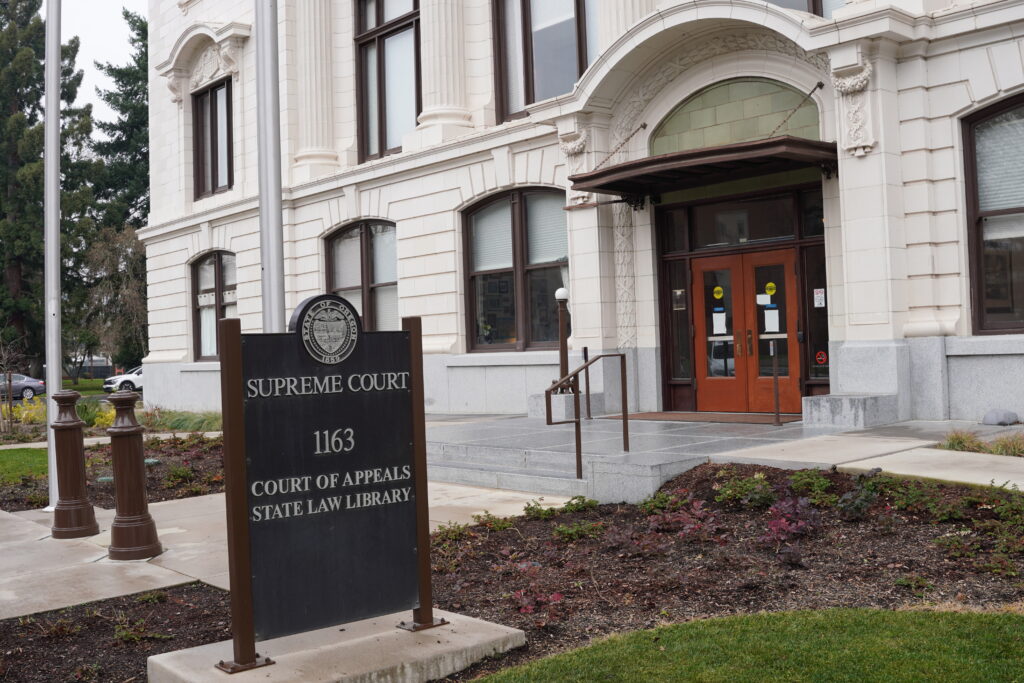
The Oregon Supreme Court and Oregon Court of Appeals are pictured in Salem on Dec. 14, 2023. A new decision from the Oregon Court of Appeals touches on the involvement of criminal investigations in public records law. (Photo by Ben Botkin/Oregon Capital Chronicle)
Documents that show up in criminal investigations undertaken by Oregon law enforcement are not automatically exempt from disclosure under state public records law, the Oregon Court of Appeals ruled.
The three-judge panel’s 10-page decision last week in favor of Oregon Public Broadcasting found that records from Oregon agencies cannot be withheld from the public “simply because they have been provided to another agency investigating or prosecuting a crime.”
The Oregon Department of Corrections had provided an inmate file of the 2017 MAX train murderer Jeremy Christian in response to a lawsuit in Marion County Circuit Court from the news agency, but the court declined to grant OPB’s request for a declaration that state corrections officials have been misinterpreting public records law. The new decision directs the Marion County Circuit Court to adopt a declaration in alignment with the appeals court’s finding that such records cannot be exempted from disclosure.
“Where, as a factual matter, a record is compiled for reasons unrelated to criminal law purposes, it is not factually accurate to describe it as being compiled for criminal law purposes simply because the record is subsequently provided to law enforcement in connection with a criminal investigation,” wrote Chief Judge Erin C. Lagesen.
Amber Campbell, a spokesperson for the Oregon Department of Corrections, declined to comment on the decision, citing pending litigation.
“DOC remains committed to its mission of protecting communities, promoting accountability and transforming lives,” Campbell wrote in an email. “As a steward of public resources, DOC is committed to transparency and earning the trust through its actions and service to Oregonians.”
OPB did not immediately respond to a request for comment Monday. Marta Hanson, a spokesperson for Oregon Attorney General Dan Rayfield’s office, said they were reviewing the decision and referred questions to the corrections department.
The news outlet originally sought the inmate file of Christian, the man who in 2017 shouted racial slurs and killed two people onboard the Portland MAX train on the eve of Ramadan in a hate crime that garnered national attention. He already had a 2002 criminal conviction for kidnapping and robbery with a firearm, but the records request came before Christian’s 2019 trial. He was sentenced in 2020 to life in prison without parole and is currently staying in the Umatilla-based Two Rivers Correctional Institution.
Both the Oregon Department of Corrections and then-Attorney General Ellen Rosenblum, however, had declined OPB’s requests to access the file under state public records law.
The Multnomah County District Attorney’s Office had subpoenaed Christian’s records relating to his original incarceration due to his 2002 conviction and indicated that those were sought in connection with his new charges, according to a letter from a deputy attorney general to OPB in 2020. The district attorney’s office had warned that disclosing the records could negatively affect pending criminal proceedings before Christian was fully convicted for the stabbing, and the subpoena came with a protective court order.
Opposing the release of those records, the Oregon Department of Justice wrote to Oregon Public Broadcasting in 2020 that public records law exempted “non-law-enforcement records that were originally created for ordinary business purposes but that are subsequently compiled or gathered in the course of a criminal investigation.” It’s similar to an exemption that now-Attorney General Dan Rayfield has tapped to keep a tight lid on potential state-led criminal investigations into federal immigration agents.
But the court rejected that reasoning. The judges said they were “reluctant to conclude” that the intent of the Oregon Legislature “would require us to step away from reality” because the requested records were not compiled for “criminal law purposes.”
“The records request at issue on appeal did not request ODOC to disclose the specific set of records that it had provided to law enforcement in connection with the investigation,” Lagesen wrote in the decision. “If that had been the request, ODOC would have a strong argument that the exemption applied to that records request because such a request would be seeking a set of records that were, in fact, compiled for criminal law purposes.”
The decision from the Oregon Court of Appeals is also the latest development in a string of state public records law disputes that could reshape access to records for Oregonians.
Oregon Public Broadcasting is facing a lawsuit from Oregon Health & Science University seeking to block the disclosure of records related to the removal of a senior university leader, though the university system argues that it is protecting the privacy of individual employees and whistleblowers. In a statement about that case, OPB said that “access to public records is a critical component of our mission and ensures the people of this region have the facts and knowledge necessary to hold institutions and public officials accountable.”
The Oregon Supreme Court is also set to hear arguments in October over whether Oregon Health & Science University owes attorneys fees to a national animal rights organization after a lower court found the university to have subjected the organization’s request to excessive delay.