Oregon Is Spending More Than Ever on Low-Income Housing. A State Law Keeps the Details Secret.

Oregon’s spending on low-income housing has exploded in the past five years. The state has given developers an unprecedented $1.4 billion, and the cost of developing each apartment has nearly doubled, to $540,000. Dozens of projects are lined up for an additional $850 million in future state funding. Federal tax credits, which the state oversees, will bring even more money to bear.
Yet one thing has remained constant: The public isn’t allowed to see the details of how all these dollars are being spent.
Oregon is one of the only states in the country with a carve-out in its public records law that prevents disclosing the financial details of subsidized housing projects, thwarting researchers and journalists who have tried to examine their costs.
The issue is especially pressing in the Pacific Northwest, where leaders have tied the lack of affordable housing to the region’s dire homelessness crisis. Understanding and controlling the cost of construction could make it possible, with the same amount of money, to either build more rent-restricted apartments or to discount rents more steeply.
Margaret Van Vliet, a former director of Oregon’s state housing agency, told ProPublica that lawmakers should revisit the exemption. Despite all the state’s spending on housing, Oregon’s homeless population continues to grow.
“For all the public money, we seem to be digging a deeper hole,” Van Vliet said.
In other states, researchers and journalists have used developers’ financial records to investigate spiraling costs of subsidized housing.
Los Angeles Times reporters in 2020 revealed that the cost of some low-income housing units in California had grown to more than $1 million each, driven in part by government rules that pushed construction prices higher. The Times found that 12,000 more low-income families could have received homes between 2011 and 2015 had costs been as low as they were elsewhere.
Researchers from the University of California, Berkeley showed earlier this year that California was spending $300 million a year just in development fees on subsidized housing, enough to have financed another 1,250 apartments each year. In July, California Gov. Gavin Newsom signed legislation that aims to slash those fees.
A study published last year and co-authored by Jason Ward, an economist who directs the nonpartisan Rand Corp.’s Housing Center, compared the costs of constructing subsidized housing among California, Texas and Colorado, finding that California’s highest-in-the-nation prices were driven by requirements to pay “substantially above-market wages and unusually large architectural and engineering fees.”
If California had Colorado’s production costs, the study found, it could have built four times as many rent-subsidized apartments.
Those types of analyses are impossible to perform in Oregon.
“For all the public money” spent on housing, “we seem to be digging a deeper hole.”
Margaret Van Vliet, former director of Oregon’s state housing agency
Ward said Oregon’s secrecy is difficult to defend. He said cost information about subsidized housing is typically public. In his research, he said, he’s gotten such data from 17 states and been denied it only in New Jersey.
“When you’re just looking at how public funds are used, there should be an incredibly strong bias towards transparency,” he said. “And when you see costs going up and up and up and the outcomes aren’t good, there’s an almost unqualified public case that these things should be open to scrutiny by taxpayers, policymakers, the media, whomever.”
Oregon’s Legislature approved the exemption in 1997, when Oregon’s state housing agency had a staff and budget that were both one-fifth what they are today.
State housing officials warned about the consequences of revealing the finances behind low-income apartment projects.
“Not that we’re concerned that there’d be something in there,” Lynn Schoessler, then the deputy director of Oregon Housing and Community Services, told lawmakers in a public hearing.
But Schoessler said there could be problems if the public were allowed to see detailed financial information that developers submit to the state while applying for funding. Disclosing the records might “give somebody an indication whether this corporation was ripe for takeover or a buyout or whatever,” Schoessler said in a hearing. “So we’re concerned on the corporate level.”
Lawmakers almost unanimously agreed to exempt the records from disclosure.
Not all details about subsidized housing in Oregon were made secret.
The Portland area’s regional government, which manages a local low-income-housing bond, publishes the costs of projects the bond has funded, showing some units have reached $900,000 apiece. And fine-grained cost information may be obtained, on request, if the project is run by a public housing authority like Portland’s. But these account for just 20% of the subsidized housing units that Oregon is building. The bulk are sponsored by private developers and funded through the state housing finance agency, Oregon Housing and Community Services.
Although the state agency will divulge how much a developer said a project would cost when it applied for funding, it redacts the itemized expenses — things like the costs of construction materials, the contractor’s profits or the fees paid to lawyers, brokers, loan agents, developers and the state agency itself.
A spokesperson said the agency knows the cost per unit, per square foot and per bedroom for each development it has subsidized. But the state said that information, which would allow the public to see which projects were the most expensive, is not subject to disclosure.
Oregon has a sunshine committee that reviews public records exemptions and identifies ones that should be rolled back. Charlie Fisher, its co-chair, said the committee should examine the low-income housing carve-out.
“Verifying how public dollars are being spent, especially at this scale, is one of the fundamental reasons why people should have access to public records,” Fisher said. “Given the amount of money we’re talking about, the case is even stronger.”
The secrecy mandate in state law shrouds more than just the financial details of a project.
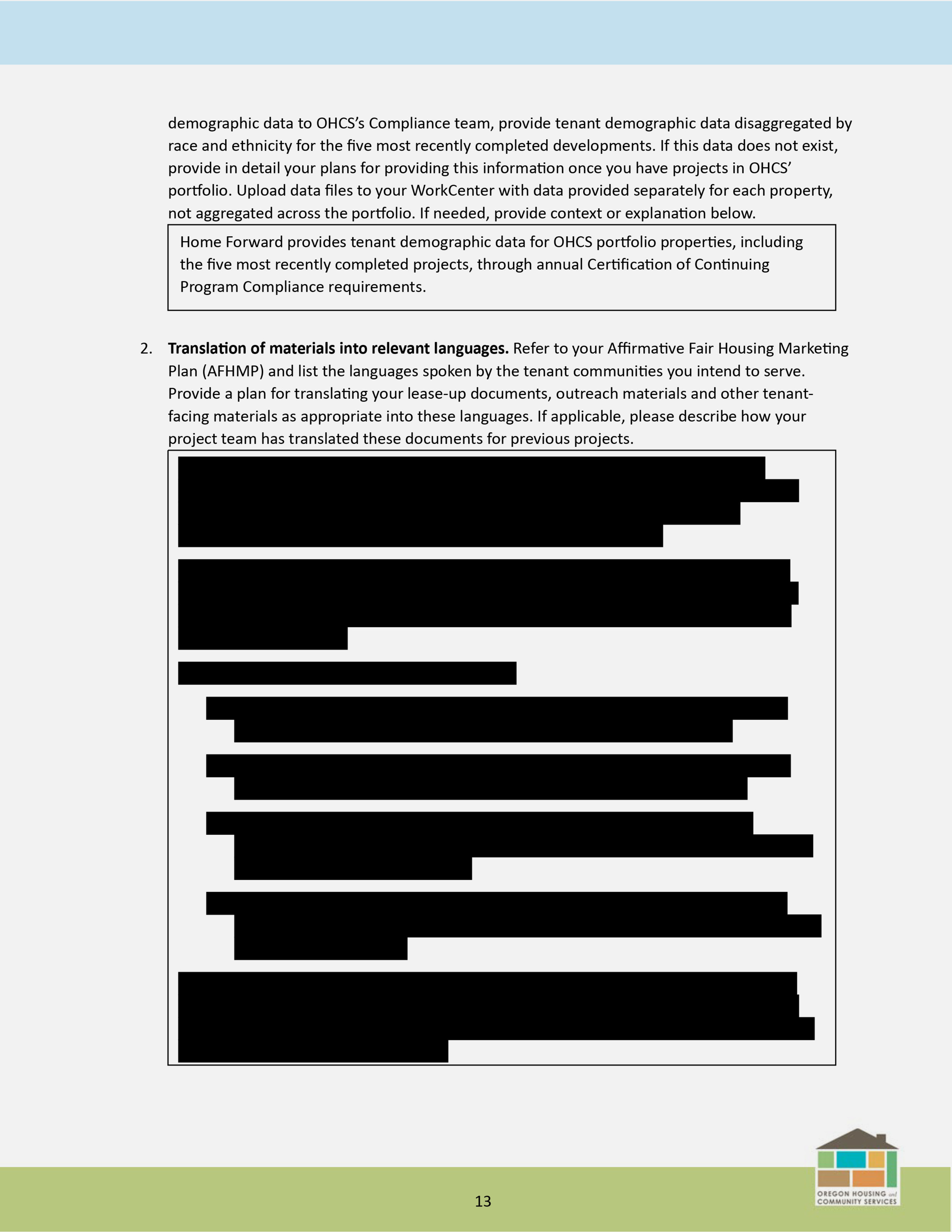
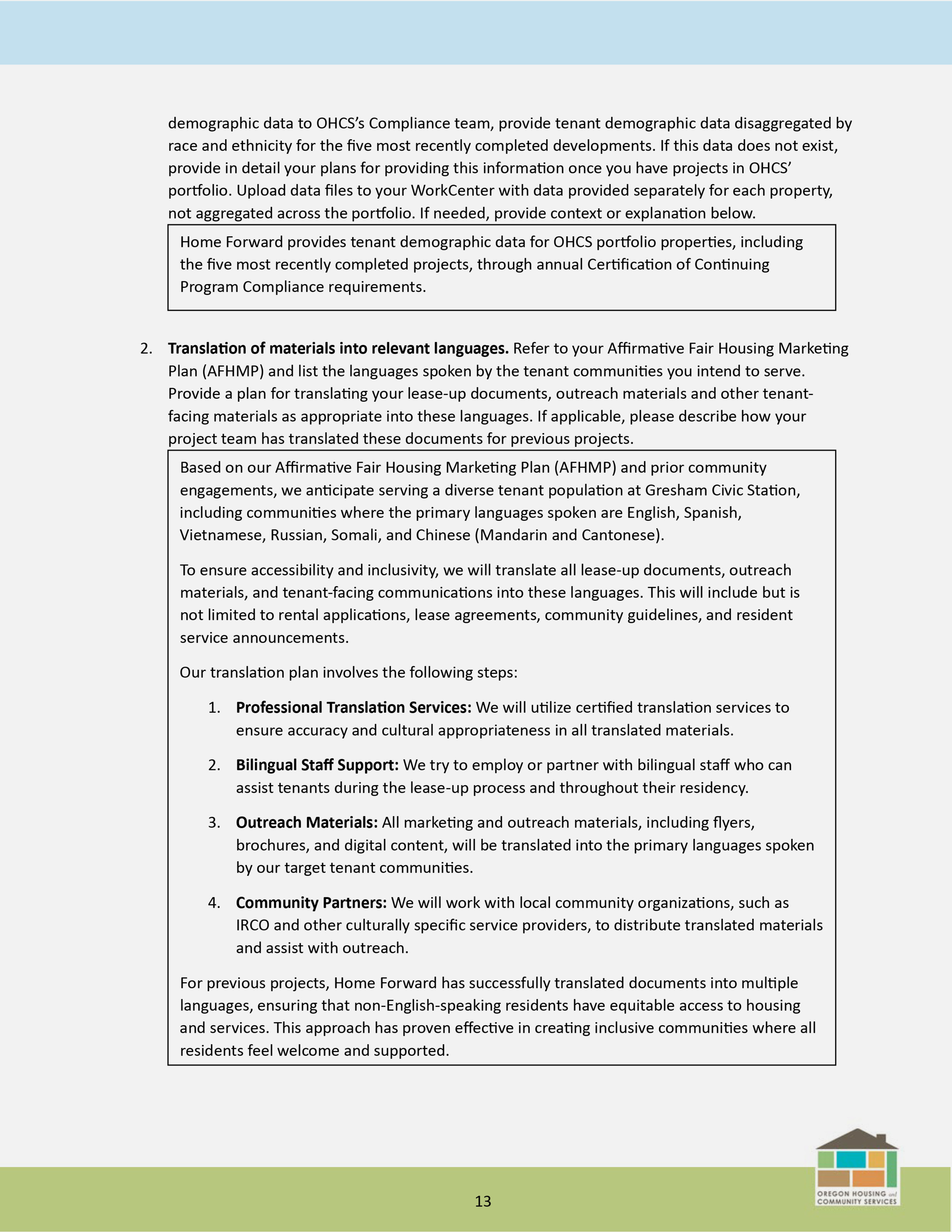
When we requested financial records for three apartment projects around Portland, the agency redacted a list of languages spoken by the tenants that a developer hoped to attract. In application material for that developer’s project, the agency also redacted the plan for translating tenant outreach brochures from English. And it blacked out an explanation of any financial risks the project might face, along with the developer’s plan for covering cost overruns.
It turns out that the developer, in this case, was Home Forward, the Portland housing authority. The local agency released a copy of its application material to ProPublica without redactions, revealing mundane details the state had tried to keep secret. Here’s a sample of what Home Forward identified as the project’s financial risks: “market volatility, site-specific challenges, and unforeseen design modifications. Economic factors such as inflation, material price fluctuations, and labor shortages could impact overall construction costs.”
A spokesperson for the state said the information about languages and financial risks was redacted because the public records exemption shields “market studies and analyses” as well as pro forma statements, which show a development’s anticipated cash flows.
Andrea Bell, the state housing agency’s director, said in an emailed statement that she is committed to transparency and expects her agency to be open, accessible and accountable to the public. But she said she takes seriously the agency’s responsibility to comply with the exemption in Oregon records law for housing financials.
Asked to comment on whether she supported the exemption and thought it was necessary, Bell said in a statement: “The cost of construction is a topic of growing interest. We will take your request under consideration as we assess ways to proactively share construction costs so that they are more readily available to the public.”
In the meantime, the agency charged ProPublica $130 for the cost of collecting and redacting the documents it provided us. It denied our request to waive the fees, saying that “the interest of the general public would be better served by preserving public resources.”
Transparency hasn’t slowed development in other West Coast states.

In California, where the financial details of housing projects are public records, the funding remains highly competitive, with more than half of shovel-ready applications being turned away because demand exceeds available funding. “We have not encountered any difficulty in developing affordable housing because those documents are public,” said a spokesperson for the California state treasurer’s office.
In Washington state, officials have repeatedly released financial information about the housing projects they’ve funded to developers, researchers, media and other members of the public. A housing official there said developers know the information is open to the public, and it hasn’t been an issue.
ProPublica asked the Washington counterpart of Oregon Housing and Community Services for financial documents for three projects around Seattle. They were released without redactions — and for free.
The post Oregon Is Spending More Than Ever on Low-Income Housing. A State Law Keeps the Details Secret. appeared first on ProPublica.