Opinion: New York’s Affordable Housing Divide
“The core problem with New York’s housing affordability is not, at its heart, a rent regulation problem. It is a divergence problem. Rents for existing affordable units have become increasingly affordable over time, while rents for new ‘affordable’ units … have become increasingly unaffordable.”

New York City’s housing debate tends to produce a lot of heat and very little light. Every spring, landlords and tenant advocates face off at the Rent Guidelines Board. Every few years, a mayoral candidate promises to solve the affordability crisis. And every year, the underlying structural problem—a widening divide between the tenants who already have affordable housing and everyone else who needs it—gets a little worse.
The data tell a story that neither side wants to fully acknowledge. Existing affordable housing has quietly gotten more affordable over time. New affordable housing has gotten dramatically more expensive. And the policies we spend the most energy debating are largely beside the point.
The Tenants Already Inside Are Doing Better Than You Think
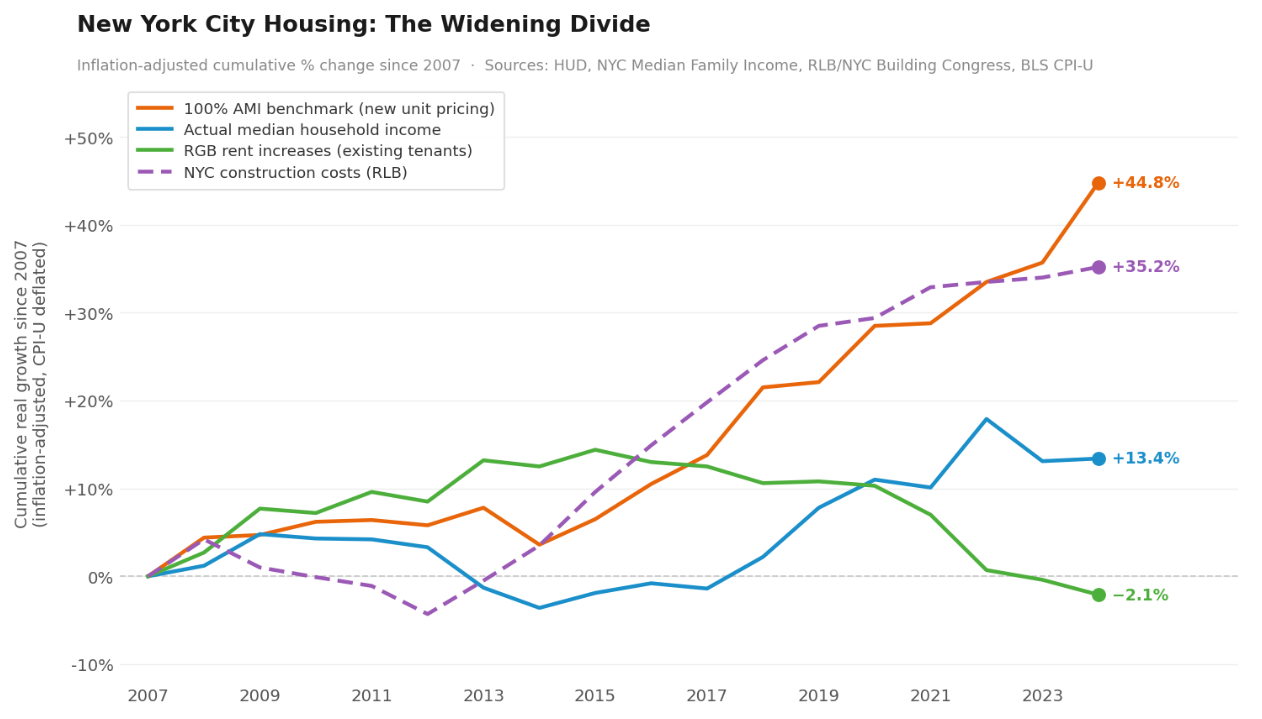
When you adjust for inflation, a striking pattern emerges. Since 2007, actual median family income in New York City has grown by about 13 percent in real terms. Over that same period, the cumulative rent increases approved by the Rent Guidelines Board total roughly −2 percent in real, inflation-adjusted terms — meaning a tenant who has been in a stabilized apartment since 2007 is paying meaningfully less of their income on rent today than when they moved in. Their rent has declined in actual purchasing power.
This is not an accident. The Rent Stabilization Law directs the RGB to weigh the operating and financing costs of rent-stabilized buildings—taxes, insurance, fuel, labor—and to set guidelines that reflect those costs while maintaining “reasonable rents.” The board is not tasked with tracking tenant incomes. But in practice, the increases it has voted over the past two decades have consistently run below both inflation and income growth—a pattern the New York Apartment Association has documented, noting that from 2013 to 2024, cumulative RGB one-year guideline increases for a representative Bronx apartment produced rents roughly 15% below where they would have been had increases tracked the CPI-adjusted commensurate adjustment over the same period.
That gap is a compounding benefit for long-term tenants. It is also, increasingly, a crisis for the buildings they live in. The RGB’s own data shows its Price Index of Operating Costs has risen between 5 and 8 percent annually in recent years, while approved increases have repeatedly fallen short. As I wrote in an earlier piece for Vital City, this gap has been measurable for years: in 2025, 10 percent of rent-regulated buildings already report operating costs equal to or greater than their rental income, and inflation-adjusted net operating income for pre-1974 100 percent rent-stabilized buildings outside the core of Manhattan has dropped 25.2 percent since 2019, reaching 35 percent in the Bronx.
So yes—for tenants lucky enough to be inside the system, the deal is getting better every year. That divergence is also why, as I have argued in Vital City, the RGB should differentiate its annual guideline by building age, size, geography, and resident income rather than applying one uniform increase across roughly a million apartments.
But New Affordable Units are Increasingly Detached
The picture inverts the moment someone needs to find a new affordable unit.
Rents in newly constructed affordable buildings aren’t set by the RGB. They’re based on a federal metric called Area Median Income (AMI)—a government-calculated benchmark for what counts as “affordable” rent. But as I’ve detailed before, when the federal High Housing Cost Adjustment (HHCA) is applied, AMI becomes tied to market rents rather than to actual incomes.
The adjustment pushes the official benchmark upward in expensive housing markets—pegged to what rents cost rather than to what residents earn. For 2025, New York’s official AMI for a family of three was $145,800, while the U.S. Department of Housing and Urban Development’s own calculation of actual median family income for the same area was approximately $103,000. The HHCA accounts for a gap of roughly 33 percent.
Because affordable rents are set as a percentage of this inflated AMI—not of real incomes—they have risen in lockstep with market rents, not with what New Yorkers take home. Since 2007, the AMI figure used to price new affordable units has risen roughly 45 percent in real, inflation-adjusted terms—more than three times the growth in actual household incomes over the same period. This system means that these projects remain financeable from a development perspective, but not that they remain actually affordable.
As an example: if a family moved into a rent regulated two-bedroom apartment in 2007 and were paying the “fair market rent” of $1,182 per month. After 17 years of modest RGB-governed increases, they would be paying around $1,824 today (well below the cumulative inflation rate over that period). That same two-bedroom, newly constructed and priced at today’s 100 percent AMI rate would rent for approximately $3,645. A gap of over $1,821 for an apartment carrying the same “affordable” label. It is also worth noting that once a tenant qualifies for an income-restricted unit at the time of entry, they can remain regardless of subsequent changes to their income. The long-term stability that comes with a stabilized apartment is itself a form of economic security—one that accrues only to those who got in.
To put this in context, according to New York City construction cost data compiled by the New York Building Congress, actual construction costs in New York have risen roughly 35 percent in real terms since 2007—significant, but well below the 45 percent real increase in AMI-linked rents over the same period. In a rational market, you would expect that if the allowable rents for new “affordable” units were outpacing the cost of building them, one of two things would follow: more new affordable buildings would get built, or developers would price units at lower AMI bands. Neither has happened at a meaningful scale.
New York City’s affordable housing programs require developers to deliver a specific share of units at a blended average AMI in exchange for tax abatements or zoning bonuses. Developers reasonably select the menu option that maximizes return, not adding additional or more affordable units unless explicitly required. The other factor is financing: rising cap rates and borrowing costs have consumed whatever margin the inflated AMI rents might have freed up. The HHCA’s ratcheting of permissible rents upward has therefore largely transferred value to private capital rather than producing more housing or lower rents. It has made new “affordable” units more expensive without making them easier to build.
These two things are not contradictory. They are the logical outcome of a housing system where the existing stock gets cheaper in real terms every year while the cost of creating new stock keeps rising — and where the benchmark used to set “affordable” rents is calibrated to market conditions rather than to what New Yorkers actually earn. The lucky tenants who secured a stabilized apartment years ago are beneficiaries of a remarkably good deal. Everyone who needs housing today is not.
Where We Go From Here
The core problem with New York’s housing affordability is not, at its heart, a rent regulation problem. It is a divergence problem. Rents for existing affordable units have become increasingly affordable over time, while rents for new “affordable” units—anchored to an AMI metric untethered from actual incomes — have become increasingly unaffordable. The two categories now describe almost entirely different housing markets, despite carrying the same label and being subject to the same yearly rent increases (or freezes).
Closing that gap requires movement in two directions simultaneously. On the older existing stock, the RGB should allow higher annual increases—calibrated by building age, size, and geography—particularly for buildings whose rents have fallen furthest behind real operating costs. That would provide a more sustainable financial foundation for the buildings where most long-term affordable tenants actually live.
On the new construction side, the goal should be to bring future affordable units into actual relation with the incomes of the New Yorkers they are meant to serve. That means moving away from the HHCA in setting affordable rents—a shift the city and state can pursue inside their own subsidy and zoning programs, where eligibility thresholds are set locally, even as federal Low Income Housing Tax Credit and Section 8 programs continue to use HUD’s AMI.
It also means government financing tools that allow developers to build at lower AMI bands without losing the ability to cover costs. A version of this was just attempted with City of Yes, which restructured affordable program thresholds to push more units into deeper affordability bands; whether that framework actually moves the needle is still an open question.
And it means addressing the primary cost drivers directly: financing (including city-funded projects that can accept a below-market cap rate so the math pencils at lower rents), insurance costs (where the city’s newly announced affordable-housing insurance program is hopefully a meaningful first step toward bringing premiums back into line), and construction regulation. These are the forces that together make building affordable housing in New York more expensive than building it almost anywhere else in the country.
None of these conversations are easy. But they are the right ones to be having.
Eddie Palka is a practicing architect in New York City focused on affordable housing and the director of AKA Urban. He is an adjunct assistant professor at City College and Columbia University, and a senior research fellow at the NYIT Center for Offsite Construction.
The post Opinion: New York’s Affordable Housing Divide appeared first on City Limits.