One State Under Whose God?
If Texas is, as its pledge of allegiance states, “one state under God,” this begs a question. What God? Whose God?
For many Texans, it’s undoubtedly the Christian God, because (so they say) we’re a Christian nation. They can point, for instance, to the 190-foot-tall “Cross of Our Lord Jesus Christ” near the Panhandle town of Groom, or the Ten Commandments monument recently installed at the Tarrant County Courthouse in my hometown of Fort Worth. (Not to mention the Ten Commandments poster now required to be displayed in Texas public school classrooms.)
But that’s far from the only answer.
Last year, my spouse Eleanor and I traveled to Houston to visit the multifaith Rothko Chapel. We also stopped by the Sri Ashtalakshmi Temple in nearby Sugar Land to check out the recently erected statue of the Hindu god Hanuman. Truly Texas-sized at 90 feet of shimmering bronze, it’s breathtaking. And just up the road, at a Buddhist temple, stands a slightly less gargantuan statue of Quan Am, the “Goddess of Compassion,” 72 feet tall. During our visit, Eleanor and I rubbed shoulders with South Asian and East Asian Texans and visitors from overseas, drawn to these spectacular icons of religious devotion. Attracted by economic opportunity, Asian Texans have brought their religions with them—just as the Spanish brought Catholicism in the 1500s and Anglo-Americans imported Protestant denominations after independence from Mexico.
Yet when we arrived at the Sri Ashtalakshmi gates, we had to stop and have our trunk inspected by a security guard. The temple, we learned, had ramped up security in the face of hostility from local Christians. A pastor had proclaimed Hanuman a “demon god,” and ex-Senate candidate Alexander Duncan asked on X why “a false statue of a false Hindu god [is allowed] to be here in Texas? We are a CHRISTIAN nation.”
Of course, there’s a simple and very American answer to Duncan’s question: religious liberty, constitutionally guaranteed. But that apparently makes little difference to those who embrace what University of North Texas historian Joseph L. Locke terms “militant Christian faith.”
Hindu Texans are not the only ones weathering Christian hostility. During the current election cycle, Muslim Texans have faced concerted Islamophobic attacks by Republican politicians. And there’s fighting over the Christian God as well. This year’s U.S. Senate race pits the Trumpian evangelical Christianity of Republican Ken Paxton against Democrat James Talarico’s liberal Mainline Protestant faith and its welcoming, compassionate God.
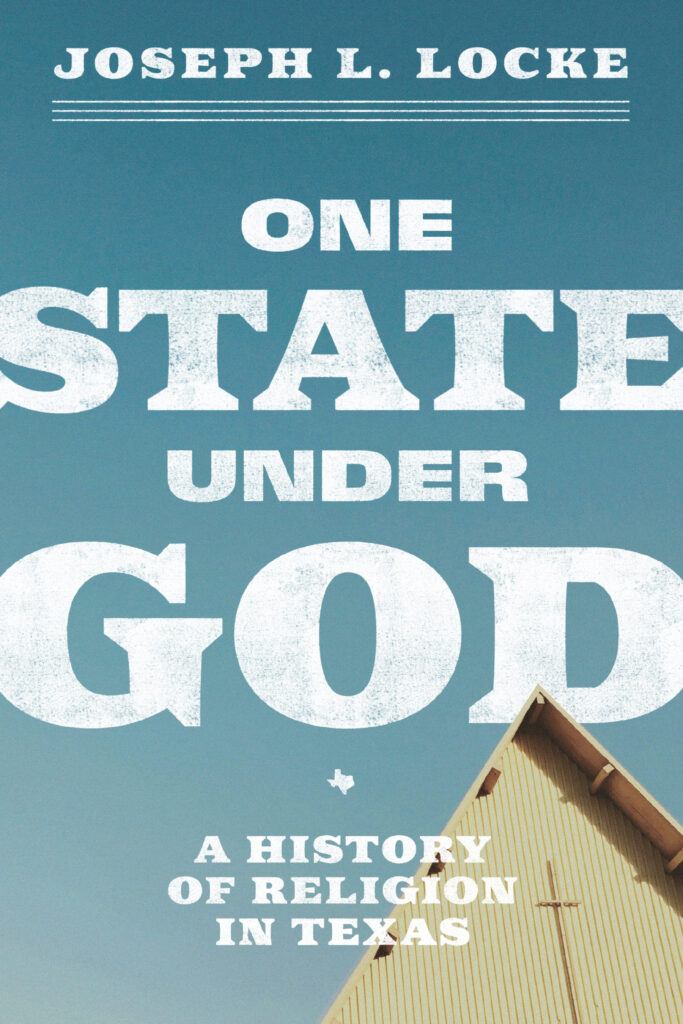
In short, the question “under whose God” is not as easily answered as some would have us believe. Despite the state’s reputation as “the buckle of the Bible Belt,” Texas religion “contains multitudes,” Locke writes in his new book, One State Under God: A History of Religion in Texas. The compelling work, immaculately researched yet thoroughly readable, brings to light “the lived reality—the blood and sinew—of Texas religion” in all its variety.
Religion “dominates the [Texas] landscape, shapes the culture, and determines the state’s politics,” Locke writes. “Politicians vie for state and national office with stadium-sized prayer rallies. … God and churches and pastors and moral politics and Christian nationalism all drown the state—and much of America—in an ocean of religion.”
Of course, it’s not just any religion that Locke’s describing here; it’s white evangelical Christianity, whose dominance has been so entrenched in Texas politics for so long that it can seem inevitable, like a law of nature. But, as Locke shows, “it wasn’t always this way.”
In the 1820s and ’30s, when Anglo Americans began settling what was then northeastern Mexico, Texas was widely regarded in the United States as godless. That perception wasn’t entirely accurate; the religions of Indigenous peoples who had for thousands of years called this land home found “divinity … everywhere.” (Locke’s accessible discussion of Indigenous religion is a highlight of the book.)
But among the Anglo and Tejano settlers, religion was sparse. One colonist wrote, “there are no churches in Texas, no ministers of the gospel, no religious associations. The people of Texas are very wicked.” Complained another settler: “There is no God in Texas.”
Though Roman Catholicism was the official religion, to which the mostly Protestant Anglos were required to convert, clergy were few, leaving children unbaptized and marriages unconsecrated. And many white Anglo settlers—ironically, forebears of Texans who today push to undermine church-state separation—despised established religion.
Once Texas broke free from Mexico and the yoke of official religion, Protestant denominations gradually gained a foothold. “Disestablishment opened Texas’s spiritual doors,” Locke writes, “and new immigrants brought their faiths with them”—not just Protestants but Jews, German freethinkers, and Czech and German Catholics.
Nevertheless, by the late 1850s, most Texans still didn’t attend church services. They stubbornly defended church-state separation and religious liberty well into the 20th century. This was true also of evangelicals, who generally considered religion “a matter between individual souls and God, not governments and citizens,” Locke writes.
So, what changed? How did Christianity become the political weapon we see today?
Arguably, the roots of this politicization predate the Civil War, in white Texans’ conviction that slavery was God’s will. The Bible told them so. Enslaved Texans, by contrast, heard in the same Bible a gospel of freedom. Locke’s account of the origins and continuing vibrance of the Black church is another highlight.
However, Locke contends that it was after the Civil War that the politicization of religion, especially evangelicalism, truly surged forward, in the crusade to ban alcoholic beverages. Prohibition, Locke writes, “lured the state’s churches into electoral politics.” Their pied piper was Waco Baptist B. H. Carroll. The bearded patriarch-preacher convinced Texas evangelicals “that there was more to religion than faith alone. There was power.” In the 1870s and ’80s, Carroll worked “to leverage the state’s infant religious organizations into public life.” Prohibitionist preachers soon barnstormed the state.
Their efforts initially failed. “Most nineteenth-century Texans—including most religious Texans—denounced religious meddling in public life,” Locke writes. For instance, Governor Oran Roberts declared, “This union of church and state is all wrong.” (Imagine a Texas governor saying such a thing today.)
Yet prohibitionist clergy kept hammering away. Prohibition eventually prevailed, not only in Texas but nationally, with the 1919 ratification of the Eighteenth Amendment, authored by U.S. Senator Morris Sheppard, of Texas. Prohibition, Locke writes, “demarcated the churches’ new obsession with moral politics.”
Of course, Prohibition ultimately proved unworkable, and after its repeal, some white evangelicals turned their ire toward the New Deal, communism, and desegregation. Still, “many … clung closely to their historical affection for the separation of church and state.” (Case in point: The Southern Baptist Convention, in both 1964 and 1971, endorsed the U.S. Supreme Court’s landmark decisions banning official school prayer and Bible reading in public schools.) As late as the 1970s, it wasn’t clear religion in Texas would be so wedded to right-wing politics as it is today.
Yet separate tributaries of politicized Christianity began to feed what became the torrent of “hard-edged Christian politics” that would sweep over the state in the 1980s and ’90s, and Locke gives a lively account of the activists that drove its rise.
Today, what Locke labels “a politicized conservative theology and Christianized conservative politics” maintains a “pugilistic hold over political life” in Texas. Yet there are signs its grip may be slipping. Supporters of Christian nationalism in Texas, Locke notes, “are generally older and whiter than the overall Texas population, and their numbers seem to be shrinking.” The fastest growing segment of the state’s population—now around 1 in 4 Texans—don’t identify with any particular religion. And the monumental statues of Hanuman and Quan Am tell their own story about Texas’ changing religious landscape.
Under the state’s fabled big sky, there’s always been room for a variety of gods. Yet the centuries-old struggle between their devotees continues—some seeking dominance, some jostling for their own place under the Texas sun. Locke’s One State Under God is a superb, compelling, essential account of how we got here.
The post One State Under Whose God? appeared first on The Texas Observer.