OHSU board replaces sanctuary plan with new vision for primate research center
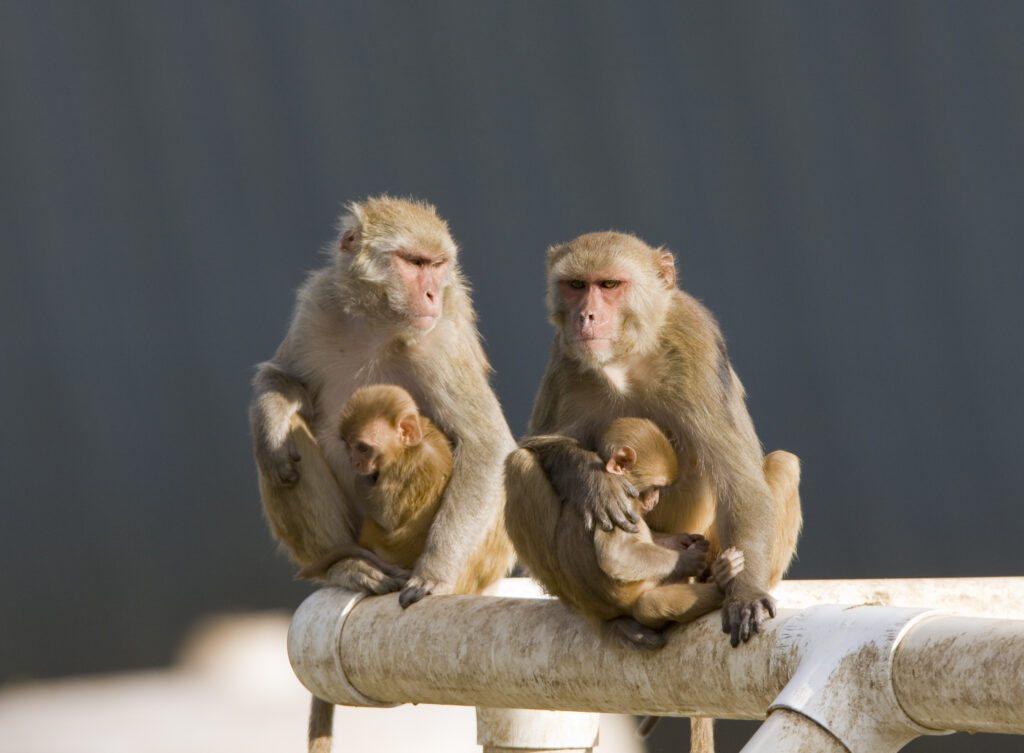
Deaths at the Oregon Health & Science University’s primate center in Beaverton have included rhesus macaques and other animals. The Legislature has passed a bill with more accountability for the center to report deaths. File photo from 2008. (Oregon Health & Science University)
Oregon Health & Science University’s board unanimously voted Monday to dramatically reshape its embattled primate research center, abandoning plans for a sanctuary and instead putting the university on a path to keep fewer monkeys while expanding human-based alternatives to animal research.
If fully carried out, the plan would fundamentally redefine the Oregon National Primate Research Center, shifting one of the nation’s seven such federally supported centers away from breeding monkeys for other research institutions and toward developing and validating research methods designed to reduce the use of laboratory animals.
The vote follows months of uncertainty over the center’s future. The Oregonian/OregonLive recently reported that faculty members and an internal email indicated OHSU had abandoned plans for a full sanctuary because the National Institutes of Health declined to provide funding for the transition. OHSU disputed the newsroom’s earlier account, saying no final decision had been made.
But on Monday, OHSU President Dr. Shereef Elnahal confirmed that six months of negotiations with the federal agency failed to produce a viable funding solution for a sanctuary.
“Ultimately, the costs to run the center do not disappear when the science stops,” he said. “That’s the major reason that ultimately a sanctuary was not possible.”
He said a sanctuary would have left OHSU “with thousands of animals, hundreds of employees and no financial support.”
“It would have been catastrophic to our people and to our financial outcome,” he said.
The resolution puts Elnahal in charge of developing a plan to substantially shrink the monkey colony, to end the center’s role as a national supplier of research primates, and to transform it into a national leader in developing and validating human-based research methods designed to reduce the need for animal studies.
The board’s vote does not immediately shrink the colony or end primate research. Instead, it establishes the direction for a broader transition that will determine how many animals the center needs, which research programs continue, how employees are affected and how the operation becomes financially sustainable.
Elnahal said OHSU expects the colony to shrink substantially because it plans to stop breeding monkeys for other research institutions while keeping only enough animals to support research the university determines can only be done at its Hillsboro campus. The colony has already shrunk by about 500 animals over the past year after OHSU curtailed breeding, he said.
The resolution also directs OHSU to prepare for the possibility of eventually relinquishing its designation as one of the nation’s seven National Primate Research Centers. Elnahal said the move reflects the university’s long-term strategy of organizing research around the scientific questions it is trying to answer rather than a particular research model, but only if OHSU can continue receiving NIH infrastructure funding to help pay for animal care.
“We want to be a university that ultimately focuses on the best way to answer the most pressing scientific questions, rather than necessarily focusing on one modality,” Elnahal said.
More than 50 people, including two state legislators, registered to testify in person and virtually during Monday’s meeting, filling the boardroom.
The board’s vote marked a sharp shift from February, when the board authorized six months of negotiations with the NIH over a possible sanctuary while emphasizing it had not yet decided the center’s future.
The 154-acre Hillsboro campus houses nearly 5,000 monkeys and baboons used in research on vaccines, infectious diseases, neuroscience, reproductive health and aging.
It has become one of OHSU’s most politically divisive programs.
Animal welfare groups and some scientists argue advances in human tissue models, artificial intelligence and other technologies have made it possible to replace many animal studies with research conducted directly on human biology. Scientists at the center counter that those newer methods still need to be proven to accurately predict what happens in living organisms before they can replace animal studies.
Elnahal said validating those newer methods is the “single greatest bottleneck.”
“Knowing whether new models may actually predict what occurs in a living system is a scientific problem,” he said.
The resolution attempts to bridge those competing views by directing OHSU to ramp up newer, human‑based research methods — known as New Approach Methodologies, or NAMs — while keeping monkey studies only in cases where scientists say there is no workable alternative yet.
Board Chair Susan King said the board took that approach because “we don’t know with certainty” how quickly newer methods will be able to replace animal studies.
“If Oregonians want to see science eventually evolve from non-human primates as a necessary model, then we intend to undertake that line of work by engaging the best science… that will allow us to get there,” Elnahal said.
Scientists who support the primate center praised the board’s vote for recognizing that some research still requires nonhuman primates, but they said any cuts to the colony should be driven by scientific need rather than an arbitrary target.
Dr. Joseph Quinn, a professor of neurology at OHSU, said primate research helped make deep brain stimulation for Parkinson’s disease possible, calling it “one of the greatest advances” in treating the disorder. He said researchers are also using the center’s aging monkey colony today to develop brain imaging tools that could improve diagnosis and treatment of Parkinson’s and Alzheimer’s disease.
Quinn said researchers share the goal of reducing reliance on animals but cautioned that some questions still cannot be answered any other way. He asked OHSU’s leaders to let scientific evidence guide when animal studies can be replaced. “This really matters for patient care,” he said.
Not everyone agreed. Dr. Iris Schrijver, a lifestyle medicine physician and adjunct clinical professor at Stanford University, argued that using monkeys to study “uniquely human” viruses such as HIV “fundamentally limits how well animal findings can translate to patients.” She urged OHSU to accelerate its transition to human-based research.
The resolution also responds to the center’s financial challenges. Federal infrastructure funding has stayed largely flat for two decades even as operating costs have climbed, forcing OHSU to cover a growing share of the center’s expenses. The board instructed university leaders to develop a strategy to eventually phase out that financial support.
Amy Meyer, associate director of primate experimentation campaigns at People for the Ethical Treatment of Animals, or PETA, welcomed the board’s proposal but urged OHSU leaders to go further by ending all monkey experiments, permanently halting breeding and setting a timeline to retire every animal to sanctuary.
Before bringing a final proposal back to the board, Elnahal said OHSU will consult scientists, veterinarians, unions, animal welfare experts and sanctuary organizations. The plan will recommend a target colony size, evaluate whether some monkeys could be transferred to sanctuaries, and outline how the transition would affect employees and ongoing research.
Elnahal said he expects the transition plan to be completed by the first quarter of next year as part of OHSU’s broader strategic plan.
This story originally appeared in The Oregonian/OregonLive: OHSU board replaces sanctuary plan with new vision for primate research center