Nymphia Wind’s gorgeous gowns told a resilient story at Asian Art Museum
Leo Tsao shows up to his own exhibition of fabulous dresses in a white button-down, dark pinstripes, and sneakers. Jade pendant. Small chunky earrings. No bananas in sight this time.
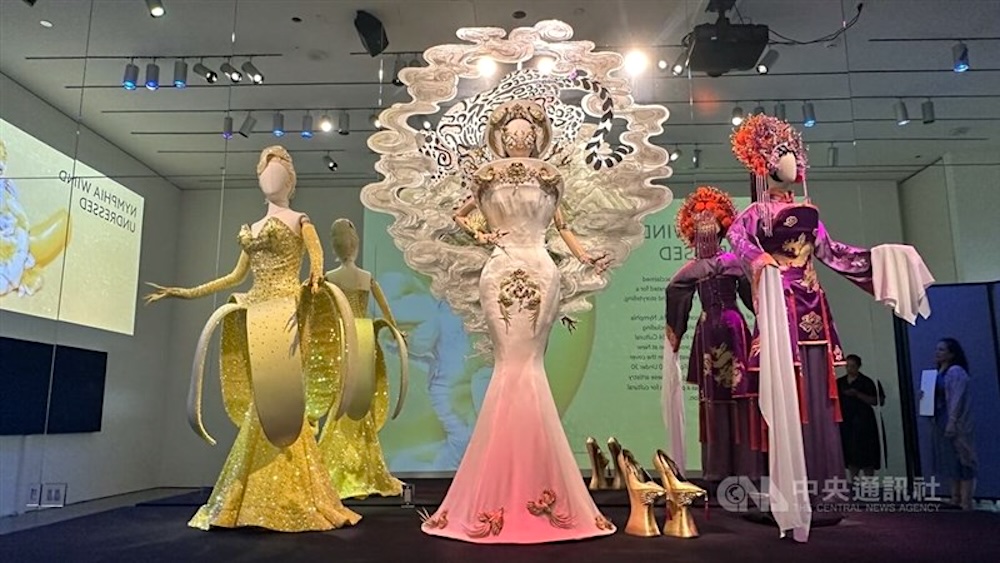
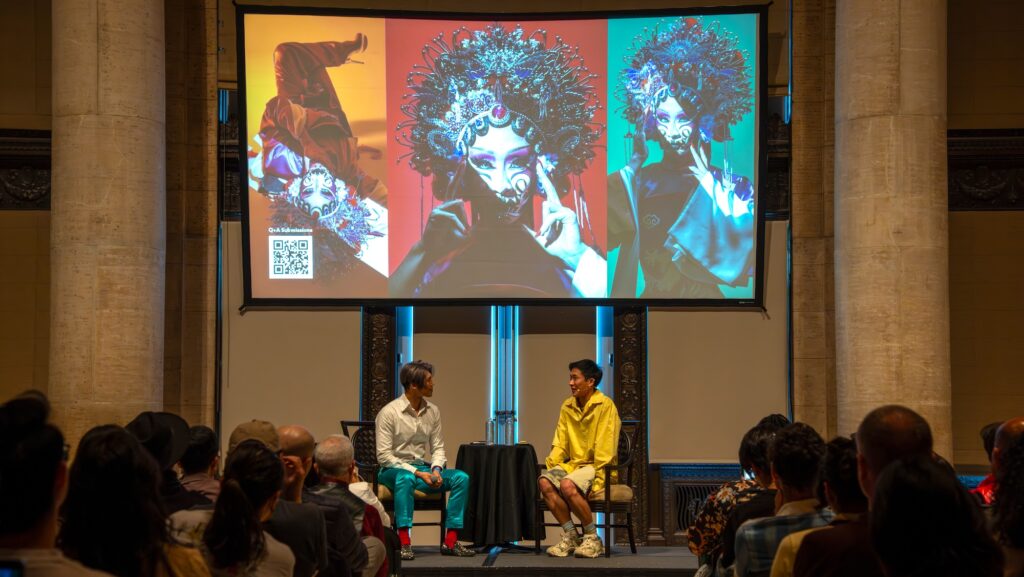
Such was the charm of Nymphia Wind Undressed—the sold-out artist talk (second of two, by audience demand) that brought the RuPaul’s Drag Race Season 16 winner to the Asian Art Museum on June 13, with three of his exquisite creations briefly displayed over the weekend in the Shriram Learning Center downstairs.
Out of drag, Leo is quieter than alter-ego Nymphia. He speaks deliberately and excitedly by turns, means what he says, and laughs when something actually lands. The audience—around 150 people packed into the Samsung Hall—treated him with the warmth you’d give someone who’d done something genuinely meaningful, not just someone famous.
He has. Nymphia Wind is 30, the first East Asian queen to win the flagship Drag Race series, and a 2024 Forbes 30 Under 30 Asia honoree. But what makes this museum induction truly momentous is less about the crown and more about the gowns.
The three looks on display were full experiences to take in, each one hand-constructed by Nymphia herself. Her rhinestoned yellow Drag Race finale gown (each stone placed by her and friends working through the night) cheekily marries her recurring joyful banana motif to Thiery Mugler’s iconic 1995 “The Birth of Venus” design. The Peking opera look incorporates a face mask drawn from temple fair deity paintings and and a phoenix crown inspired by the ancient tian-tsui technique—replacing the traditional kingfisher feather inlay with organza so no birds had to die.
Finally, Yun Xian, the cloud goddess, took center stage, with a back piece that releases hand-crafted clouds behind the wearer, a 3D-printed Formosan clouded leopard across the skirt, and, yes, tiny bananas hidden in the hem.
 妮妃雅 瘋 (@66wind99)
If you know SF’s history with its Asian communities—the Chinese Exclusion Act, the Japantown internment, the ongoing displacement of the Tenderloin’s Southeast Asian families, the long fight for this museum to even exist as a civic institution that says this art belongs here—then a drag queen’s gowns joining the collection for a few days hits differently than it might elsewhere. Pride Month programming at an Asian art museum is not a gimmick. It feels like the institution saying: Queer Asian creativity is part of what we hold.
Nymphia gets this. “As Asians growing up,” she told the room, “we don’t really see ourselves as the main character. We’re almost like the comedic sideline character.” The Serpents Tour she co-headlined earlier this year with fellow queen of fabric Plastique Tiara—a 15-city US production built around the Legend of the White Snake, platforming local AAPI artists in every city—saw Nymphia channeling her voice to amplify more voices. Fans approach her after shows. “They’ll tell me something really heartwarming, and it reminds me—oh, you’re actually representing a whole community.” She said it with great weight.

The talk was moderated by self-taught costume designer and Stanford alum Wayne Hwang—who himself has shown collections at NY, LA, and Miami Fashion Weeks. This gave the conversation a useful specificity: Two people who make things talking about making things. Hwang asked what a great costume does. “Once you see a good costume, you can see craft, you can see detail, you can see history, you can see research,” Nymphia responded. “What’s interesting is what clothes make the body do.” She’s not merely interested in effect. She’s interested in what the wearer becomes.
After the talk, I asked Nymphia whether she’d considered going the fashion-industry route after graduating from the University for the Creative Arts in the UK. “No,” she said, without a pause. “I wasn’t really interested in the fashion industry. I liked the craft of making.” For her, drag was the container big enough to hold all of it: clothes, performance, makeup, cultural research. If not drag, she thinks she’d be doing museum restoration or embroidery.
On the question of whether drag appropriates or celebrates femininity, she was thoughtful. “Every drag queen exaggerates feminine features—a big chest, a small waist—to balance a man’s body. But for me, it’s homage. Women will come up after shows and say, ‘you’re more woman than I am.’ And I tell them: I’m doing this because I want to look like you.” “I think femininity, in anyone, gets suppressed by patriarchal frameworks. I want to use it as a weapon.” It’s the same logic K-pop has applied to Asian masculinity in the West, she noted—show that it can look like this, too, and watch what happens.
Nymphia lived at home in Taipei when she started out, and cited not having to pay rent as a genuine privilege: “When you don’t have financial pressure, you have more mental space for creativity.” Rhinestoning in hotel rooms. Friends recruited as last-minute studio hands. The Yun Xian outfit’s shoes, she admitted during the talk, are 3D-printed bases and deconstructed Steve Maddens. Her detail-oriented mother Mimi, who, with her brother, cheered Nymphia on at her first show, still critiques everything. “She never just appreciates. She always points something out.” She said it like it made her better.
Last year, Nymphia visited an indigenous community in Taiwan to learn tapa, cutting a section of tree and hammering the bark away until the inner skin opens into fabric. She’s studied banana fiber weaving, done on the floor with a hand shuttle. She wants to spend months inside a single traditional craft and then make something —a garment, a performance—that carries it forward. These are intangible heritage forms, some nearly lost, some recently revived. Drag, of all containers, turns out to be a pretty good one for preservation.
I asked, in Mandarin, whether she thinks or dreams in Chinese or English. “Both,” she said. “But my personality is a little different in each language.” Chinese feels closer to something interior, she mused. She’s grown up between enough places—LA, Hong Kong, Taiwan, England, Brooklyn—that no single one alone defines her.
During our lightning round, Nymphia shared that her boba order is Four Seasons oolong with two sides of small taro balls. She proceeded to choose McQueen over Galliano because the former’s pattern cutting is recognizable even without a label. She picked Lady Gaga over Jolin Tsai, and reminisced about being raised on Gorillaz and Britney Spears. She performs Chinese songs when the theme calls for it, and the Asian fans in the crowd go loud in a different way. “They’ll hear a song they listened to as a kid.”
The gowns come down on Sunday. But for a few days in June, in a Beaux-Arts building in Civic Center that used to hold books and now holds 6000 years of Asian art, three dresses stood on platforms under good light and waited to be admired. Some people photographed them. Some just stood there for a long time. At the end of the talk, someone asked what advice she’d give to a young person who wanted to start drag but felt too insecure.
“Ask yourself: are you going to keep having these insecurities and never do the things you want to do? Or maybe just don’t listen to that voice for one hour, put the makeup on, and walk out the door.” Then you walk out the door. And it’s Pride.
The post Nymphia Wind’s gorgeous gowns told a resilient story at Asian Art Museum appeared first on 48 hills.