New ballot drop-off option proves popular in primary, potentially leading to faster election results
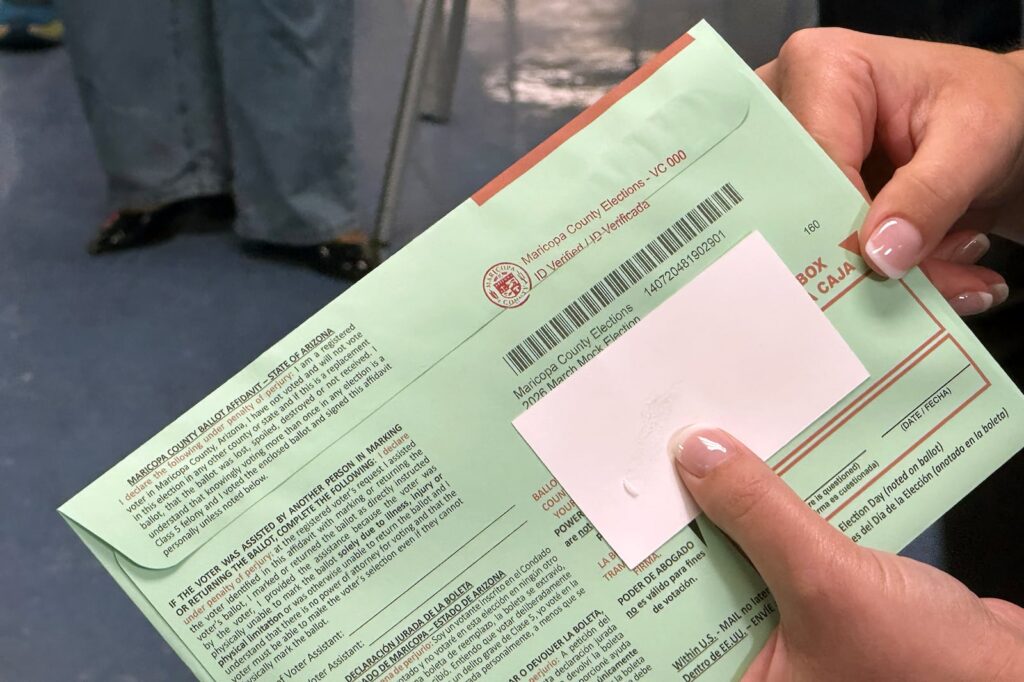
Alexandra Flahive, a communications and outreach manager at Maricopa County Elections Department, holds an ID-verified mail ballot during a mock election on Wed., April 1, 2026 in Phoenix, Arizona. About 23,000 voters used the new ID-verify process in the state’s most populous county during the recent primary election. (Sasha Hupka/Votebeat)
When Arizonans went to the polls last week for the state primary election, they made their preferences clear about more than just the candidates: They also really liked the option to get their mail ballots counted faster by showing identification.
More than 6,000 voters used the new, optional procedure in Pima County — about half of the voters who dropped off their ballots at the polls on Election Day, per county records. In Maricopa County, the state’s most populous, officials said about 23,000 voters, or 30% of those who dropped off ballots on Election Day, opted to show ID to verify their mail ballots.
Those numbers represent a successful debut for the procedure, which Republicans have pushed as a way to speed up election results. Indeed, Maricopa County finished counting mail ballots significantly faster than usual, which officials credited in part to the change.
But it remains to be seen whether ID verification is a long-term fix for Arizona’s relatively slow vote count. Officials in at least one county, Pima, said kinks remained to be worked out with the process. Plus, it’s unclear whether the option will be as popular in November.
How the new option leads to faster election results
Arizona voters have long had the option of dropping off their mail ballots at polling places. But unlike voters who cast ballots in person, they don’t have to show an ID to verify their identity or wait in line at the polls.
Instead, they just have to sign their ballot envelope and place it in a secure box at the polling place. Election officials later compare that signature to signatures the voter has on file before counting their vote.
But that process can be time-consuming. As a result, it often takes days to verify and count the thousands of mail ballots — often called “late earlies” — that are dropped off on or shortly before Election Day. The wait has caused increasing consternation as the state has morphed into a key election battleground, with major races sometimes separated by just hundreds of votes.
So, in 2024, as state lawmakers sought to find compromise on legislation to adjust election dates, Republicans pushed to require county officials to offer a new option. Now, voters can wait in line and show a driver’s license, passport, or similar form of ID when dropping off their ballots, allowing them to bypass the signature verification process.
Last week’s primary was the first big test of the new option, and with fewer ballots needing to be signature-verified, that process took less time than usual. Maricopa County Recorder Justin Heap, a Republican, announced around 8 a.m. on Wednesday, July 22 — just 13 hours after polls closed — that his staff had completed signature verification. His office said in a statement that it marked “an unprecedented milestone” and set “a new benchmark for the speed and efficiency of signature verification during a primary election.”
The statement attributed the improvement to “enhanced processes, technology improvements, and the dedication of our trained staff.” But Republican Kate Brophy McGee, chair of the county’s board of supervisors, said the ID-verify option also helped speed things up.
“This significantly reduced the number of early ballots requiring signature verification in the days after the election,” she said in a statement.
The county’s elections department also closely coordinated its ballot preparation and tabulation processes, and was fully done counting 99% of ballots as of Wednesday evening. Plus, the primary saw relatively low turnout statewide.
Judy Keane, a spokesperson for Heap, declined to respond to questions from Votebeat about how the ID-verify option contributed to the faster-than-usual signature verification. She said signature verification metrics would be available following the county’s canvass of election results on Aug. 3.
In Pima County, Democratic Recorder Gabriella Cázares-Kelly said in a statement to Votebeat that workers are capable of verifying about 2,500 to 3,500 signatures in an hour, depending on staffing levels. In last week’s primary, her office finished signature verification at about 2 p.m. on Wednesday. She estimated that it would have taken staff an additional hour and a half to signature-verify ballots from voters who opted into the ID-verify process on Election Day.
Cázares-Kelly said the number of ID-verified ballots in the primary wasn’t significant enough to truly impact her office, adding that the new procedure also slowed some ballot intake processes.
But her county saw more than 44,000 late early ballots in the 2022 general election. If that number — and the ID-verify option’s popularity — holds true this year, the new process could stand to save her team up to nine hours of signature verification. The potential time savings is much larger in Maricopa County, which saw a record 290,000 late earlies dropped at the polls in 2022.
Election official says there are still kinks to work out
Despite the numbers, Cázares-Kelly raised a host of concerns with the ID verification process for mail ballots.
She said the procedure, created without “meaningful input” from election officials across the state, created additional steps that delayed ballot processing and ultimately did not save her office time. Unlike Maricopa County, where officials used on-site tabulators to count ID-verified ballots immediately on Election Day, Pima County offered just one ballot drop box per polling place for mail ballots. As a result, on primary night, workers had to sift through thousands of late earlies to separate ID-verified ballots from those in need of signature verification.
Cázares-Kelly declined to respond to questions from Votebeat about how much time workers lost to that task and whether the issue could be mitigated by implementing a second ballot drop box for ID-verified ballots at the polls.
Cázares-Kelly said the new process also created training and communication challenges. She said her office received many complaints when poll workers began approaching voters about the ID-verify option in small, local elections earlier in the year.
“Some felt singled out, discriminated against,” she said, adding that her team eventually created signage and directed workers not to proactively talk to voters about the new option. “Some voters wondered why they were asked, while others were allowed to simply drop off their ballots. Some said they were made to feel as if it were mandatory; several alleged racial discrimination.”
Meanwhile, other staffers were confused when voters came into the polls requesting that they “signature-verify” their ballots.
“This is a specific process, which is only conducted by our highly trained signature verification staff,” Cázares-Kelly said. “We will be training staff to interpret that language as a request to ID-verify in the next election cycle.”
Will ID verification be as popular in November?
There are also questions about whether the new option’s popularity in the primary will translate to the general election.
Lines were minimal to nonexistent at the polls during last week’s primary. But in higher-turnout elections, lines of up to an hour are not uncommon at polling locations in the state’s largest cities. It’s unclear whether voters will be as enthusiastic about ID-verifying their ballots if they have to wait in long lines to do so.
State Rep. Alex Kolodin, one of the lead architects of the new option and the GOP nominee for secretary of state, did not respond to requests for comment on the process’ primary debut and how it might perform in the fall.
GOP picks election denier Alexander Kolodin to challenge Adrian Fontes for secretary of state
But Republican Stephen Richer, Maricopa County’s former recorder, was doubtful. “Remains to be seen if it will be easy in November when more people vote and lines will be longer,” he wrote in an email.
Primary data suggests voter interest in the option may also hinge on decisions by county officials. In Pima County, where a significantly larger share of voters opted to ID-verify their ballots, officials offered two separate lines at the polls — one for in-person voters, and one for those ID-verifying their mail ballots. Maricopa County offered only one line for all voters on Election Day.
Still, Richer said if the option remained popular in November, it could help “materially” with speeding up counting and race calls — although he noted voters and politicos will still have to wait if races are exceptionally close.
“The statistical models used by the networks are quicker to call results the more ballots they have in,” wrote Richer, now an adjunct scholar at the Cato Institute and a senior fellow at the Harvard Kennedy School. “So the sooner you get to 80, 85, 90, 95 percent, the sooner you can call races, even closer ones.”
This article was originally published by Votebeat, a nonprofit news organization covering local election administration and voting access.