Mohave County will debut new ballot paper with added security measures in July primary
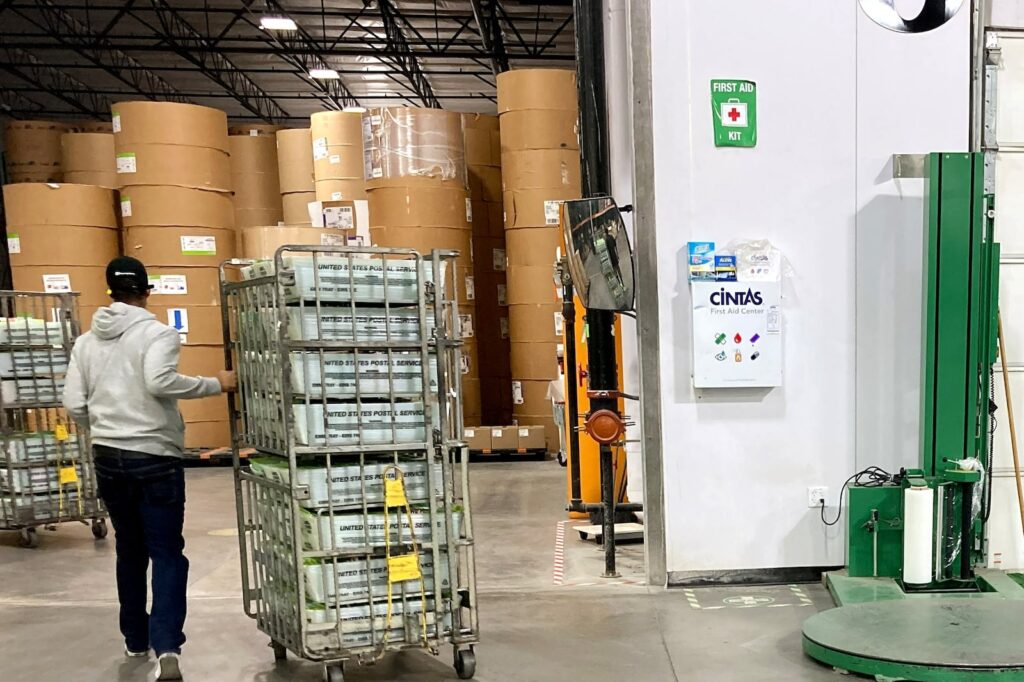
A person pushes a cage full of Maricopa County mail ballot envelopes at Runbeck Election Services during the March 2024 presidential preference election. Runbeck could provide some, but not all, of the security features that Arizona lawmakers are considering for ballot paper. Photo by Jen Fifield | Votebeat
Officials in Mohave County, Arizona, walked into a public meeting last year with bad news for their bosses.
The rural, bright-red county wanted to adopt a type of ballot paper with watermarks, embedded fibers, microprinting, and other security features for future elections. Its elected supervisors had previously voted to approve a new contract for such paper with Runbeck Election Services, a voting materials company in Phoenix, because they firmly believed the change would improve voter confidence.
But election officials had recently tested the paper, called Ballot Guard, with the county’s vote-tabulating machines and found that it wasn’t performing as hoped.
A team of staffers took the podium to lay out the situation. The paper, they said, caused the tabulators to pull multiple pages at once, leading to paper jams and other errors that required rerunning ballots. ES&S, the company that manufactured the county’s tabulators, had done its own tests and seen similar results.
Elections Director Allen Tempert warned that using the paper in a live election could significantly slow results and increase the possibility of inaccurate tallies. He urged the county’s all-Republican board of supervisors to consider another type of paper that included watermarks and had already worked successfully elsewhere.
The board appeared open to considering the alternative. But months later, another round of testing returned improved results. In January, with election officials’ blessing, supervisors voted unanimously to use Ballot Guard in upcoming elections.
“It works well,” Tempert told Votebeat, adding that he was “comfortable” with county supervisors’ decision.
Now, the stage is set for a make-or-break moment in the state’s northwest corner — starting with the state primary, scheduled for July 21. A successful debut could inspire other counties to pick up the paper. But if the paper causes problems, it could lead to an election night mess — and deal a major blow to Republicans’ longstanding efforts to encourage such security features on ballots across the state.
From bamboo to Ballot Guard: How election security concerns inspired new ballot paper
In Arizona, the push to put security marks on ballots began with a widespread conspiracy.
After the 2020 presidential election, false claims began circulating that someone had flown fake ballots from Asia to Maricopa County to rig the race for President Joe Biden. That prompted auditors assisting with a GOP-led review of the county’s election results to shine blacklights on ballots in search of bamboo fibers or watermarks.
No bamboo ballots were ever found. Arizona has a plethora of checks to ensure only ballots cast by registered voters are counted. There’s no evidence that counterfeit ballots have ever found their way into the state’s elections.
But since that episode, some GOP state lawmakers — including then-state Sen. Sonny Borrelli, who now serves on the Mohave County Board of Supervisors — have repeatedly tried, and failed, to pass legislation requiring security features on ballots.
Nationally, California has long used ballot paper with watermarks. In recent years, the push for such paper has also caught on some swing states. Georgia now requires watermarks on its ballots. In Michigan, some counties have chosen to do the same.
But Mohave County would be the first in the country to use Ballot Guard specifically. In recent elections, leaders there have also considered hand-counting ballots and voting against certifying vote tallies.
Board Chair Travis Lingenfelter, a Republican, told Votebeat that his constituents were deeply concerned about election integrity and hesitant to trust election results. He believes the new paper can help assuage those fears — particularly if other jurisdictions are inspired to pick it up, too.
Lingenfelter said the county’s contract with Runbeck was purposefully structured as a cooperative one. A number of counties — including Maricopa, the state’s most populous county and a key swing region — use it to procure their own voting materials, and any of them could opt to use Ballot Guard in the future.
A spokesperson for the Maricopa County Elections Department said it currently had no plans to use the paper. Still, Lingenfelter said he hoped other counties might follow Mohave’s lead if it proves the paper can be used successfully.
“I feel like Mohave County is contributing positively to this big overarching issue of voter confidence and election integrity,” he said, adding that his county was “proud” to serve as a trailblazer.
Ballot Guard won’t cost Mohave County any money — for now
While legislation to require security features on Arizona ballots never passed, the state did greenlight a $1 million grant program in 2022 that offered counties a chance to test out ballot paper with specialized security features.
Former Cochise County Recorder David Stevens signed up for that program, but he didn’t anticipate how long it would take to get up and running. He missed the grant’s deadline, and county officials decided to scrap the project.
But Stevens had already used grant funding to pay Runbeck to order 10 tons of ballot paper and commission a giant watermarking machine. The county’s decision left that paper sitting unused on the floor of the company’s warehouse in Phoenix.
Since then, the county had been grappling with what to do with it. Cochise County Recorder Billy Cloud urged local leaders to give it away, noting that the paper wasn’t of use to the county anymore. So in May, Cochise chose to transfer its paper to Mohave County, free of charge.
Mohave will now use that same exact paper to print its ballots for upcoming elections. Tempert and Interim Elections Director Karina Sumner — who is set to replace Tempert when he retires on July 4 — said the paper should get the county through the state primary and general election.
“For 2026, it’s a wash,” Tempert said. “We ain’t paying no more money in 2026.”
But the county could see increased election costs in 2028. Tempert said Ballot Guard costs up to 15 cents more per ballot than the county’s usual paper. There are approximately 150,000 registered voters in the county, so that could add up to an extra $22,500 per general election.
That represents a tiny fraction of Mohave County’s $600 million budget. Still, the county has long faced revenue challenges. In recent years, it has at times needed to institute temporary hiring and employee travel freezes to stave off budget deficits.
Nonetheless, officials appeared undeterred. Lingenfelter said that because his county had coordinated a cooperative contract with Runbeck, it gets a small revenue kickback if other counties sign on. He said that should help the county offset its costs.
Officials say paper is working well, despite mixed test results
In initial tests, the difference between Mohave County’s typical ballot paper and Ballot Guard was stark.
Officials found that the new paper was prone to so-called “multi-feed” and “pick” errors, both of which occur when a tabulator accidentally grabs more than one ballot at a time. On average, 3.6% of ballots printed on the new paper saw multi-feed errors and about 0.8% saw pick errors — far higher error rates than that of the county’s usual ballot paper.
In 2024, about 111,000 voters cast ballots in the county. Officials estimated it would have taken up to six hours longer to count those ballots if they were printed on the new paper, a notable timesuck for a department with just a handful of full-time employees.
“In conclusion, though the Ballot Guard paper properly tabulates every time, we would not recommend its use,” officials wrote in a testing report that they presented on Sept. 15. “The process is significantly slowed by multifeeds and pick errors, which would not happen on original Runbeck paper stock. The security added by the paper is irrelevant when counterfeit votes would never make it to the ballot tabulators in the first place.”
Later, Sumner said Runbeck hypothesized that the errors may have been the result of static electricity in the stacks of testing paper. Static causes ballots to stick together, but the issue could be solved by letting the paper sit out for a day or two.
In December, the company sent the county more paper — this time, letting it rest before shipping it out. When election officials tested ballots with that batch of paper, Sumner said, they saw dramatically improved results. On average, just 0.7% of the ballots were met with multi-feed errors, and another 0.7% with pick error messages.
That’s still more than the 0.3% and 0.0% error rates that the county’s regular paper encountered in initial testing, on average. But Sumner noted that multi-feed and pick errors happen in live elections no matter what type of paper is being used. The error rates seen with the new paper, she said, shouldn’t slow officials down too much in the counting process.
As a result, election officials say they are now on board with Ballot Guard. “The limited multi-feed and pick error rates are deemed acceptable for ballot feed errors with ballot tabulation,” a January test report read.
Katina Granger, a spokesperson for ES&S, said the company still doesn’t recommend the paper for use with its tabulators. Ballot Guard does not meet the same specifications as its recommended paper stock, she said.
“We’ve identified several differences in physical characteristics, like surface texture, thickness, stiffness, coating, and fiber composition, which can impact how ballots move through the equipment and are scanned,” Granger said, adding that ES&S had communicated “potential performance risks” to Mohave County. “We recommend jurisdictions use paper with specifications within the recommended parameters to guarantee performance.”
But Sumner said the paper has also been tested during pre-election audits and ran smoothly. She said she was confident that the paper will work well in upcoming elections.
“It’s not going to affect the tabulation or the results at all,” she said. “It’s all going to be fine.”
This article was originally published by Votebeat, a nonprofit news organization covering local election administration and voting access.