Lilly Wachowski on 30 years of ‘Bound,’ trans revolution, and Nazis snatching ‘The Matrix’
Filmmaker Lilly Wachowski pauses when asked whether an audience member has ever interpreted one of her films better than she intended.
In San Francisco this weekend for a 30th-anniversary screening of Bound and the premiere of Something You Should Know About Me at Frameline50, she’s had plenty of time to consider the question.
“I’m sure there have been,” says Wachowski. “There are a lot of bad ones, too.”
One bad interpretation comes to mind instantly.
“Just the whole appropriation of the idea of red pill and blue pill by the Nazi movement in this country is a huge one,” she says.
More than a quarter-century after The Matrix transformed popular culture and three decades after Bound premiered at the Castro Theatre, Wachowski has spent years watching audiences discover meanings in her work that she never anticipated.
Some have revealed dimensions of the films she couldn’t see while making them. Others have twisted them into something unrecognizable.
The experience helps explain why she and her sister Lana have long resisted offering definitive explanations of their movies.

“When an artist speaks about a film, it roots it,” says Wachowski. “There are so many ways to interpret your art, and it is a collective, collaborative art form. How can one person speak definitively about that piece of art?”
There was another reason for that reluctance. “We had reservations back then about speaking about our art because we were both closeted trans women,” she adds.
That tension between authorial intent and audience interpretation helped shape Bound‘s enduring place in queer cinema. The film announced the Wachowskis’ arrival as filmmakers and became a landmark for queer audiences long before either sister publicly came out.
That legacy will be celebrated this weekend when Wachowski returns to San Francisco for Frameline’s 30th-anniversary presentation of Bound (screening at Frameline on Sat/20), which she directed with her sister Lana. She’s also the executive producer of Something You Should Know About Me (screening at Frameline on Sun/21 and Fri/26), director Andy Fidoten’s trans romantic comedy.
For Wachowski, returning to the Castro carries particular emotional weight.
“That screening all those years ago was one of the greatest screenings of any of Lana’s and my films that I had ever seen,” she says. “As I look back, I have so much gratitude and humility that I was able to provide my community with a piece of art and entertainment with my sister.”
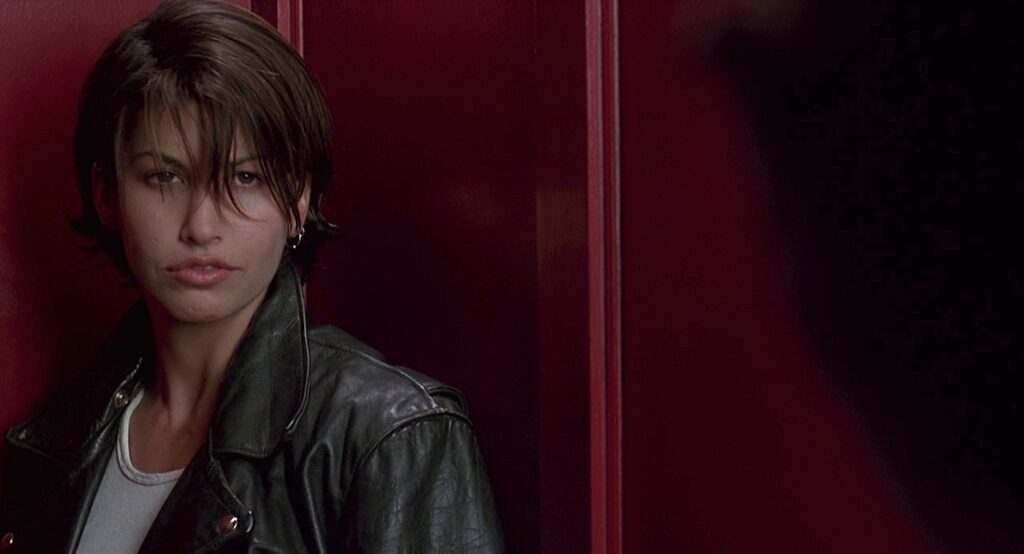
Released in 1996, Bound follows Corky (Gina Gershon), an ex-con trying to rebuild her life, and Violet (Jennifer Tilly), the girlfriend of a mob money launderer. As the two fall for each other, they hatch a plan to steal millions from the Mafia, creating a sleek thriller that blends noir traditions with a lesbian romance that refuses to end in tragedy.
The film became both a critical success and a queer classic, passed between generations of viewers who often discovered it through word of mouth.
“There is a profound dearth of happy endings for queer people,” Wachowski says.
Thirty years later, she views the film’s legacy with pride, tempered by concern about the political climate surrounding its anniversary.
“I’m also looking back with a little bit of melancholy that it’s 30 years later, and we live in a country that has taken so many steps backward and is swinging towards fascism and away from humankind,” she says. “What was true back then is still true today. Trans lives and queer lives have meaning, and trans lives and queer lives are worth fighting for.”
She remains especially grateful for the audiences who embraced Bound long before they knew how much of its longing for liberation reflected her and Lana’s own lives.
“There was something in that screening that all those queer women, all those lesbians, took in and embraced,” says Wachowski. “They were willing to wrap their arms around this movie and wait for Lana and me to emerge from the closet.”
That belief in the power of genre storytelling continues to inform the projects she chooses to support.

At Frameline, audiences will also see Something You Should Know About Me, a romantic comedy centered on Al, a young trans cartoonist secretly in love with his best friend Jesse. When the two attend a queer cartoonists’ retreat together, romantic tensions, creative aspirations, and imagined possibilities collide in a film that blends live action and animation.
When Fidoten initially approached her about the project, the premise stood out immediately.
“Andy had this idea of a raunchy rom-com with trans guys, and you don’t see anything like that,” she says. “I was instantly charmed by the way he spoke about the film, the way he wrote about it, and the snippets I saw. I was like, ‘How can I help?’”
For Wachowski, helping bring trans stories to the screen remains a political act.
“Putting trans people in main roles or even behind the camera, these are acts of revolution to me because the industry is so stagnant,” she says.
The conversation eventually returns to San Francisco, a city that has long occupied a special place in queer history and in Wachowski’s imagination.
“I am excited to march in the Trans March,” she says. “I’ve never seen anything like that anywhere for any Pride, except in San Francisco.”
She speaks passionately about the march’s connection to the 1966 Compton’s Cafeteria Riot. Appropriately, the annual route ends at the intersection of Turk and Taylor streets, not far from where that history was made.
“People just don’t understand that the Compton’s Cafeteria Riot predates Stonewall,” says Wachowski.
For the filmmaker, San Francisco remains a place where queer history, political struggle, and collective possibility continue to intersect. That symbolic power helps explain why one of the most beloved characters in the Wachowski canon came from here.
Asked why she and Lana made Nomi Marks, the trans hacker and activist played by Jamie Clayton in “Sense8,” a native San Franciscan, Wachowski’s answer is immediate.
“It’s one of the greatest American cities,” she says. “It is the foundation of queer revolutionary power in many ways.”
Nomi’s identity, she says, needed that grounding.
Then, fittingly, the conversation ends with another interpretation.
Asked whether Nomi Marks’ name was secretly inspired by Nomi Malone, Elizabeth Berkley’s character in Showgirls, also starring Gina Gershon, Wachowski laughs.
“No, but I do like that,” she says. “I’m going to use that from now on. Well done, Josh.”
FRAMELINE50 runs through June 27. For tickets and more info, go here.
The post Lilly Wachowski on 30 years of ‘Bound,’ trans revolution, and Nazis snatching ‘The Matrix’ appeared first on 48 hills.
Check this story
Is this AI-made?
AI checkers give a likelihood, not proof.