LAUSD special ed classes were meant to be smaller this fall. Teachers are worried it won’t happen
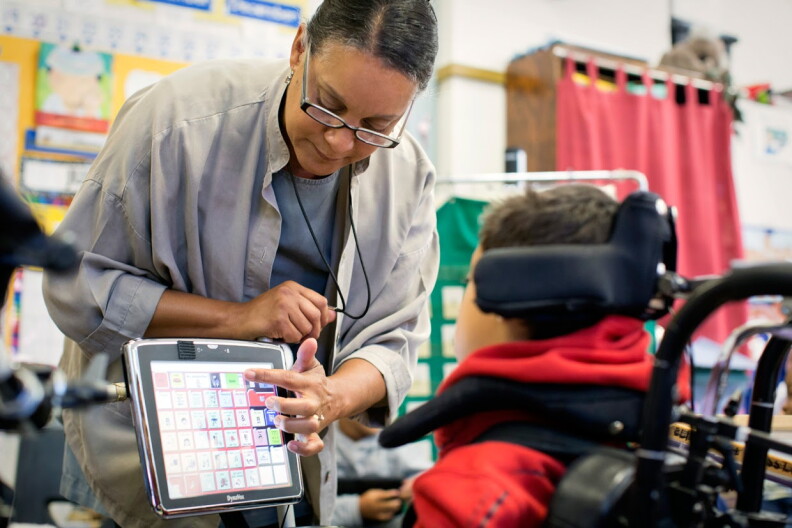
Los Angeles Unified special education teachers and parents are bracing for another year of large classes when the new school year begins, despite a first-ever limit the union negotiated this spring.
With booming special education enrollment, teachers say the district needs to hire more full-time staff to ensure tens of thousands of students receive the extra support they need — and are legally entitled to — every day.
Under the new contract ratified by the United Teachers Los Angeles, integrated classes with both special and general education students are limited to 20 students per teacher.
Classrooms with only special education students have different ratios, and those teachers qualify for a monthly stipend of $500 to $1,000, depending on how many students over the limit they have.
But teachers say that although the extra pay doesn’t hurt, they want the district to focus on making both kinds of classes smaller.
Debby Schneider, a special education teacher and UTLA committee chair, told LAist that it’s not about the money.
“The stipend is to deter the district from overloading us. Really, what they need to do is open more programs and hire more educators,” she said.
Stipends for large classes aren’t new, but Schneider told LAist that in previous years, extra compensation didn’t stop the district from overfilling classrooms. Because of that history, she said she’s concerned this year won’t be any different.
As of July 17, there were 22 open positions for teachers in full-time special education classrooms, and three vacancies for those who work in integrated classes.
There are over 70,000 students enrolled in LAUSD’s special education services, which include support for learning disabilities, autism, and hearing and visual impairments. A district spokesperson wouldn’t specify how many integrated classrooms are overfilled. The district is “continuously assessing staffing needs,” the district wrote in a statement, but would not comment on specific plans to hire more special ed teachers for the upcoming year.
A growing need
According to UTLA, the number of students in LAUSD’s special education services has grown over 7% since 2022, even though overall student enrollment is down by nearly 4%.
Emily Kolman, whose kindergartner receives speech therapy services, said that resources are overextended and the district isn’t doing much to help.
Kolman said her son was in an integrated class of 26 students last year. She told LAist that the teacher continuously asked the district to help her work with students in smaller groups. That help only came near summer break, which made it hard to identify students who needed extra support through the year.
Kolman and her son’s teacher acknowledged that her son needed additional behavioral testing, but it was “like pulling teeth” to get a screening organized by the district. She’s now paying out-of-pocket to get him tested privately.
“I feel like our students with needs are bothersome or a nuisance for the public school” district, she told LAist.
The challenges of larger classes
LAUSD teachers say they can’t support students in growing class sizes alone.
Margaret Miller, an elementary school special education teacher, recalled that in one large integrated classroom she assisted, a student would climb on the teacher while she gave a lesson.
“When you’re getting another student, it’s not just a body. It’s not just a kid in the classroom. It comes with quite a bit of work,” she said.
Amy Bogartz, a teacher of Deaf students, emphasized that in special-needs settings, each student requires personalized support.
“Every student requires something different. You have a student that you just need to check in on. … Then you have that other student that you need to spend three hours with,” she said.
Teresa Gaines is a parent of an 11-year-old with phonological awareness deficit and “focus issues.” She said her family is feeling the impacts of large integrated class size. She told LAist that her son’s classes have ranged from 21 to 24 students and he has often had to wear headphones to block out the noise to concentrate.
Teachers are burning out too
Some teachers said their colleagues are leaving the classroom because they’re stretched too thin to handle student behavior, or because they don’t feel supported by their school’s administration.
According to EdSource, LAUSD’s special education teacher retention rate dropped from 90% to 77% between 2021 and 2024.
UTLA’s Schneider explained that the special education workload is particularly challenging. She said some teachers have duties similar to general education teachers, including writing report cards, on top of the special ed services they provide. With extra students, it can cause exhaustion, she told LAist.
Gaines, the parent of the 11-year-old in special ed, said it’s important for the district to retain teachers who have extensive experience with special education.
“I don’t want to lose staff who are already teaching and in the system. I’d rather support them … so that they can further benefit all of our students,” she said.
What’s next
Teachers of classes with only special education students can qualify for the new monthly stipend starting this fall. If their class is two or more students larger than the ratio, they will be paid through a process that includes verifying the class roster.
Contract negotiations for next year will begin in the spring.