How Trump closed a key career path for Oregon immigrants and refugees
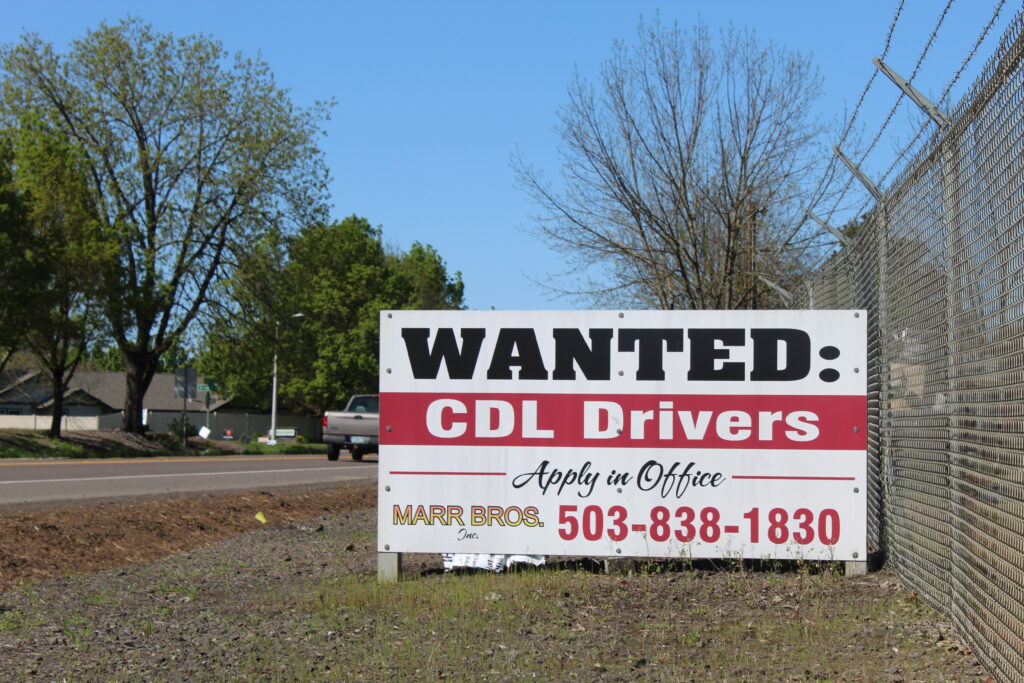
A recruitment sign for commercial truck drivers sits along Oregon Route 99 in Monmouth. (Photo by Mia Maldonado/Oregon Capital Chronicle)
Abdul Saboor Hassan moved to Oregon in 2020 after qualifying for a green card for his service to the U.S. Army in his home country, Afghanistan. He became a commercial truck driver for a short period of time before becoming a commercial driving instructor, an experience that motivated him to open his own commercial driving school in Portland in 2024.
When he opened his business, he expected to attract immigrant and refugee students because he could offer them help in multiple languages.
Instead, enrollment from those communities plummeted.
About 70% of his students came from immigrant and refugee backgrounds when his school first opened, he told the Capital Chronicle. That share dropped to about 25% in spring 2025, after the Trump administration issued an executive order enforcing stricter English-language proficiency requirements for commercial drivers, and as it began a crackdown on states that issued temporary commercial driver’s licenses.
Some states, including Oregon, issued temporary CDLs to people who are legally in the U.S. on a temporary basis without permanent residency, such as asylum seekers, refugees, Deferred Action for Childhood Arrival recipients and others granted employment authorization.
But last summer, the Trump administration determined Oregon and 24 other states violated federal regulations by issuing these licenses or not complying with other rules. In March, the Federal Motor Carrier Safety Administration followed up with a rule barring states from issuing temporary commercial drivers licenses in most cases. States that don’t follow the new rule risk losing millions in federal transportation funding.
Now, roughly 900 people — all legally living and working in Oregon — can no longer renew their temporary CDLs or learner’s permits. And others who had hoped to enter into the profession can no longer obtain one.
Hassan is still able to make a living, and he still caters his business to immigrants — but only to those who obtained citizenship or a green card.
“I know a lot of people are interested and they would like to have a commercial driver’s license, but they cannot take my class because they are not allowed,” he said, sharing that he remains deeply involved in the state’s Afghan community.
Commercial driving a common path to stable work for immigrants and refugees
Oregon began issuing non-domiciled CDLs in 2010, according to Chris Crabb, a spokesperson for Oregon’s Driver and Motor Vehicle Services division. The program paused between 2015 to 2017 and in late 2025 as the state worked to meet federal standards.
The state of Oregon is unaware of evidence indicating that drivers with limited‑term CDLs are less safe than other commercial drivers, Crabb said.

Commercial driving training is the top service requested by men seeking career help at the Immigrant & Refugee Community Organization, said Josie Majuri, the workforce development manager at the Portland-based nonprofit.
It’s an attractive career path because it offers high wages without requiring a college degree. It’s also a good fit for people still improving their English skills, and workers can begin earning soon after completing training, said Theresa Park, the nonprofit’s North/Northeast WorkSource site manager.
That accessibility, however, is part of what drew scrutiny from the Trump administration, which cited a handful of high-profile fatal crashes involving immigrant truck drivers to justify its crackdown.
One such case happened in Oregon in November 2025, when Rajinder Kumar, who the Department of Homeland Security identified as an Indian national who entered the U.S. illegally in 2022 and received a California commercial driver’s license and work authorization, reportedly jackknifed his semi across both lanes of traffic on U.S. Highway 20. Two newlyweds in a Subaru struck his truck and died.
Kumar faced felony charges in Deschutes County, but the federal government took him into custody and a judge ordered his deportation earlier in July.
“I need our state partners to understand that they work for the American people, not illegal immigrants who broke the law illegally entering our country and continue to break it by operating massive big rigs without the proper qualifications,” U.S. Transportation Secretary Sean Duffy said in a statement.
Oregon Trucking Association President and CEO Jana Jarvis said she supports the federal government’s new rule, adding that the demand for truck drivers isn’t as high as it was during the pandemic.
Immigrant and refugee advocates criticize federal rule
In response to the new federal rule, many immigrant and refugee clients about to start CDL training or in the process of finishing training had to switch career paths, Park said. Many turned to rideshare driving, warehouse and assembling line jobs.
“It’s frustrating because some of these folks had jobs lined up,” she said. “We have people to do the jobs, but they’re not allowed to do it.”
Park saw some clients invest their savings into buying several trucks with the hopes of operating their own trucking business.
“Now they cannot drive the trucks, and because of that they’re trying to sell them, but they can’t sell them,” Park said. “Some of them are getting repossessed, some of the families are having to sell their homes or move out of their apartments, and some are having to go to food pantries because the source of income that they had or had plans for is now suddenly gone.”
Many clients at the nonprofit Salem for Refugees also relied on temporary CDLs.
“For many refugees, obtaining a CDL is not just about employment; it represents independence, upward mobility, and the ability to support their families without relying on public assistance,” said Luke Glaze, the nonprofit’s director. “As a result, this policy change may disproportionately impact communities already navigating multiple barriers to employment.”