Historians warn Trump’s Smithsonian attack seeks to rewrite the American story, not correct it
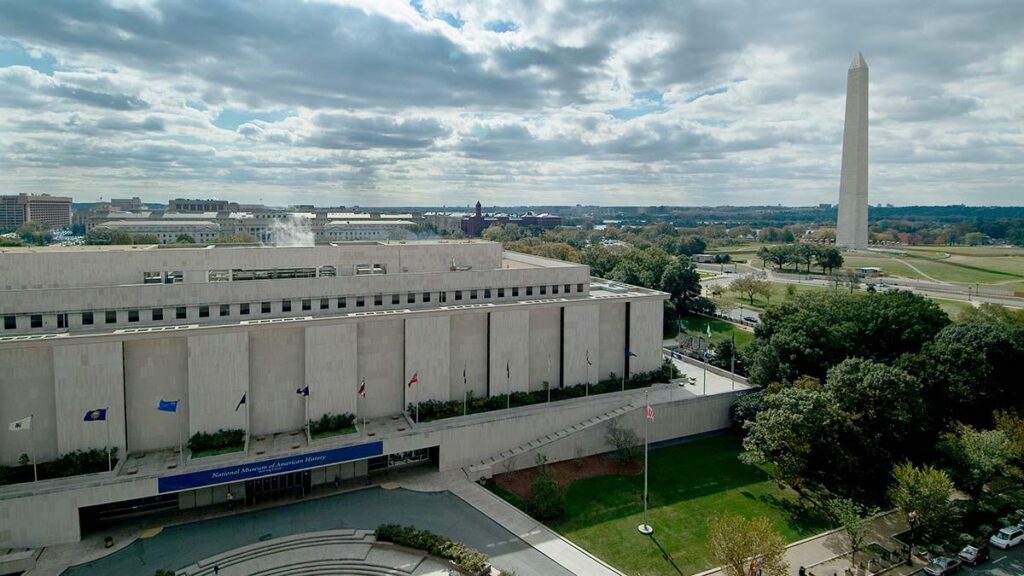
The National Museum of American History sits on the National Mall in Washington, D.C. (Photo courtesy National Museum of American History)
WASHINGTON — President Donald Trump’s latest attack on the Smithsonian Institution represents an attempt to replace a shared American history with his own ideology, academics said as the Smithsonian defended its longstanding position as a nonpartisan actor.
A July 4 White House report accused the Smithsonian Institution and its National Museum of American History of promoting what it called a “radical, activist ideology” that downplayed U.S. achievements and promoted injustices related to race, gender and sexual identity.
But the report does not advocate for a neutral presentation of history, said Asim Ali, an American studies professor at the University of Maryland. Instead, the report’s authors are promoting their own vision of American history that downplays the country’s shortcomings to promote national pride, Ali said.
“The report frames what the National Museum of American History is doing as being ideologically and politically motivated,” Ali said. “But what it is actually saying in the first several pages is that it should be following a different ideology — one that is focused on what the authors of the report want to see.”
A spokesperson for the Smithsonian, a constellation of museums largely funded by the federal government, said the museum had a nearly two-century track record of nonpartisan service.
“For more than 180 years, the Smithsonian has served the American public with nonpartisan and independent scholarship, and we remain committed to doing so,” the spokesperson wrote in a statement to States Newsroom.
Lonnie G. Bunch III, the secretary of the Smithsonian, was more forceful in an internal email, according to a July 8 Washington Post article.
His email to employees said the White House report was “not a fair characterization of the work and totality of the National Museum of American History,” according to the Post.
‘Ideological capture’
The scathing 162-page report published by the White House Domestic Policy Council represents the latest push in a broader Trump effort to restructure some of the nation’s hallmark cultural and artistic institutions to hew more closely to the nationalistic vision that animates his MAGA movement, American University history professor Pamela Nadell said.
It alleges the Smithsonian’s National Museum of American History has “explicitly adopted an ideological framework that no longer treats the American story as a shared national inheritance to be taught or celebrated,” instead painting the country in a “problematic” light with “thinly veiled anti-Americanism.”
“This ideological capture has moved the Museum’s mission away from straightforward historical education and scholarship toward an extreme political activism that seeks to transform our country,” the report said.
Struggle to define history
Ali said he thinks the report’s introduction reads like “propaganda” due to its focus on ideology and disregard of the contributions of academics and researchers.
Nadell also said the Trump administration is trying to get the Smithsonian — along with other cultural and educational institutions across the country — to conform to a certain “patriotic, heroic narrative.”
She said she disagreed with the report’s attempts to deemphasize flawed parts of America’s story that are “essential to tell the complete history of the nation.”
The White House report also has its defenders, who agree with Trump that U.S. educational and cultural institutions ought to show the country’s history in a more positive light.
U.S. Sen. Jim Banks, an Indiana Republican who introduced a bill to codify a 2025 Trump executive order on the presentation of U.S. history, said in a social media post Tuesday that the White House was right to criticize the National Museum of American History.
“The Museum of *American* History has no major exhibits dedicated to *America’s* founding,” the senator wrote. “Instead, it focuses on ‘social justice’ and ‘decolonization.’ This is wrong.”
‘Woke’ institutions
The Domestic Policy Council, which is led by former Trump campaign speechwriter Vince Haley, accused museum leadership of advancing personal ideological agendas that contradict the institution’s founding patriotic principles.
The language used in the White House report echoes arguments the second Trump administration has made against academic and cultural institutions the president has deemed too culturally liberal or “woke.”
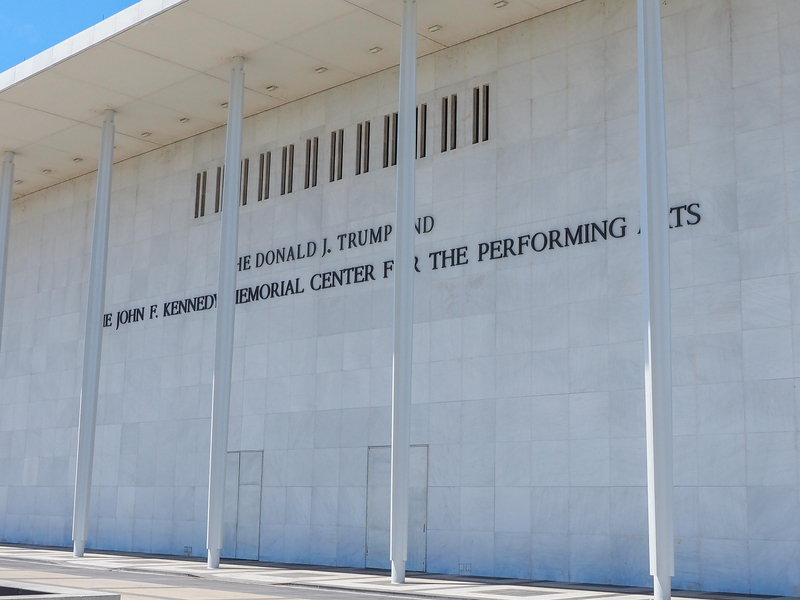
Last year, less than one month after he assumed office, Trump named himself chairman of the John F. Kennedy Center for the Performing Arts and took control of much of the center’s programming.
He has also ordered colleges and universities to make changes to their diversity, equity and inclusion-related programs and threatened to withhold federal funding if they did not comply.
And the July 4 report is not the first move the Trump administration has made against the Smithsonian Institution. The president issued a March 2025 executive order to “restore the Smithsonian Institution to its rightful place as a symbol of inspiration and American greatness” and get rid of any “improper ideology.”
Then, beginning in August of last year, he launched an investigation into exhibitions and materials from eight of the Smithsonian’s 21 museums.
Constructive criticism OK
Andrew Taylor, an associate professor of arts management at American University, said the Smithsonian should not be immune from criticism.
“I think anybody and everybody in the country has the right to hold the Smithsonian accountable and to make their best case for the things they’re concerned about,” he said. “That’s fine, that’s harmless and it’s useful.”
But, he added, the White House’s critique seemed more designed to disrupt an honest public accounting of the nation’s story.
“It feels like the report is intended to change what we consider to be our shared history, without actually going through the process of knowing what that should be,” he said.