Grattan on Friday: Albanese wants Labor’s national conference to ‘showcase’ the party – but not its AUKUS division
As Labor parliamentarians fled Canberra late this week for their long winter break, they could reassure themselves the bruises sustained in a difficult budget session were fading.
Broken promises might inflict some long-term damage on the prime minister, and the jury’s still out on the effect of the controversial tax changes. But Anthony Albanese is confident his belated embrace of boldness has paid off, as he moves on to the next big thing which, in party terms, is Labor’s national conference in Adelaide on July 23–25.
This was already in Albanese’s mind when he addressed Tuesday’s caucus, declaring the conference would be “a real opportunity to bring the whole Labor movement with us on our direction”.
It would be a chance to “showcase ourselves as an inclusive, open, democratic party”, he said, contrasting the “schmozzle” on the other side of politics.
This week the Australian Labor Party (ALP) national secretariat dispatched Labor’s draft platform and conference agenda to the some 400 delegates to what will be the party’s 50th national conference.
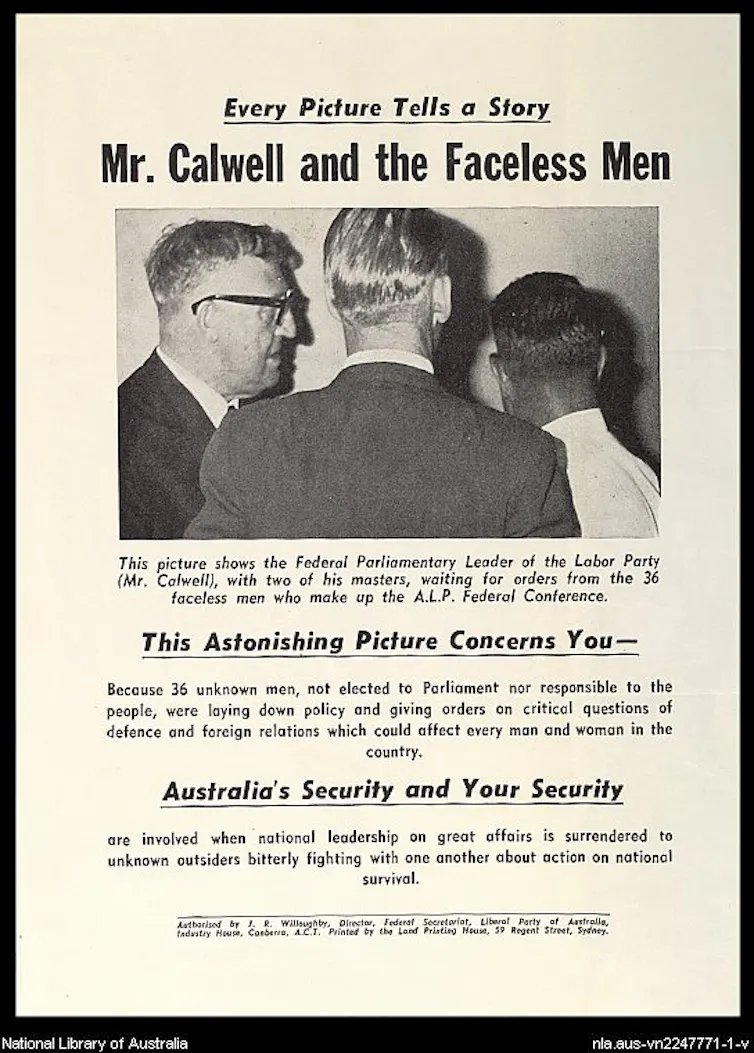
Held every three years, the modern conference is a dramatically different affair from the so-called “36 faceless men” conclaves of olden days.
In recent decades, national conferences have become increasingly micromanaged and distinctly less gritty, with a little dissent built in as a gesture to a party rank-and-file more radical than a now quiescent parliamentary caucus.
Long gone are the days when a Labor national conference could dictate to the parliamentarians, as did the famous special one held in 1963 over the North-West Cape communications facility that services US submarines.
Labor, then in opposition, paid a heavy political price when its leaders, Arthur Calwell and Gough Whitlam, were photographed waiting outside for the conference (that included one woman among its faceless men) to make its decision. As Nick Dyrenfurth and Frank Bongiorno write in A Little History of the Australian Labor Party, “what had once been taken for granted as an expression of Labor democracy seemed now to belong to another age”.
National Library of Australia (accessed via the Robert Menzies Institute)
Also passé are the days when a Labor government sought permission from a national conference for actions taken or proposed, as did the Hawke government on several key issues, including the entry of foreign banks and privatisation.
“It’s a pantomime,” rails a former senior Labor man from the left, about the coming conference. Behind the scenes, it might be added, the producers and stage hands are hard at work to make sure the performance runs smoothly, with minimum freelancing by the actors.
And that brings us to the vexed matter of AUKUS.
At the 2023 conference AUKUS was the major – albeit carefully controlled – debate. The outcome was a predictable win for the government but the process went through the motions of listening.
Three years on, Labor critics of AUKUS are as outspoken as ever.
A current public inquiry into AUKUS, launched by its opponents, features former Labor ministers Peter Garrett (lead commissioner) and Carmen Lawrence, with former foreign minister Gareth Evans making a submission bluntly declaring:
My regretful conclusion is that Australia’s no-holds-barred bipartisan embrace of AUKUS Pillar I is more likely than not to prove one of the worst defence and foreign policy decisions our country has made, not only putting at profound risk our sovereign independence, but generating more risk than reward for the very national security it promises to protect. I cannot imagine this decision being made by any of the Hawke-Keating Governments of which I was part for 13 years. Times have changed.
Those dubbed by some the “doubting elders” of Labor, together with former minister Ed Husic who had the temerity to raise the matter in caucus, can rage about AUKUS, but as far as the government is concerned the issue is settled and that’s that. The last thing it wants is for an extensive re-airing at the conference (with observers from the US embassy among the onlookers).
On present planning, any reference to AUKUS would be folded into the debate on the foreign affairs chapter of the platform. That debate, incidentally, is scheduled for Saturday, the final day and the deadest media time.
Sources say there’s not been pressure coming up through the unions or the factions for a big AUKUS debate. The traditional blue-collar unions are now focused on the jobs AUKUS can provide, and various unions have other fish they want to fry at conference.
The Minister for Defence Industry, Pat Conroy, told the National Press Club on Thursday there was “a vocal minority within the party” with questions about AUKUS. But, Conroy said, at recent elections for national conference delegates a candidate running against AUKUS “in the very progressive seat of Sydney […] got something like 25% of the vote. So for anyone saying that there’s this huge discord, disconnect between the elected members of the Labor Party and the rank-and-file, they’re just not reflecting reality.”
Marcus Strom, convener of Labor Against War, a grassroots network of more than 500 Labor members opposed to AUKUS, says:
the ALP leadership seems more concerned in assuring its partners-in-war at the Pentagon that they have us under control than in permitting democratic debate and inquiry on what all agree is the most consequential military partnership in Australia’s history.
Wrangling is also underway to manage the complicated Middle East issues.
Well before the current conflicts, Palestine for years was a hot button for Labor’s rank-and-file, with strong support for recognition of a Palestinian state, and efforts sometimes to keep the issue from blowing up at party conferences.
Given the events of the last nearly three years, the Middle East is now front and centre, and passions among grassroots members run high over Israel’s actions in Gaza and elsewhere. Large demonstrations outside the conference are likely.
The recognition of a Palestinian state will have placated some in the party, but only partially. The government’s plan is for discussion on the floor of the conference to be kept as low-key as possible, for example by confining it to just a couple of speakers.
Former prime minister Julia Gillard wrote in her memoir, My Story:
when it is good, national conference is a place to hothouse ideas and agree new directions. When it is bad, it is a place for screaming matches between factional leaders on things no one in the community cares about. When it is at its worst, it is a lifeless beast of no debate, no ideas, with everything controversial swept under the carpet.
One prime minister’s “lifeless beast” can, however, be another’s well-schooled support animal.

Michelle Grattan does not work for, consult, own shares in or receive funding from any company or organisation that would benefit from this article, and has disclosed no relevant affiliations beyond their academic appointment.